
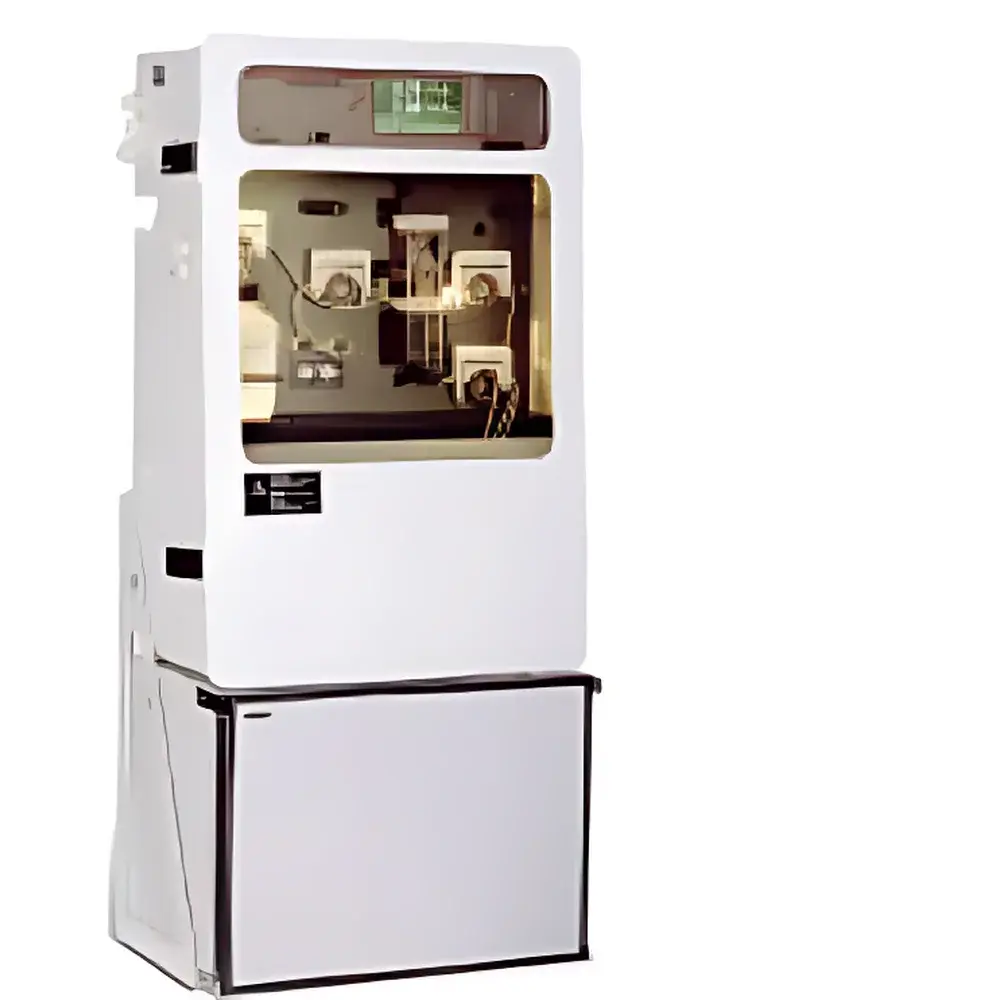
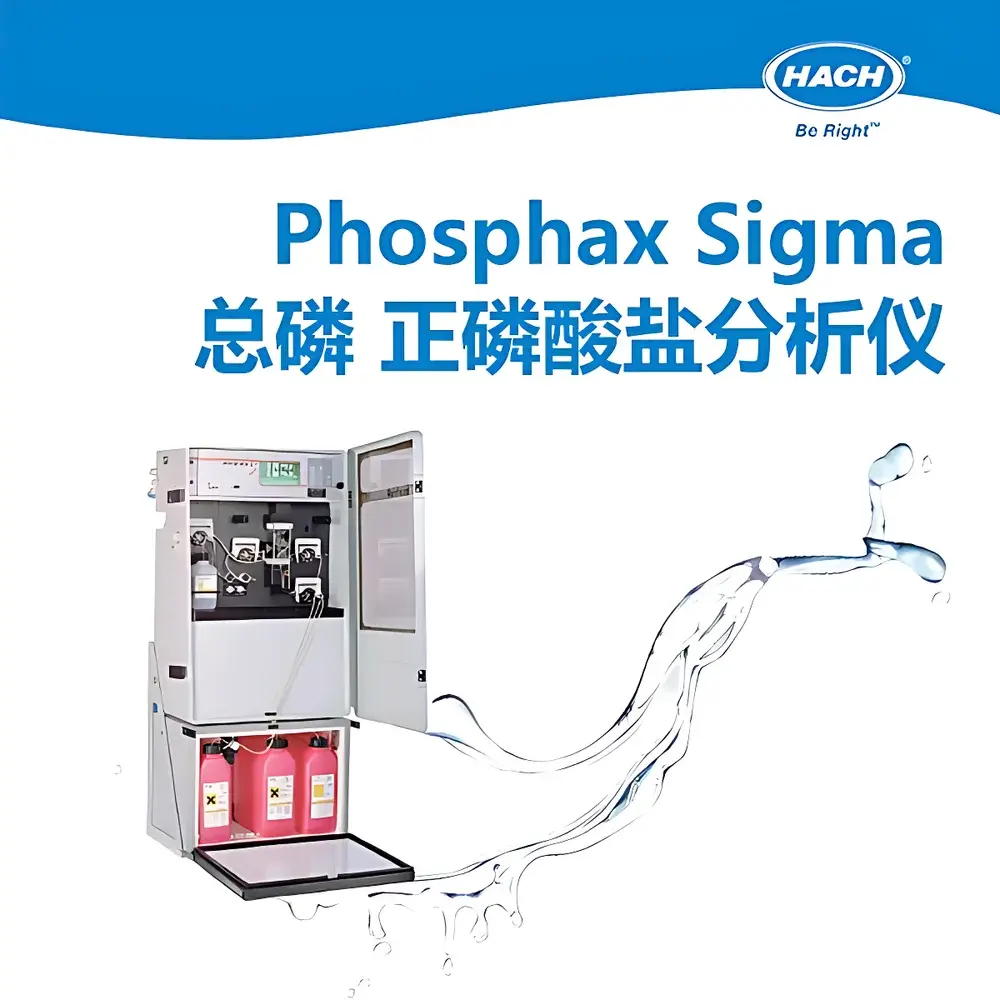
HACH Phosphax Sigma Total Phosphorus and Orthophosphate Analyzer
| Brand | HACH |
|---|---|
| Origin | Imported |
| Manufacturer Type | Manufacturer |
| Model | Phosphax Sigma |
| Measurement Parameter | Total Phosphorus |
| Instrument Type | Online Analyzer |
| Measurement Principle | Spectrophotometric Method (Molybdenum Blue) |
| Measurement Range | Total Phosphorus: 0.01–5.0 mg/L as P |
| Accuracy | ±2% of reading |
| Detection Limit | 0.01 mg/L as P |
| Resolution | 0.01 mg/L as P |
| Orthophosphate Range | 0.01–5.0 mg/L as P |
| Cycle Time | ~10 minutes per analysis |
| Calibration | Automatic |
| Sample Flow Rate | 100 mL/h |
| Reagent Replacement Interval | Every 3 months |
| Output Signals | Two isolated 4–20 mA analog outputs (max. load 500 Ω) |
| Communication Protocols | Modbus RTU, Profibus DP |
| Operating Temperature | 5–40 °C |
| Power Supply | 220 VAC, 50 Hz |
| Compliance | DIN 38405-Part D11 (German Standard for Phosphorus Determination) |
Overview
The HACH Phosphax Sigma Total Phosphorus and Orthophosphate Analyzer is an industrial-grade online spectrophotometric analyzer engineered for continuous, unattended monitoring of phosphorus species in water and wastewater streams. It operates on the standardized molybdenum blue method—fully compliant with DIN 38405-Part D11—and delivers trace-level quantification of both total phosphorus (TP) and orthophosphate (PO₄³⁻) in a single instrument platform. The system employs high-temperature, high-pressure acid digestion coupled with persulfate oxidation to convert condensed phosphates (e.g., polyphosphates) and organically bound phosphorus into orthophosphate; subsequent colorimetric reaction with ammonium molybdate and antimony potassium tartrate in acidic medium forms phosphomolybdic acid, which is reduced by ascorbic acid to yield a stable, intensely blue-colored complex. Absorbance is measured at 880 nm using a precision optical path and temperature-compensated photodiode detector, enabling reproducible quantification across dynamic process conditions.
Key Features
- Simultaneous dual-parameter capability: automatic sequential measurement of total phosphorus and orthophosphate within one 10-minute cycle
- Fully automated digestion, oxidation, color development, and photometric detection—no manual intervention required
- Integrated auto-calibration using certified reference standards at user-defined intervals (daily, weekly, or event-triggered)
- Self-cleaning fluidic pathway with high-pressure air purge and acid rinse cycles minimizes fouling and extends maintenance intervals
- Robust stainless-steel housing with IP65-rated front panel and integrated safety interlock cover for operator protection during service
- Dual 4–20 mA analog outputs with galvanic isolation support direct integration into DCS/SCADA systems for real-time control of phosphate-based corrosion inhibitors
- Optional Modbus RTU (RS232/RS485) and Profibus DP interfaces enable seamless data exchange with plant-wide automation infrastructure
Sample Compatibility & Compliance
The Phosphax Sigma is validated for use with raw surface water, secondary effluent, industrial cooling water, boiler feedwater, and treated municipal wastewater. Its digestion module accommodates suspended solids up to 100 mg/L and turbidity ≤ 500 NTU without pre-filtration. All reagents—including sulfuric acid, sodium persulfate, ammonium molybdate, antimony potassium tartrate, and ascorbic acid—are supplied in sealed, pre-dosed cartridges meeting ISO 8573-1 Class 2 purity requirements. Analytical performance adheres to DIN 38405-D11 for regulatory reporting and satisfies QA/QC criteria under ISO/IEC 17025-accredited laboratories. When deployed in GMP-regulated utilities or EPA-compliant wastewater treatment plants, the system supports audit-ready electronic records when paired with HACH’s GLP-compliant data logger (optional), including time-stamped calibration logs, alarm history, and maintenance events.
Software & Data Management
Instrument operation and diagnostics are managed via an embedded web interface accessible through standard Ethernet (HTTP/HTTPS). No proprietary software installation is required. Real-time trend graphs display TP and PO₄³⁻ concentration profiles over configurable time windows (1 hr to 30 days), with overlay capability for setpoints, alarms, and control actions. All measurement data—including raw absorbance values, temperature-compensation coefficients, and reagent consumption counters—are stored locally for ≥90 days and exportable in CSV format. For enterprise-level integration, the analyzer supports OPC UA connectivity (via optional gateway) and complies with FDA 21 CFR Part 11 requirements when used with HACH’s validated LIMS interface package, including electronic signatures, audit trails, and role-based access control.
Applications
- Real-time optimization of phosphate dosing in closed-loop cooling towers to maintain optimal corrosion inhibition while minimizing scale formation
- Compliance monitoring of total phosphorus discharge limits in municipal wastewater treatment plant outfalls (e.g., EU Urban Wastewater Treatment Directive, US EPA NPDES permits)
- Early detection of phosphorus breakthrough in tertiary filtration or membrane systems
- Process control of biological nutrient removal (BNR) systems where orthophosphate serves as a key indicator of phosphorus uptake efficiency
- Monitoring of agricultural runoff impact on sensitive receiving waters (e.g., eutrophication-prone lakes and estuaries)
FAQ
What digestion method does the Phosphax Sigma use for total phosphorus determination?
It applies high-temperature (120 °C), high-pressure (up to 6 bar) acid hydrolysis combined with sodium persulfate oxidation—fully aligned with DIN 38405-D11 and comparable to EPA Method 365.4.
Can the analyzer differentiate between orthophosphate and total phosphorus without hardware modification?
Yes—the instrument automatically switches between direct orthophosphate measurement (bypassing digestion) and full TP analysis (with digestion/oxidation) using programmable valve sequencing.
Is the system suitable for high-turbidity industrial wastewater?
It tolerates turbidity up to 500 NTU and suspended solids ≤100 mg/L; however, for samples exceeding these thresholds, inline filtration (e.g., 40 µm cartridge filter) is recommended upstream.
How is reagent consumption tracked and reported?
Each reagent cartridge contains an RFID tag storing lot-specific calibration coefficients and expiration date; the analyzer logs usage volume per analysis and triggers predictive alerts 72 hours before depletion.
Does the Phosphax Sigma support remote firmware updates?
Yes—secure HTTPS-based firmware upgrades can be initiated remotely via the embedded web server, with rollback capability and SHA-256 signature verification.







