
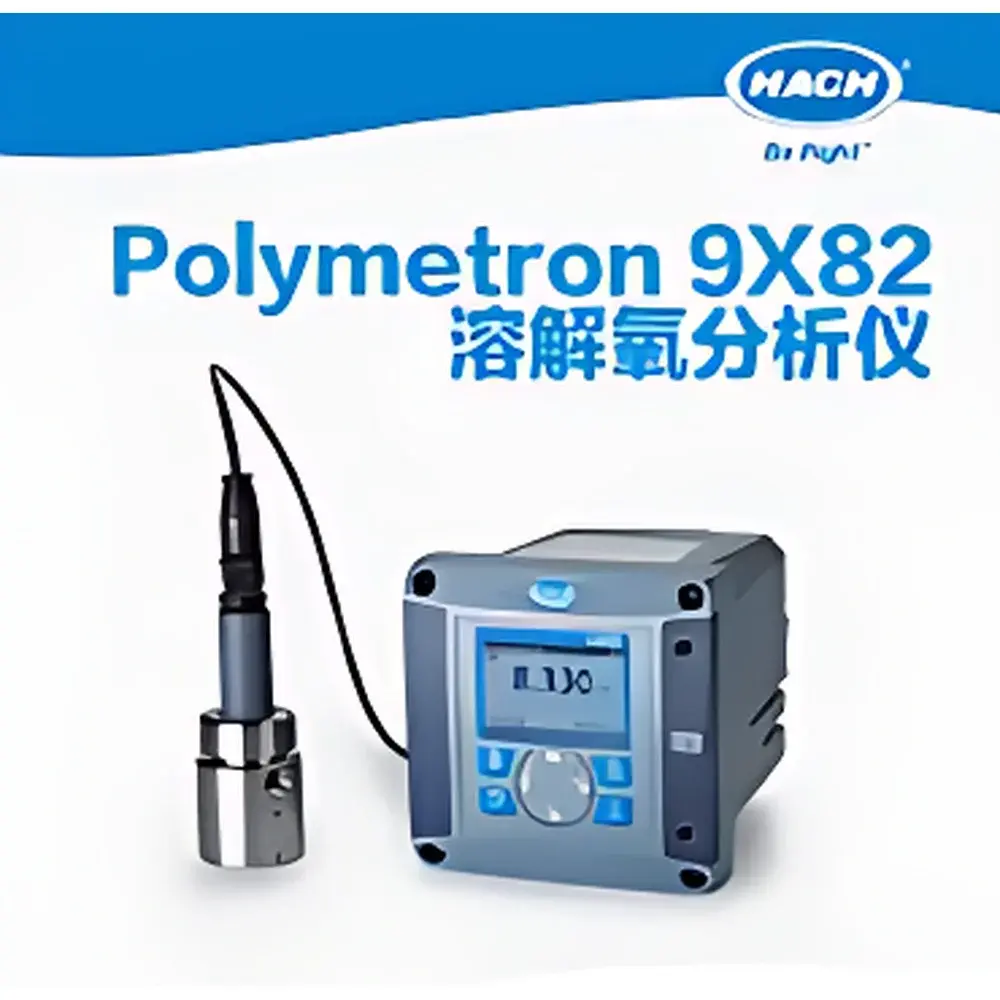
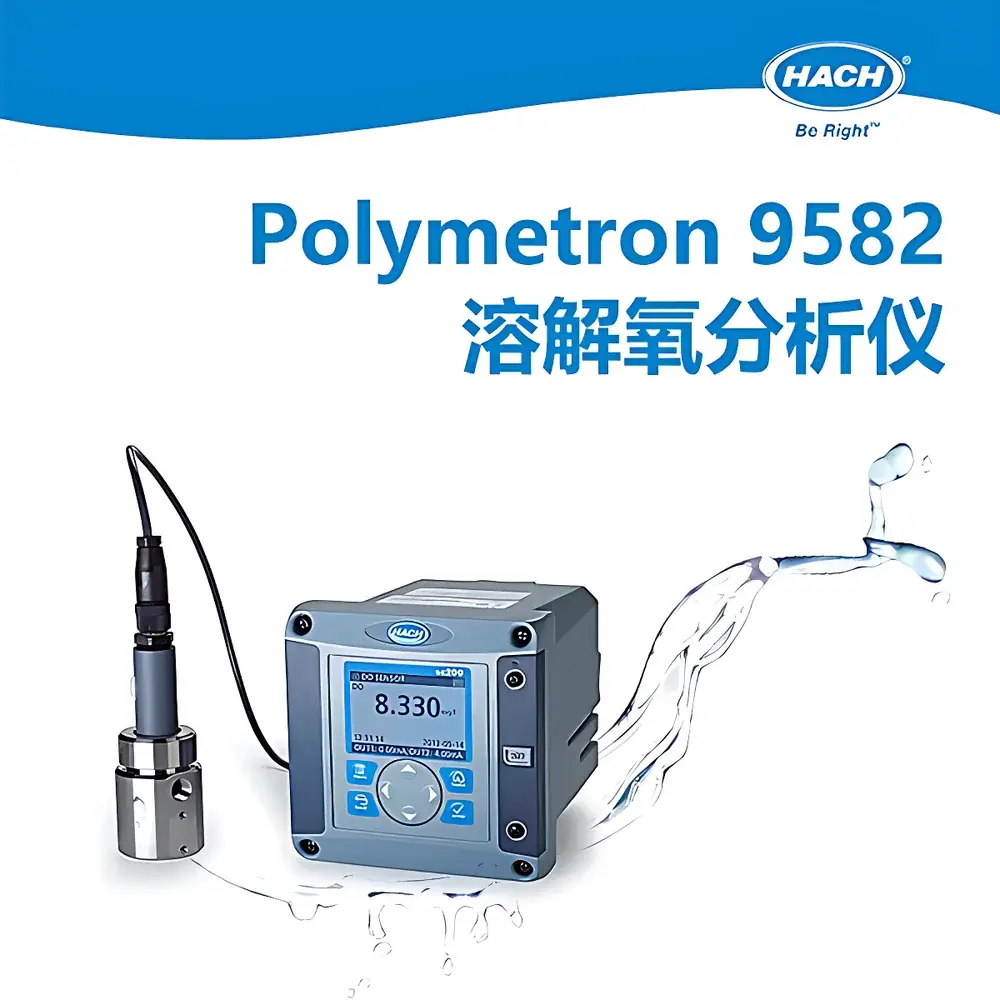
HACH POLYMETRON 9582 Dissolved Oxygen Analyzer
| Brand | HACH |
|---|---|
| Origin | USA |
| Manufacturer | HACH Company |
| Product Type | Imported Online Analyzer |
| Model | POLYMETRON 9582 |
| Pricing | Upon Request |
| Measurement Principle | Electrochemical Galvanic Cell (Clark-type) |
| Measurement Range | 0–2000 ppb |
| Accuracy | Not Specified |
| Repeatability | ±0.5 ppb or ±5% (whichever is greater) |
| Detection Limit | <1 ppb |
Overview
The HACH POLYMETRON 9582 Dissolved Oxygen Analyzer is an online, galvanic-cell-based analytical instrument engineered for continuous, low-range dissolved oxygen (DO) monitoring in ultra-pure water systems—particularly in power generation, semiconductor manufacturing, and pharmaceutical utilities where sub-ppb DO control is critical. It operates on the Clark electrode principle: a gas-permeable membrane separates the sample from internal electrodes, enabling selective diffusion of molecular oxygen while excluding interfering redox-active ions (e.g., Cl⁻, Fe²⁺, SO₃²⁻). A gold cathode reduces diffused O₂ to hydroxide ions (O₂ + 2H₂O + 4e⁻ → 4OH⁻), while a silver anode undergoes oxidation (4Ag + 4Br⁻ → 4AgBr + 4e⁻), generating a diffusion-limited current linearly proportional to dissolved oxygen concentration. This zero-power, self-polarizing cell eliminates the need for external polarization voltage, enhancing long-term stability and reducing calibration drift in high-resistivity water applications.
Key Features
- Galvanic (Clark-type) sensor architecture with factory-preconditioned membrane cap—enabling rapid commissioning and minimal field setup time.
- Ultra-low detection capability (<1 ppb) and high repeatability (±0.5 ppb or ±5%, whichever is greater) optimized for boiler feedwater, condensate, and ultrapure water loops.
- Modular design compatible with HACH’s broader POLYMETRON platform—ensuring hardware interoperability, unified firmware architecture, and shared I/O modules across pH, conductivity, silica, and sodium analyzers.
- Intuitive, menu-driven human-machine interface (HMI) with context-sensitive prompts for calibration, maintenance, and diagnostic procedures.
- Integrated alarm management system with configurable threshold alerts, event logging, and visual status indicators—supporting predictive maintenance and operational continuity.
- Robust enclosure rated IP66/NEMA 4X, suitable for indoor and outdoor installation in industrial environments subject to temperature fluctuations and humidity exposure.
Sample Compatibility & Compliance
The POLYMETRON 9582 is validated for use with deionized water, reverse osmosis permeate, mixed-bed effluent, and turbine condensate—samples with conductivity <0.2 µS/cm and temperature range 5–50 °C. Its galvanic sensor requires no electrolyte refill and exhibits negligible flow dependence above 10 cm/s, making it suitable for bypass loop or direct-in-line configurations. The analyzer complies with ASTM D888 (Standard Test Methods for Dissolved Oxygen in Water), supports traceable calibration per ISO/IEC 17025 laboratory practices, and provides audit-ready data logs required under FDA 21 CFR Part 11 for regulated pharmaceutical and biotech facilities. Optional analog (4–20 mA) and digital (Modbus RTU/TCP, HART 7) outputs facilitate integration into DCS, PLC, and SCADA systems.
Software & Data Management
The analyzer features embedded firmware supporting dual-language display (English/Spanish), time-stamped measurement history (up to 30 days at 1-minute intervals), and non-volatile storage of calibration records, sensor diagnostics, and fault codes. Configuration and diagnostics are accessible via local keypad or remote connection through HACH’s System Manager software (Windows-based), which enables batch configuration, firmware updates, and export of CSV-formatted datasets for trending and regulatory reporting. All user actions—including calibration initiation, zero/span adjustment, and parameter modification—are logged with timestamp, operator ID (if configured), and pre-/post-change values—ensuring full traceability for GLP/GMP audits.
Applications
- Real-time monitoring of dissolved oxygen in thermal power plant feedwater and condensate systems to prevent oxidative corrosion of boiler tubes and steam turbines.
- Final polishing loop surveillance in semiconductor fab ultrapure water (UPW) distribution networks, where DO >1 ppb risks particle nucleation and wafer surface oxidation.
- Pharmaceutical water-for-injection (WFI) and purified water (PW) systems requiring compliance with USP and EU GMP Annex 1 for microbial control and material compatibility.
- Research-grade deionized water systems in analytical laboratories where baseline DO stability directly impacts ICP-MS, LC-MS, and electrochemical instrumentation performance.
- Integration into multi-parameter water quality monitoring skids for nuclear plant secondary coolant loops and desalination plant pretreatment stages.
FAQ
What type of electrochemical cell does the POLYMETRON 9582 use?
It employs a self-powered galvanic (Clark-type) cell with gold cathode and silver/silver bromide anode—requiring no external polarization voltage.
Is the sensor suitable for high-purity water with conductivity below 0.1 µS/cm?
Yes—the membrane-based design minimizes ionic interference and maintains accuracy in low-conductivity matrices typical of power and semiconductor applications.
Does the analyzer support automated calibration verification?
While it does not include built-in standard addition or air-saturation auto-calibration, it supports manual zero (sodium sulfite) and span (air-saturated water) calibration with step-by-step on-screen guidance.
Can the 9582 be integrated into existing HACH POLYMETRON controllers?
Yes—it shares common backplane communication, power supply specifications, and mounting dimensions with other POLYMETRON analyzers, enabling seamless rack integration and centralized configuration.
What maintenance intervals are recommended for routine operation?
Membrane cap replacement every 6–12 months (depending on water quality); full sensor replacement every 24–36 months; quarterly verification of zero and span response recommended for critical applications.







