
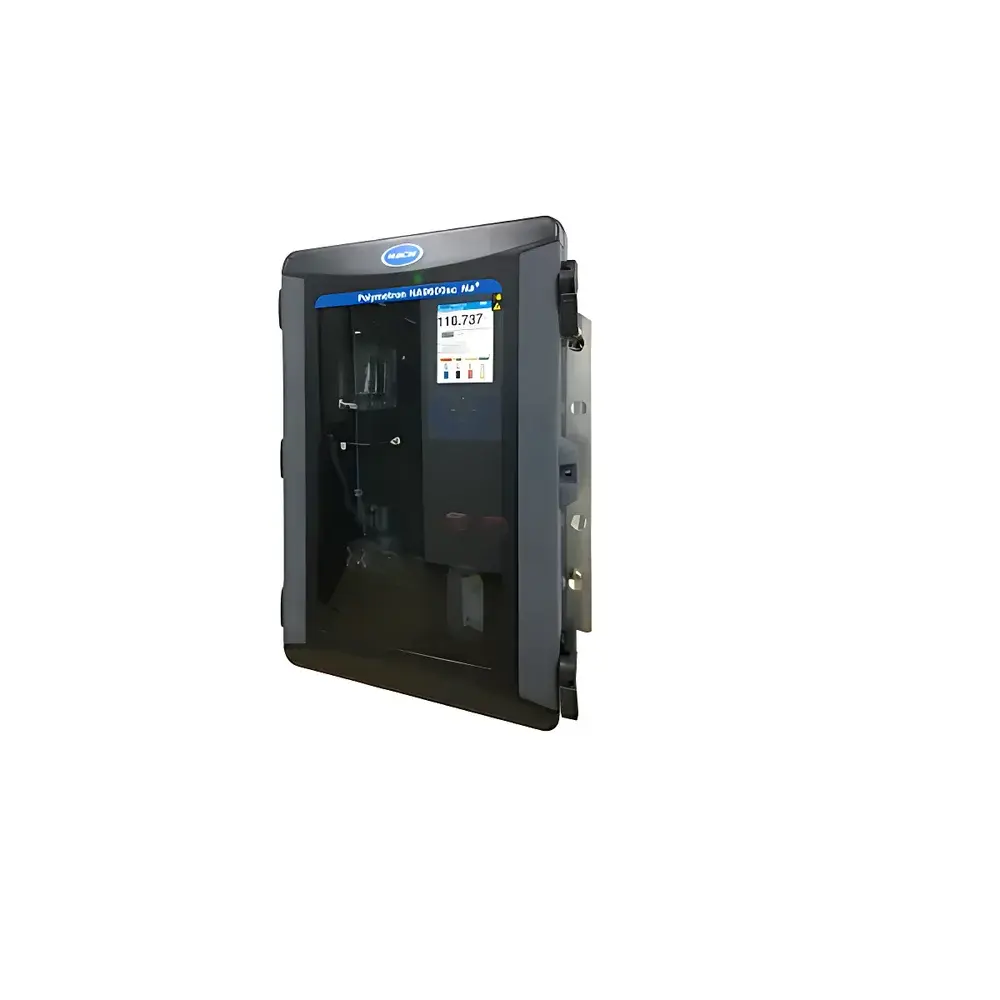
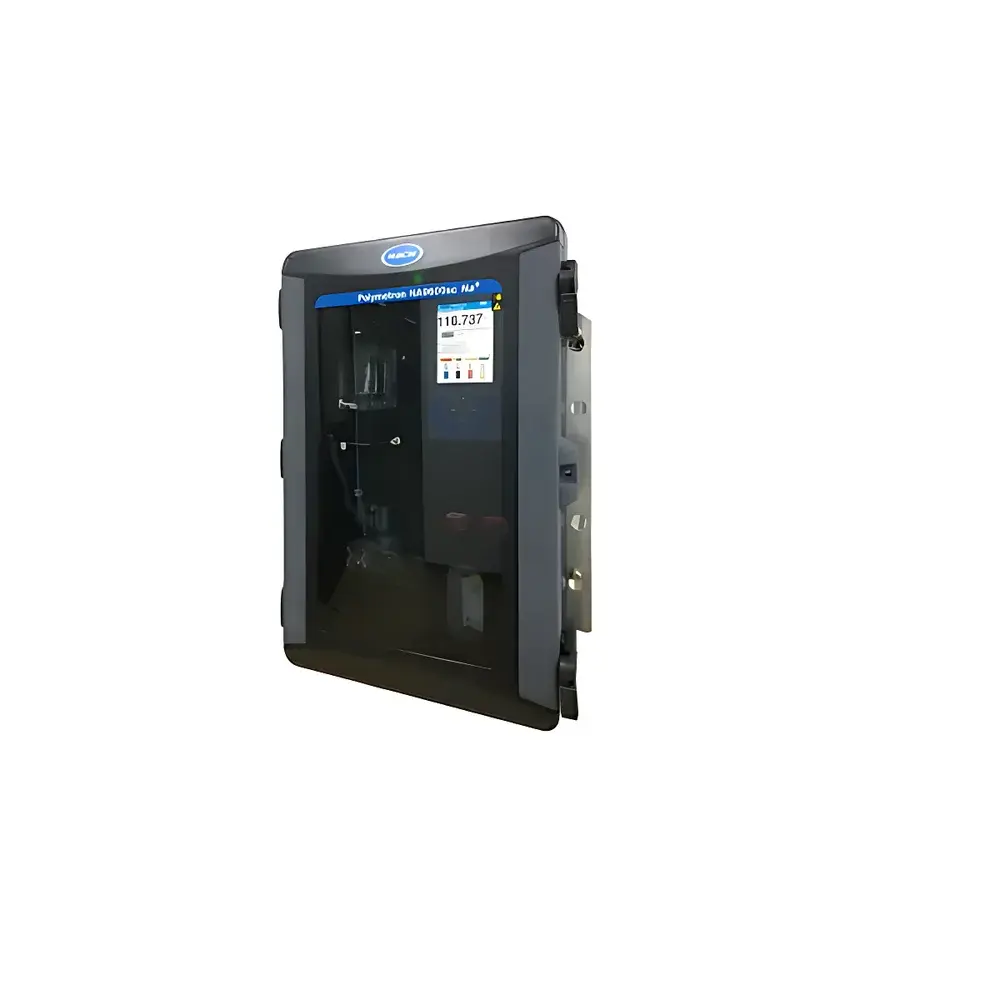
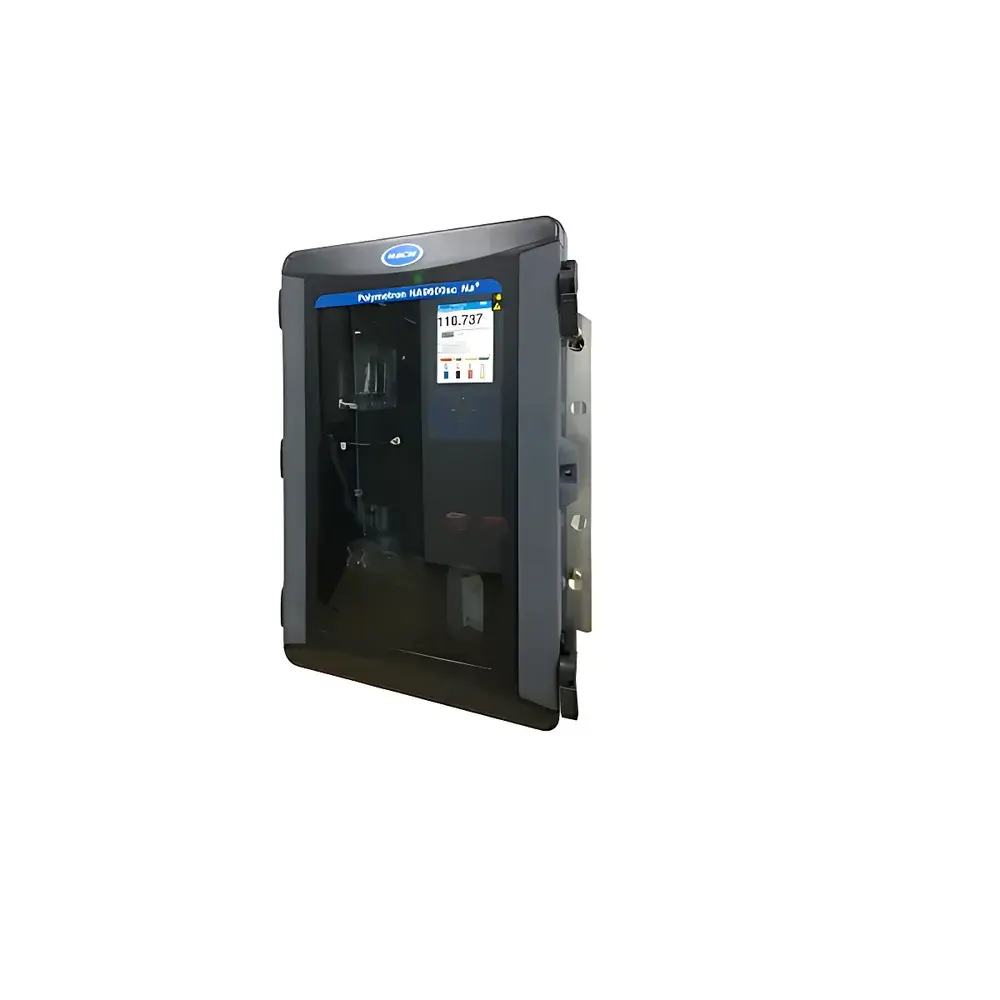
Hach Polymetron NA9600 sc Online Sodium Analyzer
| Brand | Hach |
|---|---|
| Origin | USA |
| Model | NA9600 sc |
| Detection Limit | 0.01 ppb |
| Measurement Range | 0.01–10,000 ppb (non-cation-bed mode) |
| Accuracy | ±0.1 ppb (0.01–2 ppb, non-cation-bed) |
| Repeatability | <0.02 ppb or 1.5% of reading (whichever is greater) |
| Response Time | T90 ≤ 2 min (1–100 ppb) |
| Sample Temperature Range | 5–45 °C |
| Ambient Operating Temperature | 5–50 °C |
| Sample Pressure | 0.2–6 bar |
| Sample Flow Rate | 100–150 mL/min |
| Sample pH Adjustment | Diisopropylamine (DIPA), 1 L/90 days (non-cation-bed), 1 L/month (cation-bed) |
| Enclosure Rating | NEMA 4 / IP65 (with enclosure) |
| Display | 5.7-inch color LCD |
| Analog Outputs | 6 isolated 4–20 mA (max 600 Ω load) |
| Digital I/O | 6 programmable relay outputs (SPDT, 5 A, 240 VAC), 6 isolated TTL/dry-contact digital inputs |
| Communication Protocols | HART, PROFIBUS DP, Modbus RTU/TCP |
| Power Supply | 100–240 V AC, 50/60 Hz |
| Dimensions (H×W×D) | 681 × 452 × 335 mm (with enclosure) |
| Weight | 20 kg (with enclosure, no reagents) |
| Maintenance Interval | Electrolyte, activator, and calibration solutions replenished every 90 days |
Overview
The Hach Polymetron NA9600 sc Online Sodium Analyzer is a high-precision, industrial-grade potentiometric instrument engineered for continuous, low-level sodium ion monitoring in ultra-pure water streams. It operates on the principle of direct potentiometry using a specialized sodium-selective glass electrode and a stable reference electrode. The measurement follows the Nernst equation, where the potential difference between the sensing and reference electrodes is logarithmically proportional to the activity of sodium ions in solution. This electrochemical approach enables trace-level detection down to 0.01 ppb—critical for protecting high-pressure boiler systems, steam cycles, and turbine condensate networks from sodium-induced corrosion and deposit formation. Unlike optical or ion-chromatographic methods, the NA9600 sc delivers real-time, interference-resistant quantification without consumable columns or complex sample pretreatment—making it a cornerstone of reliability in power generation, petrochemical refining, and semiconductor ultrapure water (UPW) distribution systems.
Key Features
- Ultra-low detection limit of 0.01 ppb with validated accuracy across dual operational modes: standard (0.01–10,000 ppb) and cation-exchange bed-integrated (0.01–200 ppm)
- Automated electrode activation and two-point standard addition calibration—eliminating manual intervention and drift-related uncertainty
- Integrated Prognosys predictive diagnostics that monitor electrode impedance, response slope, and calibration stability to flag degradation before failure
- Robust NEMA 4/IP65-rated enclosure with polyurethane-coated steel chassis and stainless-steel 304 hardware for long-term deployment in humid, chemically aggressive environments
- Configurable multi-channel architecture supporting 1, 2, or 4 independent measurement streams with sequential sampling logic and shared reagent management
- Full compliance with ANSI/ISA-84.00.01 (IEC 61511) functional safety requirements for critical water chemistry control loops
Sample Compatibility & Compliance
The NA9600 sc is optimized for samples with turbidity <2 NTU, zero oil/grease content, and suspended solids <100 µm (recommended filtration for boiler feedwater). It accommodates pH adjustment via diisopropylamine (DIPA) dosing—standardized at 10.5 ± 0.2 at 25 °C—to suppress hydrogen ion interference and ensure selective sodium response. The analyzer meets ASTM D4582–22 for low-level sodium determination in high-purity water and supports audit-ready data integrity under FDA 21 CFR Part 11 when paired with Hach’s compliant software suite. Its design conforms to IEC 61000-6-2 (EMC immunity) and IEC 61000-6-4 (EMC emissions), ensuring stable operation near variable-frequency drives and switchgear. For GMP-regulated utilities, the system supports GLP-compliant calibration logs, electronic signatures, and full audit trails—including timestamped event history for all maintenance actions and calibration events.
Software & Data Management
The NA9600 sc integrates seamlessly with Hach’s SCADA-agnostic communication stack, offering native support for HART 7, PROFIBUS DP v1, and Modbus TCP/RTU protocols—enabling plug-and-play integration into legacy DCS and modern IIoT platforms. Its embedded firmware includes configurable alarm thresholds, trend logging (up to 30 days of 1-minute resolution data), and automated report generation (PDF/CSV) via Ethernet or USB export. When deployed with Hach’s PlantWeb® Digital Ecosystem, the analyzer feeds time-synchronized sodium concentration data into centralized asset performance management (APM) dashboards—correlating sodium excursions with turbine efficiency metrics, blowdown rates, or cation resin exhaustion profiles. All configuration changes, calibration records, and diagnostic alerts are cryptographically signed and stored with immutable timestamps—meeting ALCOA+ (Attributable, Legible, Contemporaneous, Original, Accurate, Complete, Consistent, Enduring, Available) principles for regulated industries.
Applications
- Power generation: Continuous monitoring of boiler feedwater, condensate return, and steam purity in subcritical, supercritical, and ultra-supercritical units
- Petrochemical refineries: Sodium leak detection in high-pressure steam generators and desalination pre-treatment trains
- Pharmaceutical water systems: USP compliant monitoring of purified water (PW) and water for injection (WFI) distribution loops
- Microelectronics UPW networks: Real-time verification of sodium breakthrough post-mixed-bed polishing, aligned with SEMI F63 standards
- Nuclear plant secondary coolant circuits: Early warning of steam generator tube integrity loss via sub-ppb sodium anomaly detection
FAQ
What is the recommended sample filtration for boiler water applications?
A 100 µm inline filter is strongly advised upstream of the analyzer inlet to prevent particulate fouling of the flow cell and sodium electrode surface.
Does the NA9600 sc require temperature compensation?
Yes—the built-in Pt100 RTD sensor automatically compensates for sample temperature variations between 5–45 °C, ensuring Nernstian response stability within ±10 °C ambient fluctuations.
How does the cation-bed pump option improve measurement accuracy?
The integrated cation exchanger removes interfering cations (e.g., K⁺, Ca²⁺, NH₄⁺) prior to measurement, extending the linear dynamic range to 200 ppm while maintaining ±2 ppb accuracy below 40 ppb.
Can the NA9600 sc operate unattended for extended periods?
Yes—its 90-day reagent replenishment cycle, annual electrode replacement schedule, and Prognosys self-diagnostics enable >12 months of uninterrupted operation with minimal scheduled maintenance.
Is the analyzer compatible with third-party LIMS or MES platforms?
Absolutely—via Modbus TCP or OPC UA (with optional gateway), raw and processed sodium values, status flags, and diagnostic codes can be mapped directly into enterprise laboratory or manufacturing execution systems.




