
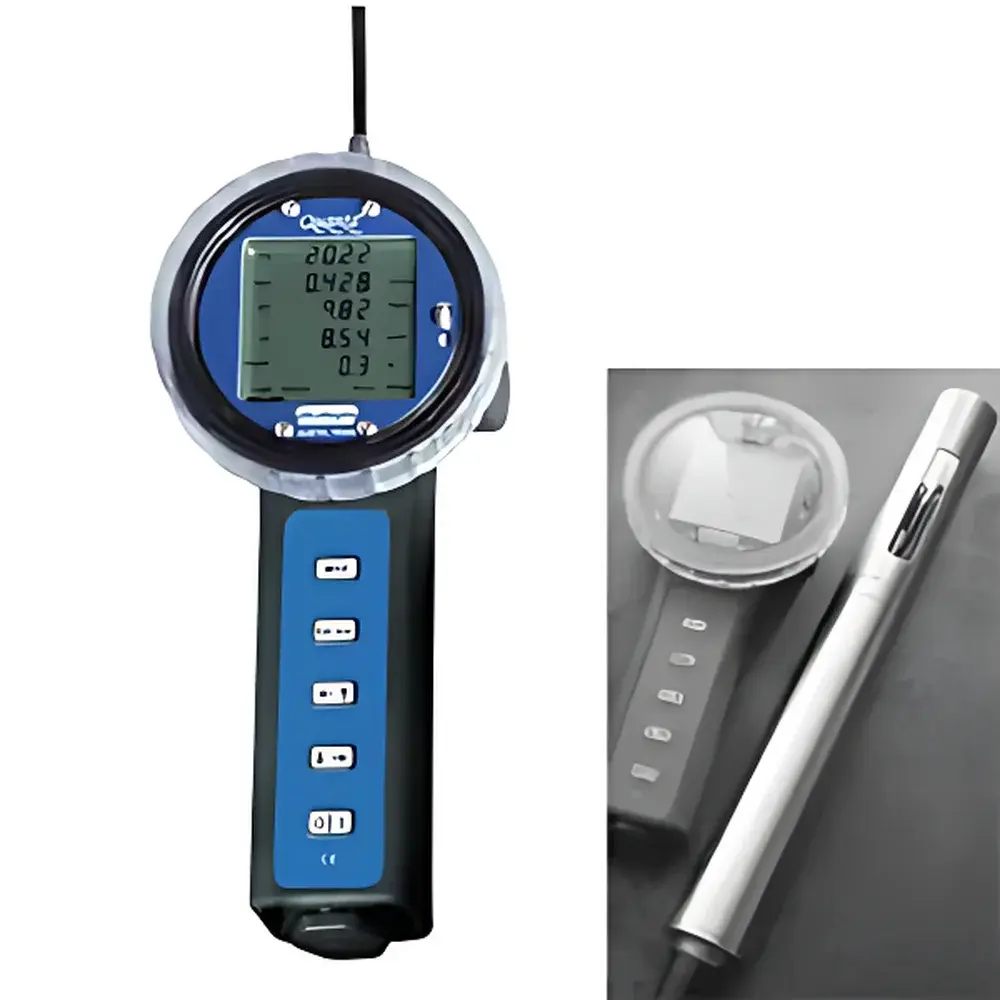
HACH Quanta-G Groundwater Quality Analyzer
| Brand | OTT Hydromet |
|---|---|
| Origin | Imported |
| Model | Quanta-G |
| Sensor Compatibility | pH, ORP, Dissolved Oxygen (DO), Conductivity, Temperature, Depth/Pressure, Salinity |
| Output Interface | SDI-12 |
| Housing Material | 316 Stainless Steel (1.75" diameter) or PVC (optional) |
| Data Storage | 200 datasets (5 parameters per display screen) |
| Operating Temperature | −5 °C to 50 °C |
| Battery | 3 × C-cell, up to 16 h runtime |
| Submersible Depth Options | 0–25 m (±0.1 m), 0–100 m (±0.3 m), Absolute Pressure Range: 0–10 m (±0.003 m) |
| DO Range | 0–50 mg/L (±0.2 mg/L ≤20 mg/L |
| Conductivity Range | 0–100 mS/cm (±1% of reading, ±0.01 PSS) |
| pH Range | 0–14 (±0.2, resolution 0.01) |
| ORP Range | −999 to +999 mV (±20 mV, resolution 1 mV) |
| Temperature Range | −5 °C to 50 °C (±0.15 °C, resolution 0.01 °C) |
| Salinity Range | 0–70 PSS (±1% of reading, ±0.01 PSS, resolution 0.01 PSS) |
Overview
The HACH Quanta-G Groundwater Quality Analyzer is a field-deployable, multi-parameter water quality monitoring system engineered specifically for long-term, in-situ groundwater characterization. Built upon Hydrolab’s legacy of robust sensor architecture and calibrated for low-flow, high-resistivity environments, the Quanta-G employs electrochemical (pH, ORP), optical (luminescent dissolved oxygen), inductive (conductivity), and piezoresistive (depth/pressure) sensing principles to deliver stable, traceable measurements across seven core parameters—temperature, pH, ORP, dissolved oxygen, conductivity, salinity, and depth—simultaneously. Its modular design separates the submersible Quanta-G transmitter (rated to 100 m depth) from the handheld Quanta display unit, enabling flexible deployment in wells, piezometers, and monitoring boreholes while maintaining NEMA 6-rated ingress protection on the display. The system operates without proprietary software or PC dependency, leveraging standardized SDI-12 digital communication for direct integration with third-party data loggers compliant with USGS, EPA, and ISO 17025-accredited environmental monitoring networks.
Key Features
- Simultaneous real-time measurement of up to eight parameters—including temperature-compensated pH, ORP, luminescent-based dissolved oxygen (no membrane or electrolyte replacement), graphite-electrode conductivity (resistant to chloride-induced polarization and salt fouling), and absolute pressure-derived depth/salinity calculations.
- Field-serviceable 316 stainless steel housing (1.75″ OD) with optional PVC variant; optimized geometry minimizes sediment accumulation and cross-contamination during repeated well profiling.
- Integrated “quick-stir” hotkey activates an internal micro-stirrer to homogenize stagnant groundwater prior to sampling—critical for representative DO and pH readings in low-permeability aquifers.
- Self-contained Quanta display unit stores 200 full-profile datasets locally (each containing all measured parameters), features a backlit 8.9 cm LCD, intuitive menu navigation, and battery-level indication—enabling rapid operator training (<30 minutes) and minimal learning curve for field technicians.
- SDI-12 output ensures protocol-compliant interoperability with Campbell Scientific CR-series, Onset HOBO, and other ANSI/ISO 11452-3-certified environmental data loggers—eliminating need for vendor-specific gateways or middleware.
- Temperature sensor embedded within the probe body provides real-time thermal compensation for all electrochemical and optical measurements, satisfying ASTM D3370 and ISO 5814 traceability requirements for field calibration verification.
Sample Compatibility & Compliance
The Quanta-G is validated for use in freshwater, brackish, and saline groundwater matrices (0–70 PSS), including iron-rich, sulfide-laden, and low-conductivity (<100 µS/cm) aquifer systems. Its liquid-filled pH reference electrode eliminates gel drying and supports field refilling—extending service life without sensor replacement. Conductivity cells utilize corrosion-resistant graphite electrodes and dual-frequency excitation to mitigate polarization errors in high-TDS environments. All sensors comply with EPA Method 150.1 (conductivity), 365.3 (DO), and 365.1 (pH), and are designed to meet GLP documentation standards when paired with SDI-12 loggers supporting audit-trail metadata (e.g., timestamped calibration events, sensor diagnostics). The system’s mechanical construction adheres to IP68 and NEMA 6 specifications, and its materials of construction (316 SS, Ryton®, Teflon®, urethane cable jacket) resist microbial growth and chemical degradation per ASTM D543.
Software & Data Management
No proprietary software is required for basic operation or data retrieval. Raw SDI-12 output is ASCII-encoded and human-readable, allowing direct parsing by spreadsheet tools or custom Python/Matlab scripts. For regulatory reporting, the Quanta-G integrates seamlessly with data management platforms that support SDI-12 ingestion—including Aquarius Time Series, HydroSphere, and USGS NWISWeb via compatible telemetry gateways. When used with FDA 21 CFR Part 11-compliant data loggers, full electronic audit trails—including operator ID, calibration date, sensor offset values, and raw voltage outputs—are retained alongside environmental measurements. Internal memory retains time-stamped datasets with parameter-specific resolution (e.g., 0.01 °C, 0.01 mg/L DO, 0.001 m pressure), ensuring alignment with ISO/IEC 17025 clause 7.5.2 on measurement traceability and data integrity.
Applications
- Long-term groundwater monitoring networks (GWMNs) under EPA UCMR and state-led contaminant surveillance programs.
- Wellhead protection assessments requiring vertical profiling of redox gradients (ORP/pH/DO) across confined aquifer zones.
- Landfill leachate plume tracking using conductivity-salinity anomalies and dissolved oxygen depletion signatures.
- Managed aquifer recharge (MAR) operations where real-time salinity intrusion detection and temperature stratification analysis inform infiltration rate optimization.
- Regulatory compliance sampling for RCRA Subpart F and CERCLA site investigations, particularly where multi-parameter co-location reduces well interference and installation costs.
- Academic hydrogeology studies involving seasonal aquifer response modeling, where consistent inter-parameter correlation (e.g., inverse DO–salinity relationships) supports solute transport parameterization.
FAQ
Does the Quanta-G require factory recalibration between deployments?
No—field calibration is supported via two-point pH and single-point DO/span conductivity checks using NIST-traceable standards. Sensor drift diagnostics are accessible through the display’s service menu.
Can the Quanta-G operate continuously in a fixed-well installation?
Yes—the transmitter is rated for indefinite submersion at depths up to 100 m; however, periodic cleaning (every 3–6 months depending on iron/manganese content) is recommended to maintain optical DO sensor performance.
Is SDI-12 output compatible with cellular or satellite telemetry systems?
Yes—when interfaced with SDI-12-compatible RTUs such as the Campbell Scientific NL115 or Stellar SAT-2, the Quanta-G supports remote transmission of all parameters at user-defined intervals (1 min to 24 h).
What validation documentation is provided for regulatory submissions?
Each unit ships with a Certificate of Conformance listing sensor serial numbers, factory calibration dates, and traceability to NIST SRMs. Optional IQ/OQ protocols are available for GMP-aligned groundwater monitoring sites.
How does the Quanta-G handle air calibration for dissolved oxygen?
The luminescent DO sensor supports 100% O2 gas or ambient air calibration using built-in barometric pressure compensation—no manual altitude entry required.
Related Products







