
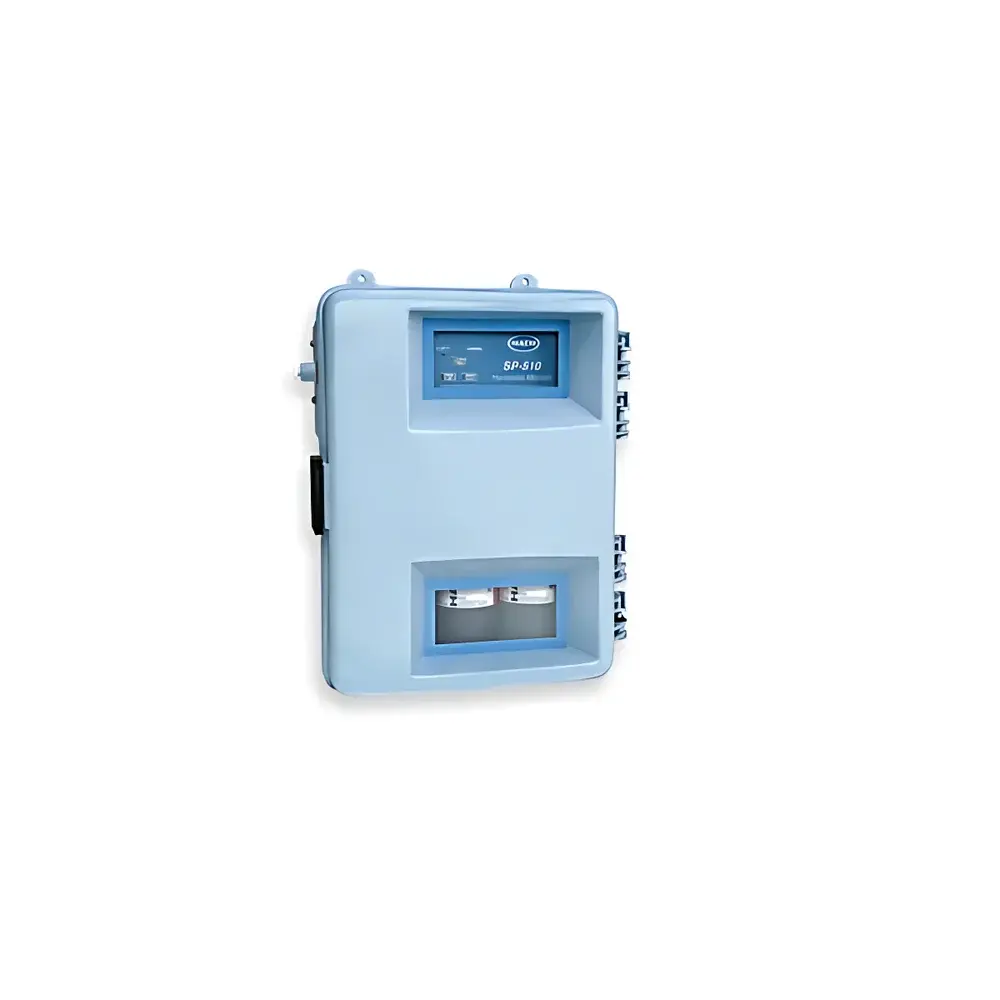
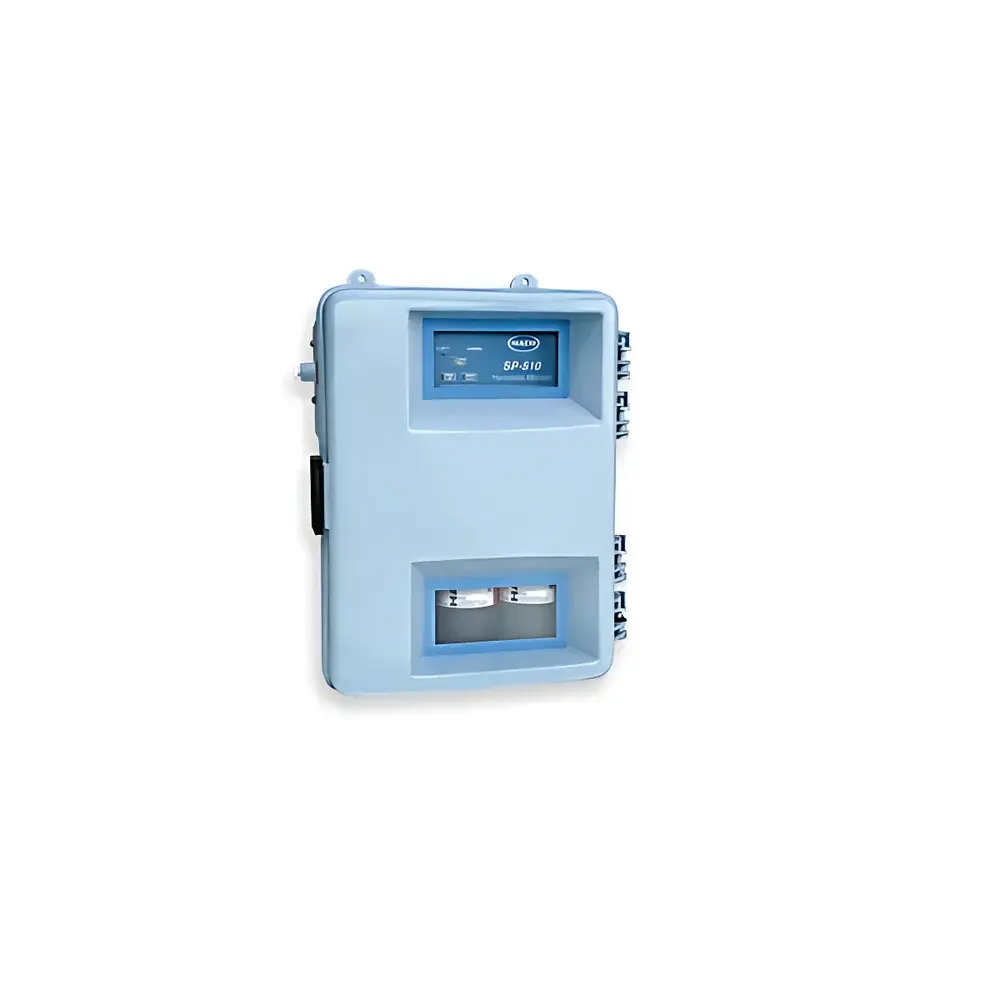
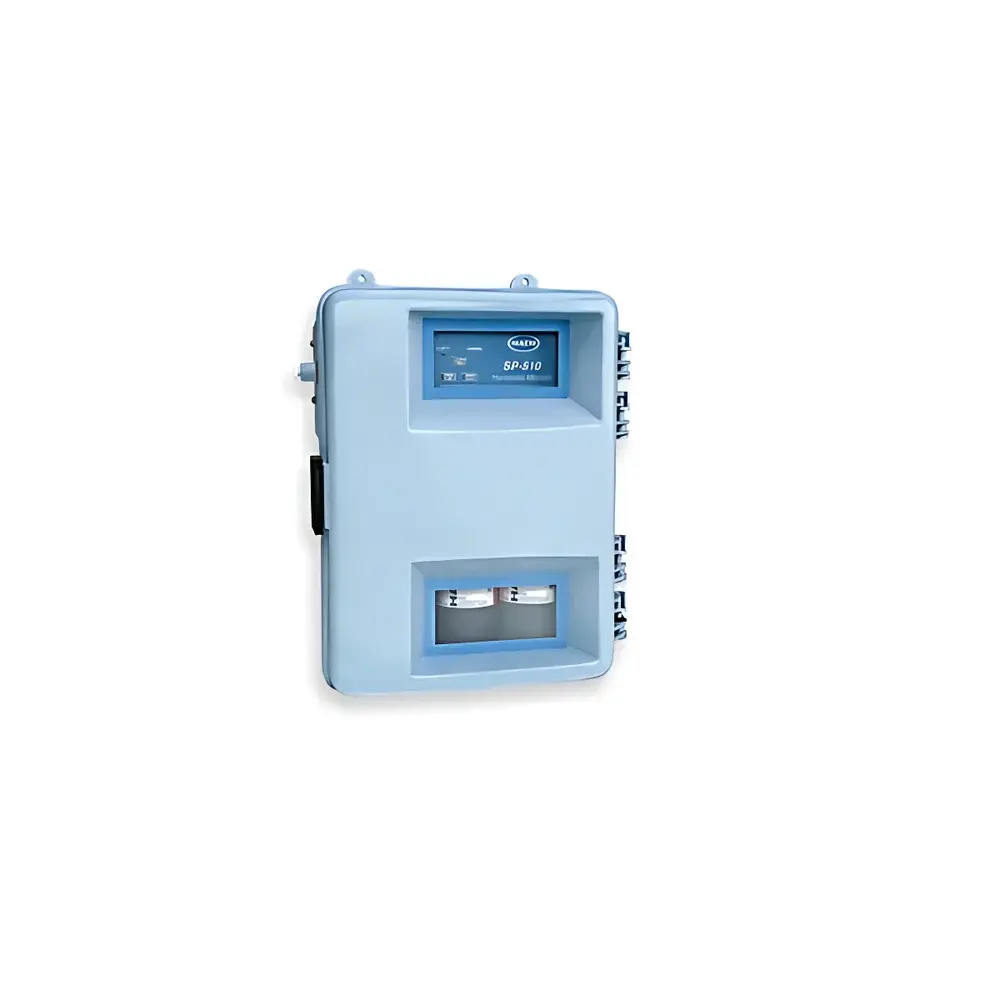
Hach SP510 Online Water Hardness Analyzer
| Brand | Hach |
|---|---|
| Model | SP510 |
| Origin | USA |
| Instrument Type | Online Water Quality Analyzer |
| Measurement Principle | Colorimetric Method (Calcium/Magnesium Complexation with Arsenazo III) |
| Measured Parameter | Total Hardness (as CaCO₃) |
| Range | 0.3–100 mg/L as CaCO₃ |
| Repeatability | ≤4% RSD |
| Accuracy | ±10% of setpoint at 0.3–2 mg/L |
| Cycle Time | ~2 minutes per measurement |
| Calibration | Automatic on-board standardization using factory-preloaded reagent cartridges |
| Reagent Consumption | One cartridge supports ~60 days of continuous operation |
| Maintenance Interval | Pump tubing replacement every 6 months |
| Alarm Outputs | 1 SPDT relay (configurable setpoints: 0.3, 1, 2, 5, 10, 20, 50, 100 mg/L) |
| Power Supply | 115/230 VAC, 50/60 Hz |
| Certifications | UL 61010-1, CSA C22.2 No. 61010-1, CE marked per EMC and LVD directives |
| Compliance | Designed for use in industrial water treatment environments requiring GLP-aligned operational traceability |
Overview
The Hach SP510 Online Water Hardness Analyzer is an industrial-grade, colorimetric-based process analyzer engineered for continuous, unattended monitoring of total water hardness—expressed as calcium carbonate (CaCO₃)—in real time. It employs the standardized arsenazo III complexometric method, where calcium and magnesium ions in the sample react with arsenazo III dye under controlled pH conditions to form stable colored complexes. Absorbance is measured photometrically at 650 nm, and concentration is calculated via a pre-established calibration curve stored in firmware. Unlike grab-sample lab analysis, the SP510 integrates directly into feedwater, boiler feed, or softener effluent streams, delivering repeatable measurements every ~120 seconds with minimal operator intervention. Its architecture supports closed-loop control integration, enabling direct actuation of softener regeneration cycles upon threshold violation—thereby optimizing resin utilization, minimizing salt and water waste, and extending equipment service life.
Key Features
- Automated colorimetric analysis using arsenazo III reagent chemistry—validated for interference resistance against common ions including iron, aluminum, and phosphate within typical industrial water matrices.
- Onboard automatic calibration system utilizing factory-preloaded, temperature-compensated reagent cartridges; eliminates manual standard preparation and reduces drift-related uncertainty.
- Configurable alarm thresholds (0.3, 1, 2, 5, 10, 20, 50, and 100 mg/L as CaCO₃) with a single SPDT relay output for hardwired interlock to softener controllers or PLCs.
- Low-maintenance design: only one consumable—the peristaltic pump tubing—requires replacement every six months under normal operating conditions (24/7 duty cycle).
- Compact, panel-mount enclosure rated IP65 for installation in utility rooms, boiler houses, or water treatment skids; compatible with 115/230 VAC power supplies and dual-frequency operation (50/60 Hz).
- Reagent cartridge life supports >60 days of continuous operation at standard 2-minute cycle intervals—reducing downtime and logistics overhead associated with frequent reagent handling.
Sample Compatibility & Compliance
The SP510 is optimized for low-turbidity, clarified water streams with suspended solids <5 mg/L and temperature stability between 5–40 °C. It is routinely deployed in softened makeup water lines, reverse osmosis permeate monitoring, steam boiler feedwater circuits, and cooling tower blowdown control applications. While not certified to ISO 9001 or ASTM D1126 for laboratory-grade reporting, its methodology aligns with EPA Method 130.1 (colorimetric hardness) and is referenced in ASME B31.1 Power Piping Code Annex A for feedwater quality verification. The instrument’s electrical safety compliance (UL 61010-1, CSA C22.2 No. 61010-1, CE) ensures suitability for Class I, Division 2 hazardous locations when installed per manufacturer guidelines. Data integrity is supported through timestamped measurement logs accessible via local serial interface—though native 21 CFR Part 11 audit trail functionality is not embedded; integration with external SCADA systems can provide compliant electronic record retention.
Software & Data Management
The SP510 operates autonomously without external software dependencies. All configuration—including alarm setpoints, relay behavior, display units, and cycle timing—is performed locally via a four-button keypad and backlit LCD. Measurement data (hardness value, timestamp, status flags) are retained in non-volatile memory for up to 30 days and retrievable via RS-232 serial output (ASCII protocol). For enterprise-level integration, analog 4–20 mA output provides real-time hardness values to DCS or PLC systems, while the SPDT relay enables discrete control actions. Firmware updates require Hach-certified service personnel and are performed via proprietary diagnostic port—ensuring version consistency across fleets and simplifying validation documentation for regulated facilities operating under GMP or GLP frameworks.
Applications
- Boiler feedwater hardness control to prevent scale formation in high-pressure steam generators and economizers.
- Softener effluent monitoring to dynamically trigger sodium-cycle regeneration based on actual breakthrough—not fixed time or volume schedules.
- RO pretreatment verification ensuring hardness removal efficiency prior to membrane stages.
- Cooling water system optimization by correlating hardness trends with corrosion inhibitor dosing efficacy.
- Pharmaceutical purified water (PW) loop surveillance where hardness excursions may indicate carbon bed exhaustion or resin degradation.
- Municipal water blending stations verifying hardness compliance prior to distribution network entry.
FAQ
What measurement principle does the SP510 use, and why is it suitable for industrial online monitoring?
The SP510 uses the arsenazo III colorimetric method, which offers high selectivity for Ca²⁺ and Mg²⁺ in low-conductivity waters. Its robustness against matrix interferences and stable reagent shelf life make it ideal for unattended, long-term deployment.
Can the SP510 be integrated into a DCS or PLC system?
Yes—it provides isolated 4–20 mA analog output for continuous hardness data and a configurable SPDT relay for alarm or control signaling, both compatible with standard industrial automation protocols.
Is the SP510 compliant with FDA 21 CFR Part 11?
No—the device lacks built-in electronic signature, audit trail, or user access controls required for Part 11. However, its analog and relay outputs may be incorporated into validated systems that meet those requirements externally.
How often must reagents be replaced?
One reagent cartridge supports approximately 60 days of operation at default 2-minute measurement intervals—equivalent to ~43,000 analyses per cartridge.
Does the SP510 require periodic manual calibration?
No—automatic calibration is performed daily using onboard standards; no user intervention is needed beyond scheduled pump tubing replacement every six months.
Related Products







