
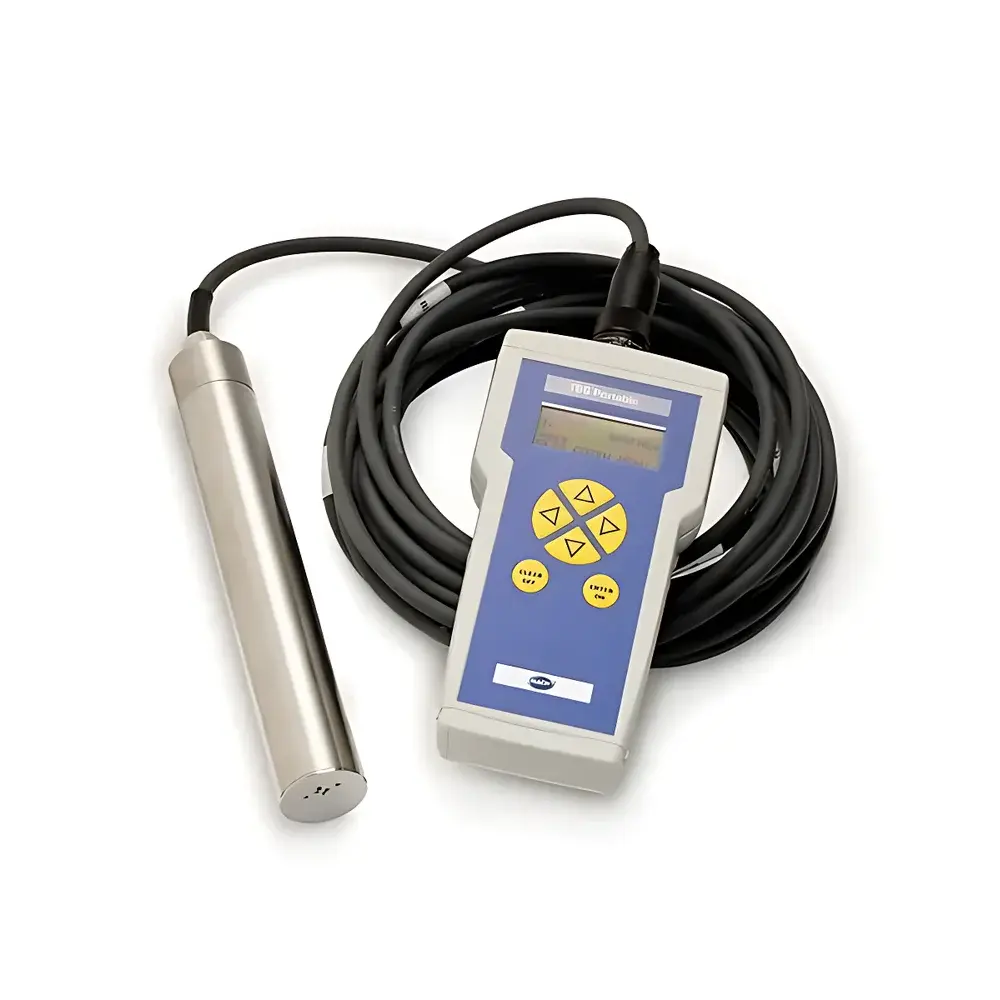
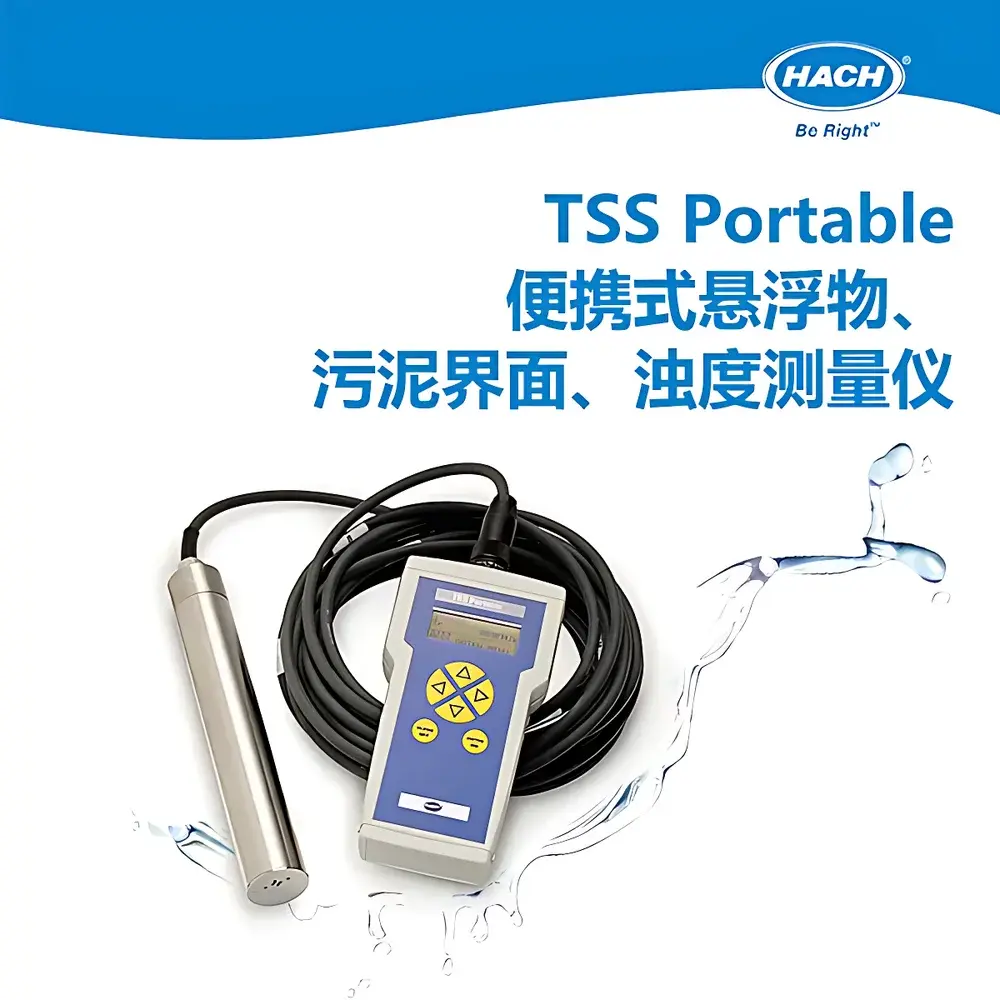
HACH TSS Portable Turbidity, Suspended Solids, and Sludge Interface Monitor
| Brand | HACH |
|---|---|
| Origin | Imported |
| Manufacturer | HACH Company |
| Model | TSS Portable |
| Power Supply | Rechargeable Battery |
| Measurement Principle | Dual-beam alternating infrared LED optical system with bubble compensation |
| Calibration | Multi-curve calibration support |
| Construction | Rugged, field-deployable housing |
| Compliance | Designed for ASTM D6507, ISO 7027, and USP <85> turbidity measurement guidelines |
| Sample Compatibility | Liquid samples from municipal/industrial wastewater, drinking water, surface water, and activated sludge basins |
Overview
The HACH TSS Portable Turbidity, Suspended Solids, and Sludge Interface Monitor is an engineered field instrument designed for simultaneous, on-site quantification of turbidity (NTU), total suspended solids (TSS, mg/L), and sludge blanket interface depth in liquid-phase environmental matrices. It operates on a dual-beam alternating infrared LED optical architecture—distinct from conventional single-wavelength nephelometry—where synchronized emission and detection of multiple infrared wavelengths mitigate interference from color, air bubbles, and particulate scattering heterogeneity. This method enables stable signal acquisition across dynamic wastewater conditions without manual path-length adjustment or frequent recalibration. The instrument is purpose-built for transient deployment in clarifiers, sedimentation tanks, influent/effluent streams, and open-channel monitoring stations where real-time stratification profiling and sensor validation are operationally critical.
Key Features
- Dual-parameter optical engine: Simultaneous acquisition of turbidity (per ISO 7027-compliant 860 nm infrared detection) and suspended solids concentration via empirically derived multi-curve calibration models.
- Sludge interface detection: Integrated depth-resolved optical profiling using time-synchronized light attenuation gradients to identify the upper boundary of settled sludge layers within clarifier zones—output as interface depth (cm) relative to sensor immersion point.
- Bubble compensation algorithm: Real-time correction of gas entrainment artifacts through differential signal analysis between primary and reference photodiodes, improving measurement reproducibility in aerated or turbulent flows.
- Ruggedized field design: IP67-rated enclosure with corrosion-resistant stainless-steel wetted parts and shock-absorbing polymer housing suitable for repeated submersion, drop impact, and outdoor temperature cycling (–10 °C to 50 °C).
- Rechargeable lithium-ion power system: Supports ≥12 hours of continuous operation per charge; includes low-power sleep mode and USB-C charging interface compatible with standard lab power banks.
- On-device data logging: Stores up to 10,000 timestamped records (date/time, parameter values, temperature, operator ID) with automatic CSV export via microSD card slot.
Sample Compatibility & Compliance
The TSS Portable is validated for use across heterogeneous aqueous media including primary and secondary wastewater effluents, potable water distribution systems, riverine sediments, and activated sludge mixed liquor. Its optical configuration minimizes interference from dissolved organic matter (e.g., humic substances), colored effluents, and fine colloidal suspensions that commonly compromise traditional white-light turbidimeters. Regulatory alignment includes adherence to ASTM D6507 for suspended solids estimation in wastewater, ISO 7027 for turbidity measurement traceability, and USP requirements for pharmaceutical water clarity verification. While not certified for GLP/GMP production environments, its audit-ready data logs—including user authentication, calibration history, and firmware version stamps—support compliance with EPA Method 1622 and ISO/IEC 17025 documentation expectations.
Software & Data Management
Instrument configuration, calibration management, and report generation are handled via HACH’s free desktop application, HACH Link™ v4.2+, which supports Windows 10/11 and macOS 12+. The software enables secure import of calibration curves (up to 8 user-defined TSS correlations), batch export of field data with metadata tagging (site ID, sampling depth, analyst initials), and automated PDF report generation compliant with internal QA/QC templates. All logged measurements include embedded digital signatures and immutable timestamps, satisfying basic FDA 21 CFR Part 11 requirements for electronic record integrity when used in non-GxP contexts. Firmware updates are delivered over-the-air via Bluetooth LE connection to mobile devices running the HACH FieldLink app.
Applications
- Clarifier optimization: Quantify sludge blanket rise rate and settling velocity profiles to adjust return activated sludge (RAS) pumping schedules.
- Online sensor validation: Perform periodic field checks against fixed-mount turbidimeters or TSS analyzers to verify drift or fouling-induced bias.
- Emergency response monitoring: Rapid deployment during combined sewer overflow (CSO) events or post-storm runoff assessments where laboratory turnaround is impractical.
- Drinking water treatment: Confirm filter backwash endpoints and detect early-stage breakthrough of floc particles into finished water.
- Educational and research use: Support student-led water quality surveys and longitudinal studies of sediment transport dynamics in fluvial systems.
FAQ
What optical principle does the TSS Portable use, and how does it differ from standard turbidimeters?
It employs a dual-beam alternating infrared LED system operating at 860 nm, with independent reference and measurement channels. Unlike white-light turbidimeters, this design reduces chromatic interference and improves linearity across wide turbidity ranges (0.01–4000 NTU) and TSS concentrations (0.1–10,000 mg/L).
Can the instrument measure sludge interface depth in deep tanks?
Yes—it provides reliable interface detection up to 5 meters depth when deployed with optional extension rod and depth encoder accessory.
Is calibration traceable to NIST standards?
Primary turbidity calibrations use AMCO AEPA-1 and StablCal® standards traceable to NIST SRM 2000 series; TSS calibrations require site-specific correlation using gravimetric reference methods.
Does the device meet explosion-proof requirements for hazardous locations?
No—it is not rated for Class I, Division 1 environments; use in potentially explosive atmospheres requires external barrier housings or intrinsically safe enclosures.
How often does the optical window require cleaning during field use?
Under typical wastewater exposure, weekly manual wipe with lint-free cloth and isopropyl alcohol is recommended; optional ultrasonic cleaning module (sold separately) extends maintenance intervals by 3×.







