
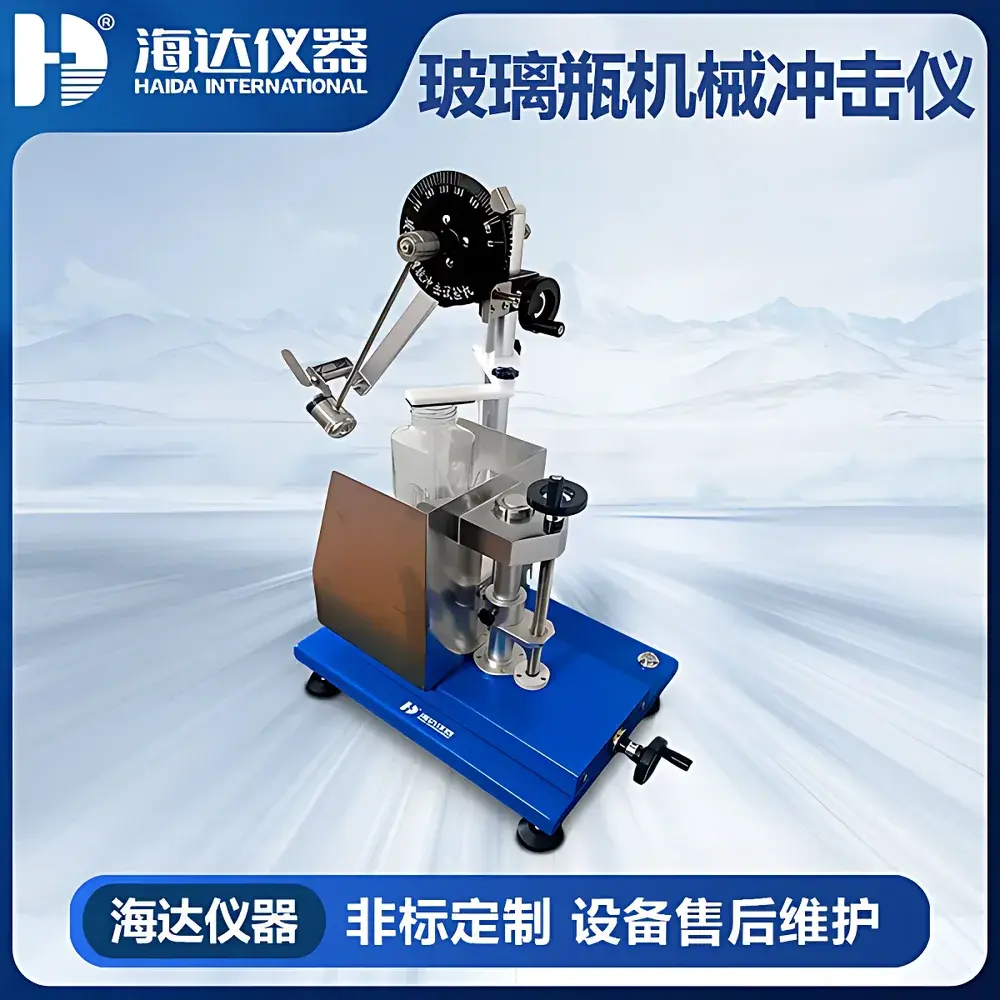
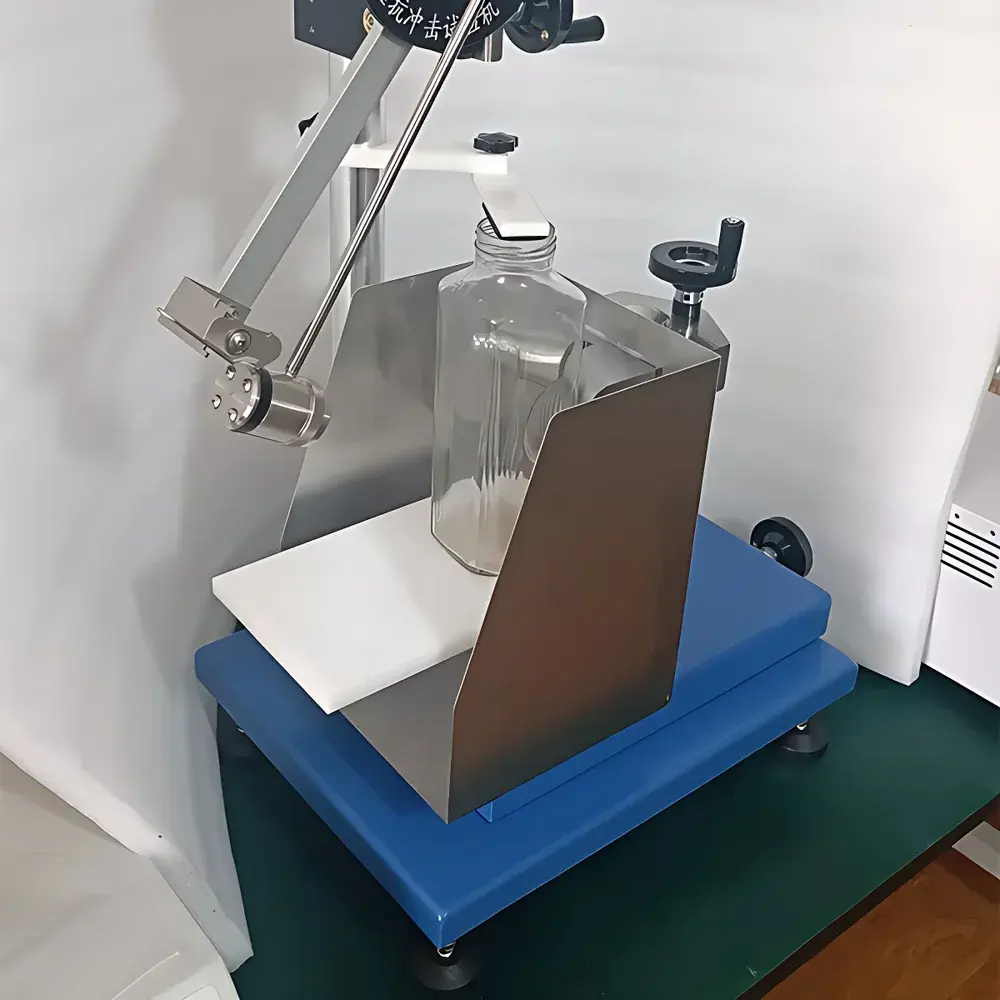
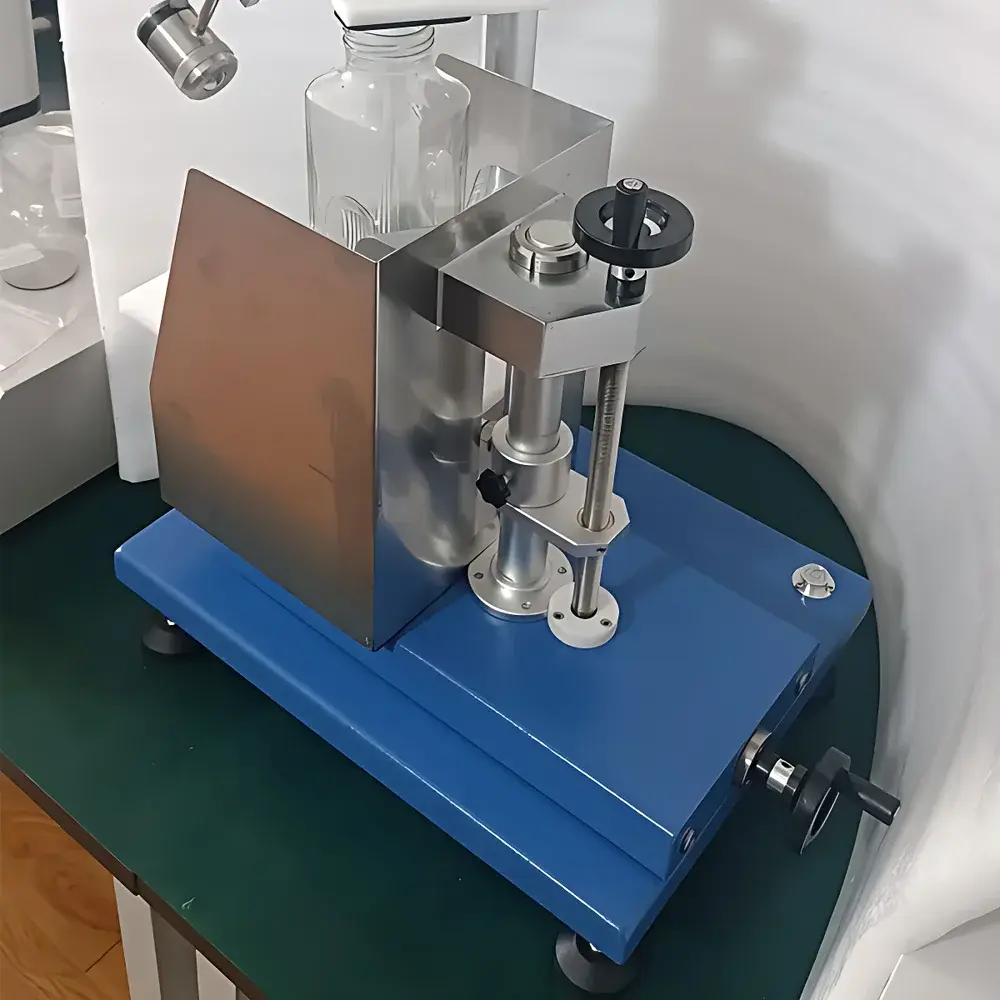
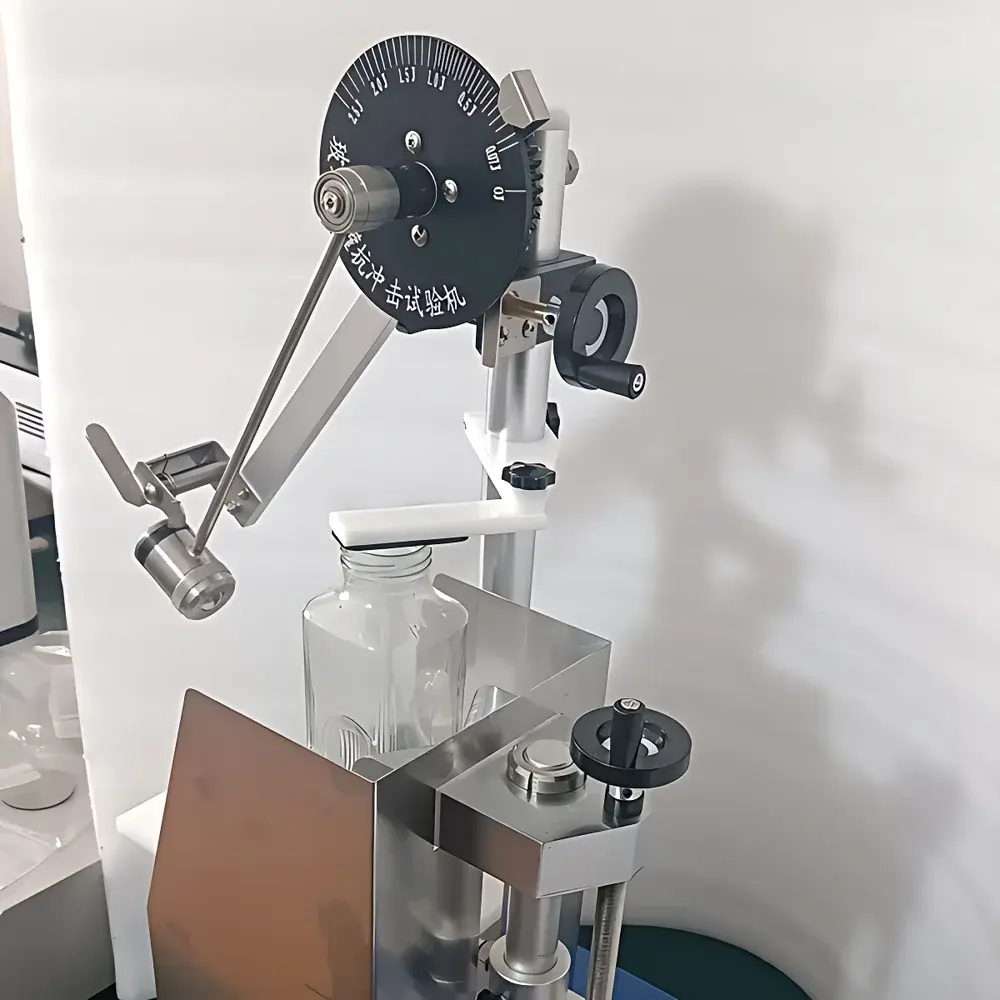
HAIDA HD-5081 Glass Bottle Impact Tester
| Brand | HAIDA INTERNATIONAL |
|---|---|
| Origin | Guangdong, China |
| Manufacturer Type | Direct Manufacturer |
| Product Origin | Domestic (China) |
| Model | HD-5081 |
| Quotation | Available Upon Request |
| Sample Diameter Range | φ20–160 mm |
| Sample Height Adjustment | 20–180 mm |
| Impact Energy Range | 0–2.9 N·m |
| Dimensions (L×W×H) | 500 × 350 × 700 mm |
| Weight | 28 kg |
| Compliance Standards | GB/T 6552–2015, YBB00382004–2015 |
Overview
The HAIDA HD-5081 Glass Bottle Impact Tester is a precision-engineered mechanical pendulum impact system designed for quantitative assessment of mechanical shock resistance in rigid glass containers. It operates on the fundamental principle of gravitational potential energy conversion: impact energy delivered to the test specimen is determined solely by the pendulum’s mass, drop height, and release angle—ensuring traceable, repeatable, and physics-based energy application without reliance on electronic actuation or velocity feedback. This gravimetric method aligns with internationally recognized static-energy calibration protocols used in packaging and pharmaceutical container testing laboratories. The instrument is purpose-built for compliance-driven quality control environments where regulatory auditors require demonstrable linkage between set impact energy (N·m) and physical pendulum geometry—eliminating ambiguity inherent in spring-loaded or pneumatic impact systems.
Key Features
- Pendulum-based energy delivery with calibrated angular release mechanism, enabling precise, stepwise energy increments from 0 to 2.9 N·m in accordance with GB/T 6552–2015 Annex A and YBB00382004–2015 Section 4.2.
- Adjustable support stage with dual-axis positioning: vertical (20–180 mm range) for bottle shoulder/heel alignment and horizontal fine-tuning to ensure tangential contact between striker tip and bottle surface at zero pre-load.
- Three-point circumferential impact sequence capability—automatically spaced at ~120° intervals—supports both pass/fail verification (single-energy screening) and progressive failure analysis (energy ramping until fracture).
- Rigid cast-iron base and reinforced steel frame minimize vibration coupling and ensure geometric stability during repeated high-energy strikes, contributing to inter-laboratory reproducibility.
- No electrical power required for core impact function—reducing maintenance complexity and eliminating electromagnetic interference concerns in regulated GMP/GLP facilities.
Sample Compatibility & Compliance
The HD-5081 accommodates cylindrical glass containers with outer diameters ranging from 20 mm to 160 mm—including pharmaceutical ampoules, vials, infusion bottles, beer bottles, wine bottles, and carbonated beverage containers. Its adjustable height and lateral positioning system ensures consistent strike location across diverse neck-to-body geometries. The instrument is fully compliant with two mandatory standards governing glass container mechanical integrity in China: GB/T 6552–2015 (“Glass containers — Test method for resistance to mechanical shock”) and YBB00382004–2015 (“Determination of mechanical shock resistance for pharmaceutical packaging materials”). These standards are referenced in Chinese NMPA registration dossiers and align structurally with ISO 8547 (glass container strength testing) and USP <660> (glass containers for pharmaceutical use), supporting cross-border regulatory submissions.
Software & Data Management
As a mechanically actuated, non-digital impact tester, the HD-5081 does not incorporate embedded firmware or proprietary software. All test parameters—including release angle, striker mass, impact point coordinates, and observed failure mode (crack propagation, chip formation, catastrophic fracture)—are recorded manually in laboratory notebooks or LIMS-integrated electronic batch records. This analog architecture satisfies FDA 21 CFR Part 11 requirements for audit trails when paired with controlled documentation practices, as no electronic records are generated or stored within the device itself. Calibration certificates for pendulum geometry and striker tip radius (±0.1 mm tolerance) are supplied with each unit and must be retained as part of equipment qualification (IQ/OQ).
Applications
- Pre-release validation of glass container robustness in pharmaceutical manufacturing (e.g., lyophilized product vials subjected to freeze-drying cycle stresses).
- Supplier qualification testing for glass bottle vendors supplying breweries and soft drink producers under ISO 22000 and FSSC 22000 frameworks.
- Root cause analysis of field failures—correlating lab-measured impact thresholds with real-world handling damage patterns.
- Process validation support for annealing furnace parameters, where thermal treatment directly influences residual stress distribution and measurable impact resistance.
- Regulatory submission evidence for packaging compatibility studies under ICH Q5C and Q5E guidelines.
FAQ
Does the HD-5081 require electrical power to operate the impact mechanism?
No—the pendulum release and impact action are purely mechanical and gravity-driven. Only optional accessories (e.g., digital angle encoder or high-speed camera synchronization module) would require external power.
Can the HD-5081 be used for plastic or aluminum containers?
It is specifically engineered and validated for rigid glass substrates per GB/T 6552–2015. Non-glass materials exhibit different fracture mechanics and energy absorption profiles; alternative test methods (e.g., drop-weight impact per ASTM D7136) are recommended.
Is third-party calibration certification included with shipment?
Yes—each unit ships with a factory-issued calibration report verifying pendulum moment of inertia, striker tip radius, and angular scale linearity against NIST-traceable references.
How is impact energy verified between user calibrations?
Users perform daily verification using the included reference test bottle and documented energy-check procedure outlined in the operator manual—consistent with GLP requirement §58.81(b) for instrument performance checks.
What maintenance is required to sustain measurement accuracy?
Biannual inspection of pivot bearing wear, striker tip roundness (using optical profilometry), and stage linear guide lubrication—detailed in the preventive maintenance log provided with the system.



