
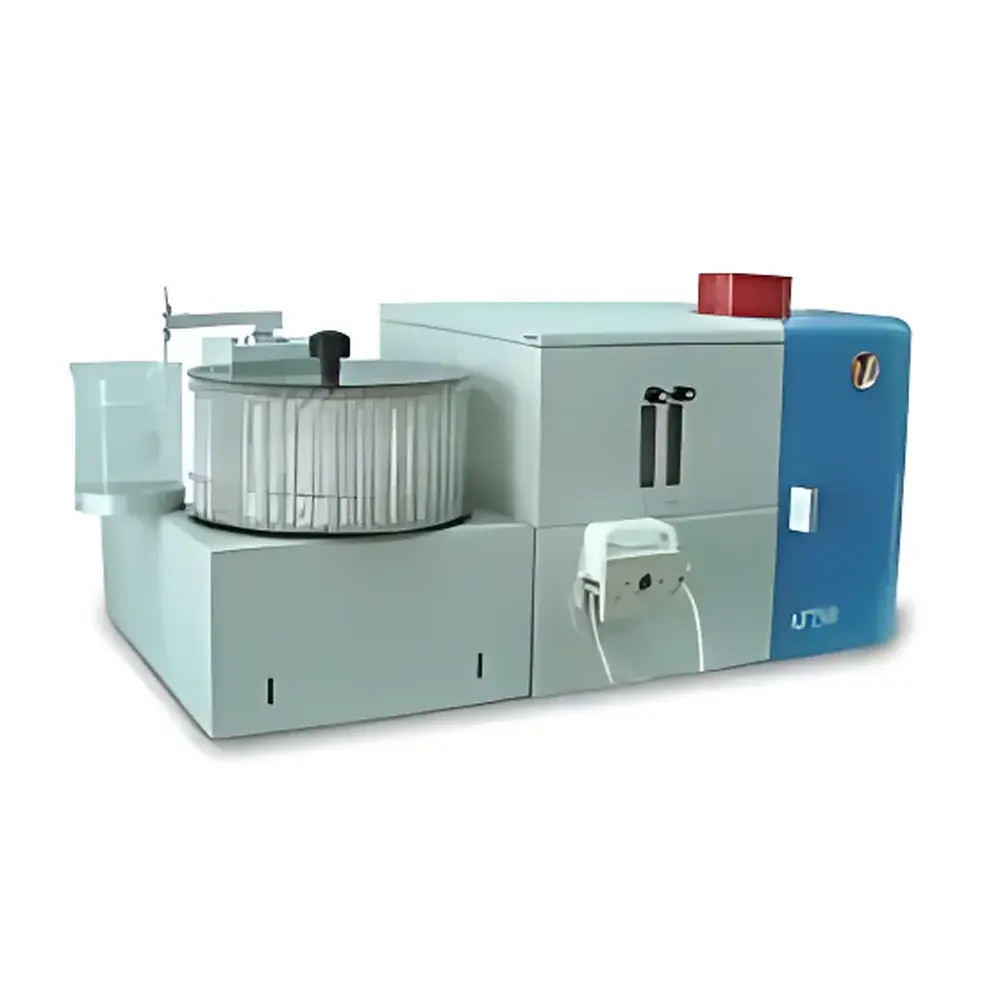
Haiguang AF-7500 Atomic Fluorescence Spectrometer
| Origin | Shandong, China |
|---|---|
| Manufacturer Type | Authorized Distributor |
| Origin Category | Domestic (China) |
| Model | AF-7500 |
| Price Range | USD 7,000–14,000 |
| Instrument Type | Flame–Graphite Furnace Hybrid AFS |
| Monochromator | Plane Grating |
| Optical System | Single-Beam |
| Detector | Solid-State Photodetector |
| Background Correction | Deuterium Lamp |
| Spectral Resolution | 0.3 nm |
| Sensitivity | ≥0.3 A for 5 ppm Cu |
| Precision (RSD) | ≤1.0% |
| Detection Limit (DL) | As/Sb/Se/Bi/Te < 0.01 ng |
| Linear Dynamic Range | 4–5 orders of magnitude |
Overview
The Haiguang AF-7500 Atomic Fluorescence Spectrometer is a high-performance, dual-channel hydride generation atomic fluorescence instrument engineered for ultra-trace and sub-trace elemental analysis in aqueous matrices. It operates on the principle of atomic fluorescence spectroscopy (AFS), where analyte elements—primarily Group VA, VIA, and IIB metals—are chemically reduced to volatile hydride species (e.g., AsH₃, SbH₃, Hg⁰ vapor) or cold-vapor forms, atomized in a low-temperature argon–hydrogen flame, and excited by a high-intensity hollow cathode lamp (HCL). The resulting element-specific fluorescence emission is collected at right angles to the excitation beam, minimizing background scatter and enabling exceptional signal-to-noise ratios. Designed for routine compliance-driven laboratories, the AF-7500 delivers detection limits well below regulatory thresholds for environmental, food safety, and clinical testing applications governed by standards such as EPA Method 1631E, ISO 17294-2, GB/T 22105 (China), and USP /. Its hybrid flame–graphite furnace capability supports both rapid hydride-forming element analysis and direct cold-vapor mercury determination without hardware reconfiguration.
Key Features
- Dual-channel simultaneous analysis with independent optical paths and detectors, enabling true concurrent quantification of two elements (e.g., As + Se) without spectral interference or time penalty.
- Patented infrared-controlled, membrane-based gas–liquid separator (Patent No. ZL200720104068.X) eliminates mechanical pump-driven waste removal, ensures complete phase separation, suppresses flame flicker noise, and enables stable, colorless atomization—directly contributing to sub-pg/mL detection limits.
- Automated eight-port injection valve coupled with precision peristaltic pumping (Patent No. ZL200620012910.2) supports four operational modes: continuous flow, discrete sampling, alternating dual-channel analysis, and synchronized wash–analyze cycles—maximizing throughput while eliminating cross-contamination.
- Far-infrared heated quartz atomizer provides rapid thermal ramping (≤3 s to operating temperature), precise temperature stabilization (±0.5 °C), and extended service life (>5,000 analyses) under repetitive hydride generation conditions.
- Integrated pneumatic control system with real-time pressure monitoring, automatic gas shutoff on flame failure, and redundant overpressure relief ensures full compliance with OSHA 1910.1200 and IEC 61010-1 safety requirements.
- Modular HCL power supply accommodates standard and specialty hollow cathode lamps—including high-current pulsed operation—enabling optimal excitation for low-yield emitters (e.g., Te, Sn) without lamp replacement downtime.
- Compact footprint (480 × 420 × 360 mm) achieved via miniaturized optical train and embedded microcontroller architecture, suitable for space-constrained environments including mobile labs, marine research vessels, and GLP-compliant QC suites.
Sample Compatibility & Compliance
The AF-7500 accepts liquid samples in 10–50 mL volumes following standardized acid digestion (HNO₃/HCl/HF) or alkaline leaching protocols. It is validated for direct analysis of drinking water, wastewater, soil extracts, biological tissues (urine, blood), food digests, pharmaceutical excipients, and cosmetic raw materials. All analytical methods implemented on the platform adhere to traceability requirements under ISO/IEC 17025:2017. Data integrity is maintained through audit-trail-enabled software compliant with FDA 21 CFR Part 11 (electronic signatures, user access tiers, immutable method logs). Routine performance verification includes daily calibration verification standards (CVS), continuing calibration verification (CCV), and matrix spike recovery checks per EPA guidance.
Software & Data Management
The AF-7500 is operated via Windows-based Haiguang AFS Control Suite v3.2, a 64-bit application supporting dual-channel acquisition, real-time spectral visualization, peak integration with baseline correction algorithms (tangent skim, linear interpolation), and automated calibration curve fitting (linear, quadratic, or weighted least-squares). Raw data files (.afsd) are stored with embedded metadata: instrument ID, operator login, method version, sample ID, acquisition timestamp, and environmental sensor readings (ambient temperature, argon pressure). Export options include CSV, PDF analytical reports (with GLP headers), and XML for LIMS integration. Software validation documentation (IQ/OQ/PQ protocols) and electronic signature configuration templates are provided for regulated laboratory deployment.
Applications
- Environmental monitoring: Quantification of As, Sb, Hg, and Se in surface water, groundwater, and EPA-defined hazardous waste leachates (TCLP/SPLP).
- Food safety: Screening for inorganic arsenic in rice, mercury in seafood, and cadmium in infant formula per EU Commission Regulation (EU) No 1881/2006.
- Pharmaceutical quality control: Verification of catalyst residues (Pd, Pt) and elemental impurities (As, Cd, Pb, Hg) in APIs per ICH Q3D guidelines.
- Clinical toxicology: Measurement of urinary arsenic speciation metabolites (inorganic As³⁺/As⁵⁺, MMA, DMA) following derivatization and hydride generation.
- Geological surveying: Multi-element profiling of ore concentrates and sediment cores for exploration geochemistry (Au pathfinder elements: As, Sb, Bi).
FAQ
Does the AF-7500 support graphite furnace atomization for non-hydride-forming elements?
No—the AF-7500 is optimized exclusively for hydride generation and cold-vapor AFS. It does not incorporate electrothermal atomization hardware. For Pb, Cd, or Ni analysis outside hydride chemistry, coupling with an external GF-AAS system is recommended.
What is the typical maintenance interval for the membrane separator?
Under normal operation (≤200 samples/day), the hydrophobic PTFE membrane requires replacement every 6–9 months. Visual inspection for wetting or channeling is advised during weekly preventive maintenance.
Can the instrument be integrated into a centralized laboratory network with remote diagnostics?
Yes—via optional Ethernet module and Haiguang Remote Support Protocol (HRSP), enabling secure TLS-encrypted remote troubleshooting, firmware updates, and method synchronization across multi-site deployments.
Is method transfer from older AF series instruments supported?
Full backward compatibility is maintained for method files (.afm), calibration databases, and report templates from AF-610, AF-630, and AF-640 platforms, minimizing revalidation burden during instrument upgrades.
Related Products





