
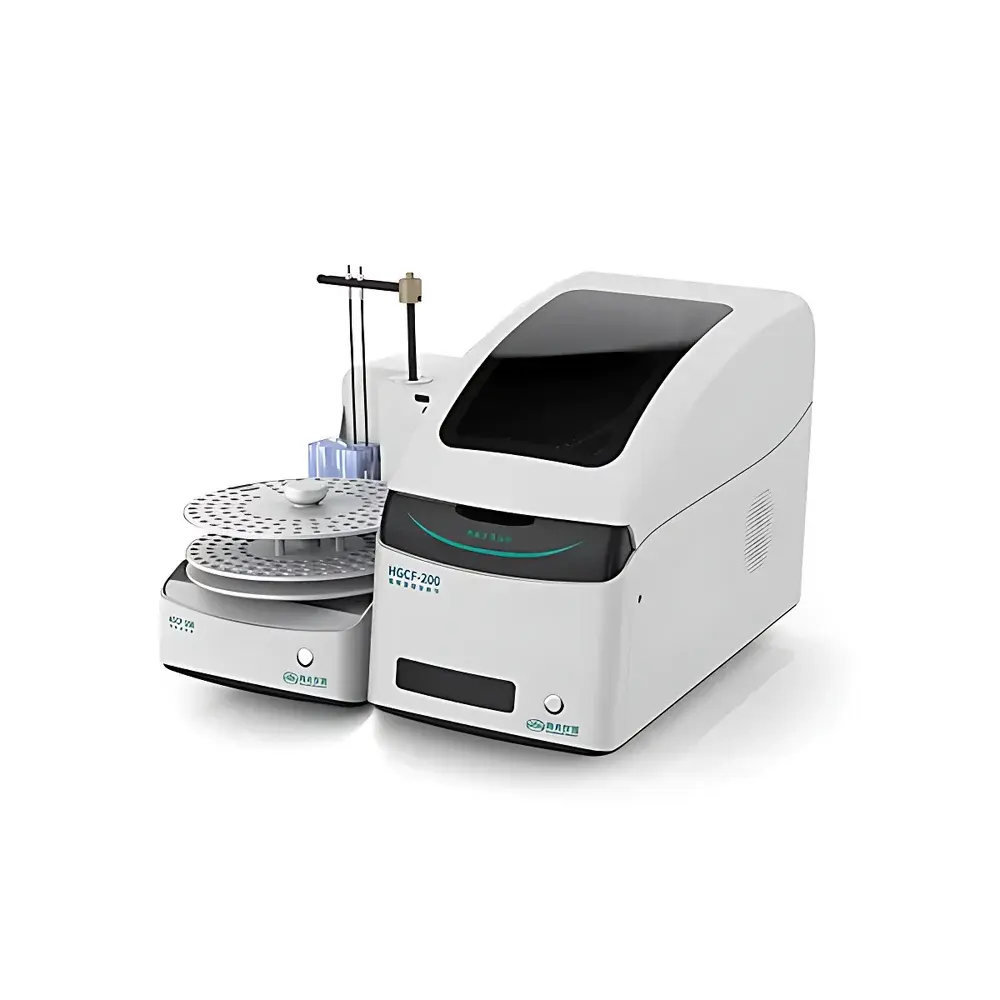
Haiguang HGCF-200 Continuous Flow Analyzer for Volatile Phenol
| Brand | Haiguang Instrument |
|---|---|
| Origin | Beijing, China |
| Model | HGCF-200 Volatile Phenol |
| Instrument Type | Laboratory-Based Volatile Phenol Analyzer |
| Compliance | ASTM D3164, ISO 14402:1999, ISO 23913:2016, ISO 15681-2:2003, HJ 665–670/667–2013, CJT 141–2018, SL/T 788–2019, NY/T 1121.7–2014, NY/T 1228–2015 |
Overview
The Haiguang HGCF-200 Continuous Flow Analyzer (CFA) for Volatile Phenol is a laboratory-grade, fully automated analytical platform engineered for high-throughput, reproducible quantification of volatile phenol in environmental and industrial water matrices. It operates on the principle of segmented continuous flow analysis (SCFA), utilizing air segmentation to isolate discrete sample and reagent zones within chemically inert quartz tubing. This architecture ensures complete reaction kinetics, eliminates carryover between samples, and enables precise control over mixing, heating, digestion, and detection timing. The system integrates online distillation, UV photolysis, and bubble removal modules—critical for robust recovery of volatile phenol from complex matrices such as wastewater, surface water, seawater, and soil extracts. Designed for compliance with international regulatory frameworks—including ISO 14402:1999 (Water quality — Determination of phenol index by flow analysis), HJ 667–2013, and SL/T 788–2019—the HGCF-200 delivers trace-level sensitivity (sub-µg/L detection capability) with long-term baseline stability required for routine monitoring and accreditation-ready reporting.
Key Features
- Air-segmented flow architecture with quartz manifold (ID ≥2 mm) for low memory effect, high chemical resistance, and minimal clogging—even with suspended solids in raw wastewater or sediment extracts.
- Integrated on-line pretreatment: programmable steam distillation unit for selective volatilization of phenolic compounds; high-efficiency UV photolysis module (254 nm) for oxidation of interfering organics; and precision gas-elimination system to stabilize optical path integrity.
- Optical detection system featuring a high-stability LED light source coupled with a full-spectrum CCD detector and built-in monochromator—enabling multi-wavelength acquisition, automatic reference wavelength selection, and real-time correction for source drift and background absorbance without mechanical filter wheels.
- Modular flow cell design: interchangeable quartz cuvettes with selectable optical path lengths (10 mm, 20 mm, 50 mm) to optimize sensitivity and dynamic range across diverse concentration levels—from drinking water (1 mg/L).
- On-board dilution module co-located with autosampler: programmable 1:1 to 1:5000 dilution ratio, supporting single-point calibration curve generation and auto-dilution of out-of-range samples—eliminating manual recalibration steps.
- Intelligent reagent management system: integrated reservoir monitoring, leak detection, pressure regulation, and tubing routing optimization to reduce maintenance frequency and ensure traceable reagent usage per ICH-GCP and GLP audit requirements.
Sample Compatibility & Compliance
The HGCF-200 accommodates liquid samples ranging from filtered tap water to undiluted municipal wastewater, marine water, digested soil leachates, and food extract supernatants—without mandatory pre-filtration or degassing. Its robust flow path tolerates turbidity up to 500 NTU and total suspended solids (TSS) ≤150 mg/L. Method validation data confirm adherence to ISO 14402:1999, EPA Method 420.1 (modified), and Chinese national standards HJ 667–2013 and SL/T 788–2019. The system supports full audit trails, electronic signatures, and 21 CFR Part 11-compliant data handling when paired with optional LIMS integration modules. All critical parameters—including temperature, flow rate, lamp intensity, and detector gain—are logged at 1-second intervals for retrospective method verification.
Software & Data Management
Control and data acquisition are managed via Haiguang’s CFA-Studio v4.x software—a Windows-based application compliant with ISO/IEC 17025:2017 documentation requirements. It provides intuitive workflow configuration (method editor with drag-and-drop module sequencing), real-time chromatogram visualization, peak integration using adaptive baseline algorithms, and customizable report templates aligned with ISO 14040 and EU WFD reporting formats. Raw spectral data (absorbance vs. wavelength) and time-resolved signal traces are stored in open-format HDF5 files, ensuring long-term archival integrity and third-party software interoperability. Optional cloud synchronization enables remote instrument status monitoring and centralized QA/QC review across multi-site laboratories.
Applications
The HGCF-200 serves as a core analytical tool in environmental testing laboratories accredited to ISO/IEC 17025, municipal water utilities performing regulatory compliance monitoring, and research institutions studying contaminant fate in aquatic systems. Validated applications include volatile phenol determination in riverine and estuarine waters per ISO 14402; simultaneous multi-analyte profiling (ammonia-N, orthophosphate, nitrate, sulfide, Cr(VI), cyanide) in wastewater treatment plant influent/effluent streams; and nutrient speciation in agricultural runoff and fertilizer leaching studies. Additional use cases span food safety (phenol migration from packaging), dairy quality control (phenolic preservative residues), and tobacco leaf analysis (natural phenol content).
FAQ
Does the HGCF-200 require daily calibration for volatile phenol analysis?
No—systematic calibration verification is performed before each batch using certified reference materials (CRMs); full calibration is required only after major maintenance or reagent lot change.
Can the instrument analyze samples with high chloride content, such as seawater?
Yes—the integrated UV digestion and optimized distillation parameters mitigate chloride interference; method validation data show <5% bias at Cl⁻ concentrations up to 20,000 mg/L.
Is the software compatible with LIMS interfaces?
Yes—CFA-Studio supports ASTM E1384-compliant HL7 and ASTM E2500 XML export, as well as direct ODBC connectivity for seamless integration with major LIMS platforms.
What maintenance intervals are recommended for the quartz flow cell and distillation module?
Quartz manifolds require cleaning every 200 runs using 10% HNO₃; distillation coils are inspected quarterly and replaced annually under standard operating conditions.
Does the system meet GLP or GMP data integrity requirements?
When configured with audit trail logging, electronic signature, and role-based access control, the HGCF-200 satisfies ALCOA+ principles and supports FDA 21 CFR Part 11 compliance assessments.
Related Products







