
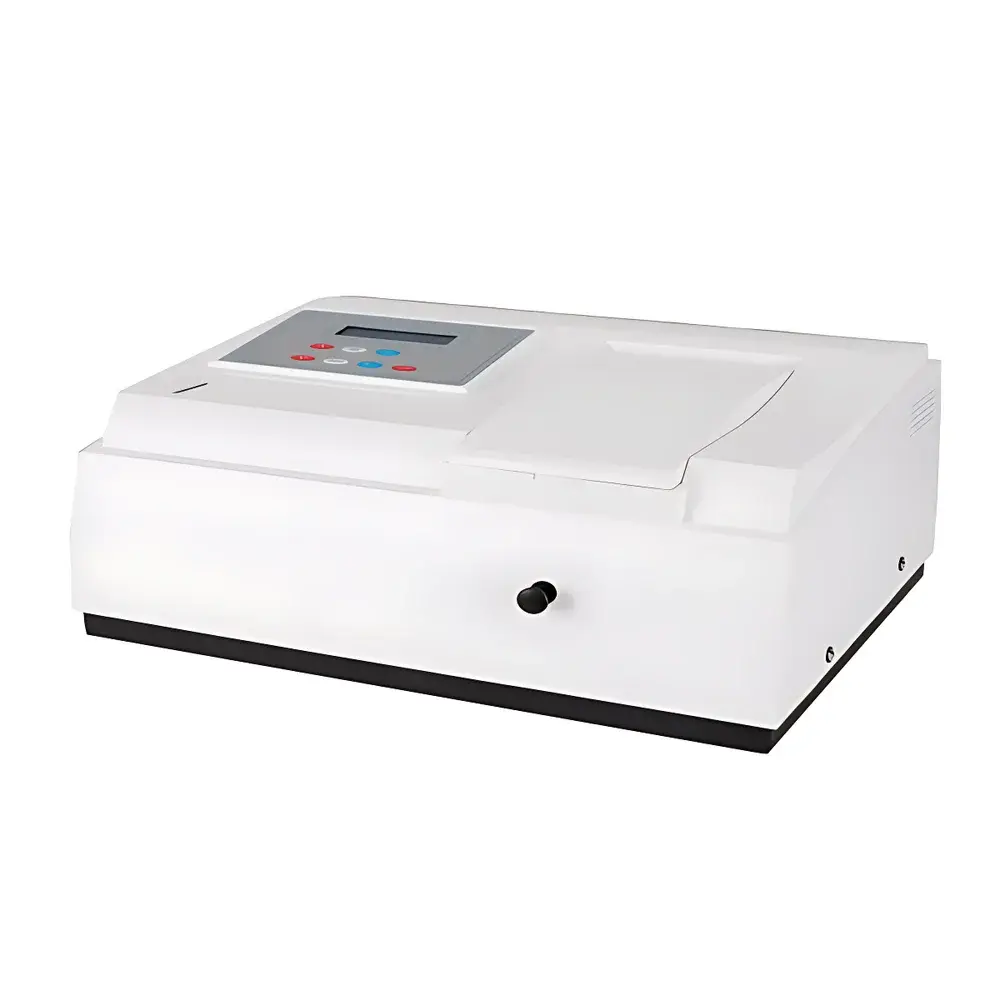
Haileong UV-2204 Advanced Double-Beam Ultraviolet-Visible Spectrophotometer
| Brand | Haileong |
|---|---|
| Model | UV-2204 |
| Optical System | Double-beam |
| Detector | Photomultiplier Tube (PMT) |
| Wavelength Range | 200–1000 nm |
| Spectral Bandwidth | 4 nm |
| Wavelength Accuracy | ±1 nm |
| Wavelength Repeatability | ±0.3 nm |
| Photometric Accuracy | ±0.3% T |
| Photometric Repeatability | ≤0.2% T |
| Stray Light | ≤0.2% T @ 220 nm & 360 nm |
| Baseline Stability | ±0.002 A/h @ 500 nm |
| Display Resolution | 0.1 nm |
| Measurement Modes | Transmittance (T), Absorbance (A), Concentration (C), Factor (F) |
| Light Sources | Imported Deuterium Lamp & Tungsten-Halogen Lamp (Auto-Switching) |
| Monochromator | Czerny-Turner (CT) Type |
| Interface | USB 2.0 |
| Sample Compartment | Accommodates Cuvettes from 5 mm to 100 mm Pathlength |
| Power Supply | AC 90–240 V, 50 Hz |
| Dimensions | 470 × 370 × 200 mm |
| Weight | 13 kg |
Overview
The Haileong UV-2204 is a precision double-beam ultraviolet-visible (UV-Vis) spectrophotometer engineered for routine and research-grade quantitative and qualitative analysis in academic, pharmaceutical, environmental, and industrial laboratories. It operates on the principle of Beer-Lambert law-based absorbance measurement, utilizing a Czerny-Turner monochromator with a high-efficiency 1200 lines/mm holographic grating to deliver consistent spectral resolution across its full 200–1000 nm wavelength range. The instrument employs auto-switching between a deuterium lamp (for UV region, 200–350 nm) and a tungsten-halogen lamp (for visible/NIR region, 350–1000 nm), ensuring optimal signal-to-noise performance without manual intervention. Its double-beam optical architecture continuously compensates for source drift and detector variability by splitting the light path into sample and reference beams—enabling high photometric stability (±0.002 A/h at 500 nm) and minimizing baseline drift during extended kinetic or scanning protocols.
Key Features
- Double-beam optical design with real-time reference beam correction for enhanced photometric reproducibility and long-term measurement stability.
- High-sensitivity photomultiplier tube (PMT) detector optimized for low-light UV detection and wide dynamic range (0–200% T / –0.3 to 3.0 A).
- Automated wavelength calibration and zero/100% T adjustment—no black body or manual alignment required; single-button initiation ensures rapid system readiness.
- CT-type monochromator with imported 1200 lines/mm grating delivers precise spectral separation and minimal peak broadening.
- Large sample compartment accommodating standard cuvettes from 5 mm to 100 mm pathlength—compatible with microvolume adapters, flow cells, and solid-sample holders (optional).
- Integrated 0.1 nm wavelength display resolution and ±1 nm absolute accuracy—meeting ASTM E275 and ISO 6223 calibration traceability expectations.
- USB 2.0 interface supporting Windows XP–11 compatible analytical software for method storage, spectral scanning, kinetics, multi-point quantitation, and GLP-compliant data export.
Sample Compatibility & Compliance
The UV-2204 supports liquid-phase analysis of aqueous and organic solutions in quartz, glass, or plastic cuvettes, as well as solid thin films and translucent materials using optional accessories. Its optical path accommodates variable pathlengths (5–100 mm), enabling both high-sensitivity trace analysis and high-concentration measurements without dilution. The instrument complies with fundamental requirements of ISO/IEC 17025 for testing laboratories and aligns with pharmacopeial methods referenced in USP , EP 2.2.25, and JP 17 for UV-Vis absorbance validation. While not pre-certified for FDA 21 CFR Part 11, its software architecture supports audit-trail-enabled operation when deployed with validated third-party analytical platforms compliant with GxP data integrity standards.
Software & Data Management
The UV-2204 interfaces via USB with Haileong’s XP-compatible analytical suite (optional), providing intuitive GUI-driven workflows for photometric mode selection (T/A/C/F), spectral scanning (200–1000 nm), time-resolved kinetics (up to 600 s), and multi-wavelength quantitative analysis. All measurement sessions are timestamped and stored with metadata including lamp status, wavelength setting, slit width, and user ID. Raw absorbance spectra and calibration curves can be exported in CSV, TXT, or XML formats for integration into LIMS or statistical analysis tools (e.g., JMP, OriginLab). Software supports customizable report templates meeting internal QA documentation requirements and facilitates batch processing for QC release testing.
Applications
- Pharmaceutical quality control: assay of active pharmaceutical ingredients (APIs), excipient purity screening, and dissolution profile monitoring per USP chapters.
- Environmental testing: quantification of nitrate, phosphate, COD, and heavy metal complexes (e.g., Cr(VI) with diphenylcarbazide) in water samples.
- Biochemical analysis: protein concentration (Bradford/Lowry assays), nucleic acid purity (A260/A280 ratio), and enzyme kinetics (e.g., NADH oxidation at 340 nm).
- Materials science: bandgap estimation of semiconductor nanoparticles via Tauc plot analysis, and thin-film transmittance characterization.
- Food & beverage: colorant concentration (e.g., tartrazine, carmine), antioxidant capacity (DPPH assay), and adulterant detection.
FAQ
What is the difference between the UV-2204 and UV-2202 models?
The UV-2204 features a 4 nm spectral bandwidth and ±1 nm wavelength accuracy, whereas the UV-2202 uses a narrower 2 nm bandwidth and achieves ±0.5 nm accuracy—making the latter more suitable for high-resolution applications such as narrow peak identification in complex mixtures.
Does the instrument support GLP-compliant data handling?
Yes—when used with validated analytical software, the UV-2204 supports electronic signatures, audit trails, and secure user access controls required under GLP and GMP frameworks.
Can I perform kinetic measurements over extended time periods?
Yes—the instrument supports up to 600-second time-scan intervals with configurable sampling frequency (0.1–10 s), ideal for monitoring slow enzymatic reactions or thermal degradation studies.
Is the PMT detector replaceable in the field?
The photomultiplier tube is a factory-aligned component; replacement requires recalibration and is recommended only by authorized service personnel to maintain wavelength and photometric accuracy specifications.
What cuvette materials are compatible with the full 200–1000 nm range?
Quartz cuvettes are required for measurements below 340 nm; fused silica or UV-grade quartz is recommended for optimal transmission at 200–220 nm. Standard optical glass cuvettes are suitable for >350 nm applications.




