
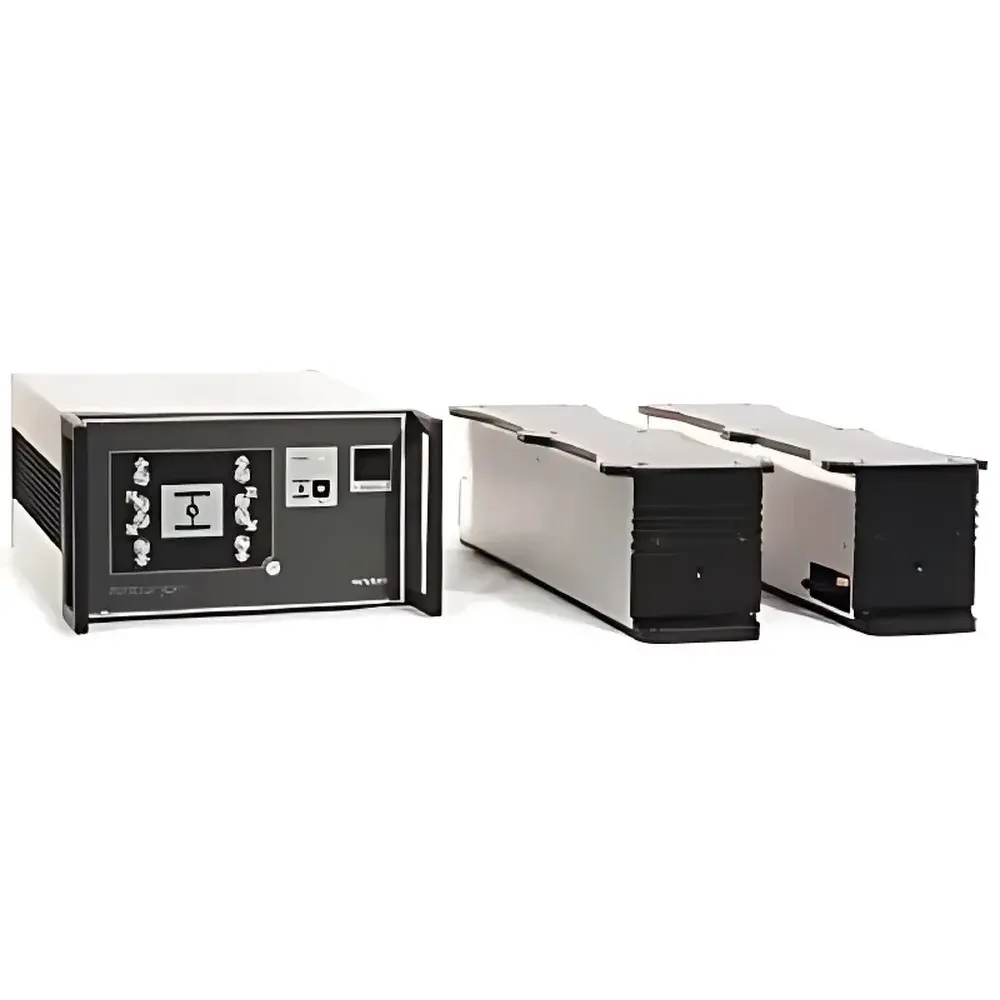
Halcyonics Vario Series Active Vibration Isolation Platform
| Brand | Accurion |
|---|---|
| Origin | Germany |
| Manufacturer Type | Authorized Distributor |
| Product Origin | Imported |
| Model | Halcyonics Vario Series |
| Price | Upon Request |
| Load Capacity | 0–600 kg |
| Operating Frequency Range | <5 Hz (effective isolation down to DC) |
| Power Supply | Standard DC Input |
| System Architecture | Separated Actuator Units + Dedicated Controller Unit |
| Key Technology | Piezoelectric Sensor Feedback + Real-Time Active Force Cancellation |
| Compliance | Designed for ISO 20483-compliant lab environments |
Overview
The Halcyonics Vario Series Active Vibration Isolation Platform is an engineered solution for high-stability instrumentation environments where sub-Hz mechanical disturbances critically compromise measurement fidelity. Unlike passive isolation systems—whose performance degrades below ~5 Hz due to inherent resonance peaks—the Vario Series employs real-time, closed-loop active control based on piezoelectric sensing and electromagnetic actuation. This architecture eliminates natural low-frequency resonances and delivers broadband attenuation from DC up to 100 Hz, making it especially suited for scanning electron microscopes (SEM), transmission electron microscopes (TEM), atomic force microscopes (AFM), and other nanoscale metrology tools requiring vibration amplitudes below 1 nm RMS in vertical and horizontal axes. Each platform consists of modular isolation units mounted beneath the instrument, paired with a dedicated controller that continuously monitors inertial motion and applies counteracting forces with microsecond latency.
Key Features
- True active feedback control architecture using high-sensitivity piezoelectric accelerometers and precision voice-coil actuators
- No intrinsic mechanical resonance—enables stable operation at frequencies as low as 0.1 Hz, critical for long dwell-time imaging and spectroscopy
- Auto-load compensation: The controller dynamically adapts gain and damping parameters to maintain optimal performance across the full specified load range (0–600 kg)
- Modular system design: Isolation units and controller are physically separated, enabling flexible integration into constrained cleanroom or shielded enclosure layouts
- Low-power DC operation: Compatible with standard laboratory power supplies (24 VDC); no external air supply, hydraulic lines, or bulky compressors required
- Dual-platform configuration: Vario Series (higher bandwidth, enhanced stability) and Vario Basic Series (cost-optimized, broad compatibility) support application-specific deployment
Sample Compatibility & Compliance
The Vario Series is validated for use with mid-to-large format electron optical instruments—including field-emission SEMs, dual-beam FIB-SEM systems, and cryo-TEM stages—where payload mass, center-of-gravity height, and dynamic coupling to floor-borne vibrations must be rigorously managed. All models comply with ISO 20483:2022 (Vibration isolation systems for sensitive equipment) and meet mechanical interface requirements defined in ASTM E2531-21 (Standard Guide for Vibration Testing of Electron Microscopes). Platforms are constructed from non-magnetic, anodized aluminum alloys to prevent magnetic interference and support ultra-high vacuum (UHV) chamber integration. Footprint dimensions are optimized for standard optical table cutouts and OEM mounting patterns, with optional seismic anchoring kits available for earthquake-prone regions.
Software & Data Management
The integrated controller includes Ethernet and USB interfaces for remote monitoring and configuration via Halcyonics’ proprietary VarioControl software (Windows/Linux compatible). Real-time vibration spectra, control loop status, and actuator health diagnostics are logged with timestamped metadata. Audit trails and user-access logs support GLP/GMP-aligned workflows, and the system is configurable to meet FDA 21 CFR Part 11 requirements for electronic records and signatures when deployed in regulated R&D or QC laboratories. Firmware updates are delivered over secure HTTPS channels, and configuration profiles can be exported/imported for reproducible setup across multi-instrument facilities.
Applications
- High-resolution SEM imaging and EDS/WDS elemental mapping requiring 30 s
- In-situ TEM experiments involving mechanical straining or heating stages, where low-frequency drift directly impacts diffraction pattern fidelity
- Nanoscale AFM force spectroscopy and nanoindentation, where environmental vibration introduces noise into pico-Newton force resolution
- Quantum device characterization platforms (e.g., superconducting qubit readout setups) demanding sub-10 nm displacement stability
- Optical interferometry and laser-based metrology systems sensitive to phase perturbations induced by floor-borne vibration
FAQ
What distinguishes active isolation from passive systems in practice?
Active systems like the Vario Series suppress vibrations across the entire spectrum—including near-DC frequencies—by generating opposing forces in real time. Passive systems rely solely on mass-spring-damping mechanics and become ineffective below their resonant frequency (~5–10 Hz), often amplifying rather than attenuating low-frequency energy.
Can the Vario platform be retrofitted to an existing SEM installation?
Yes. The modular unit design allows replacement of legacy passive mounts without structural modification. Load capacity, footprint, and interface bolt patterns are cross-referenced against major OEM specifications (Thermo Fisher, Zeiss, JEOL, Hitachi) during pre-installation assessment.
Is electromagnetic compatibility (EMC) verified for use near sensitive detectors?
All Vario Series units undergo CISPR 11 Class B EMC testing. Radiated emissions are suppressed below 30 dBµV/m at 3 m distance across 30 MHz–1 GHz, ensuring compatibility with secondary electron detectors, EBSD cameras, and RF-sensitive cryogenic sensors.
How does auto-load compensation function during instrument service or accessory changes?
The controller performs a brief (<15 s) self-calibration sequence upon power-up or manual trigger, measuring static deflection and updating internal stiffness and damping models. No manual recalibration or parameter tuning is required after adding/removing sample stages or detectors.
Are custom mounting interfaces or integration support available?
Accurion provides mechanical CAD models (STEP/IGES), mounting torque specifications, and on-site commissioning support through certified field engineers—subject to regional service agreements.




