
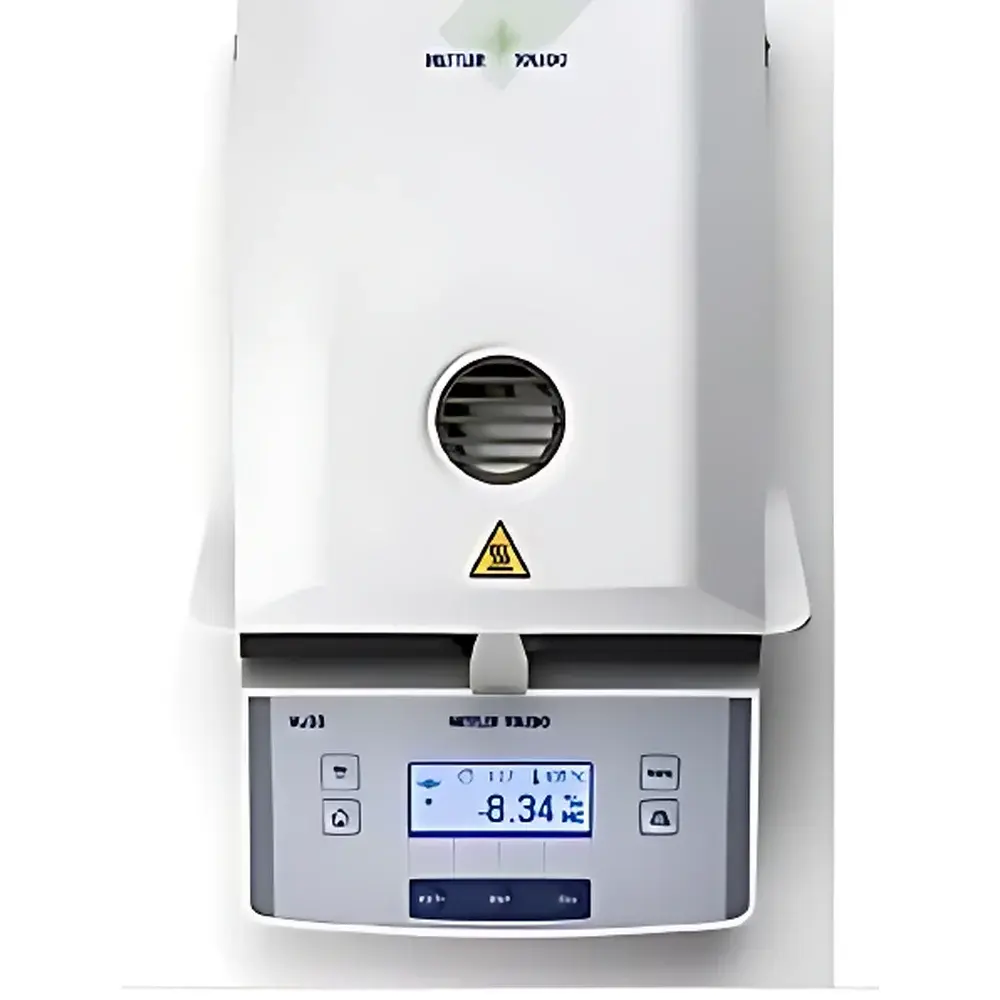
Halogen Moisture Analyzer MJ33
| Origin | Switzerland |
|---|---|
| Manufacturer Type | Authorized Distributor |
| Origin Category | Imported |
| Model | MJ33 |
| Pricing | Upon Request |
Overview
The Halogen Moisture Analyzer MJ33 is a compact, robust, and precision-engineered instrument designed for rapid, reliable moisture content determination in routine industrial and quality control environments. Unlike halogen-based elemental analyzers used for total halogen quantification (e.g., Cl, Br, F), the MJ33 is specifically configured as a *halogen lamp-assisted thermogravimetric moisture analyzer*. It operates on the principle of loss-on-drying (LOD): a precisely weighed sample is heated under controlled infrared radiation from dual halogen heating units, and real-time mass loss is monitored via a high-resolution analytical balance until a predefined endpoint criterion is met. This method complies with standardized test protocols including ASTM D4017, ISO 15512, and USP <921> for moisture determination in solids and semi-solids. The MJ33 is not a combustion-based halogen elemental analyzer (e.g., for TOX or AOX analysis); rather, it leverages halogen lamp technology for uniform, responsive, and reproducible thermal energy delivery—ideal for raw material acceptance testing, incoming inspection, and batch release workflows in pharmaceutical, food, chemical, and polymer manufacturing.
Key Features
- Dual halogen heating units ensure rapid, homogeneous sample heating with minimal thermal lag and excellent temperature stability across the 50–160 °C range (adjustable in 1 °C increments).
- Integrated high-precision weighing unit with 1 mg readability and 35 g maximum capacity, engineered for low-drift performance under thermal load.
- Automated endpoint detection based on absolute mass change rate (Δm/Δt) and time-based stabilization criteria—no user programming required for standard operation.
- Intuitive step-by-step guided interface displayed directly on the built-in monochrome LCD, minimizing operator training time and procedural errors.
- GLP/GMP-ready functionality: full audit trail support via RS232 serial interface (standard), enabling traceable data export to LIMS or validated printers (e.g., RS-P25, optional).
- Robust mechanical design with aluminum housing and optimized thermal shielding—rated for continuous use in production labs and warehouse QC stations.
- Single pre-stored method memory supports standardized SOP execution without method reconfiguration between shifts.
Sample Compatibility & Compliance
The MJ33 accommodates solid, granular, and powdered samples within the 0.1–35 g mass range, using a standard Ø90 mm aluminum sample pan. It is validated for use with hygroscopic, thermally sensitive, and moderately volatile matrices—including APIs, excipients, resins, grains, and mineral concentrates—provided decomposition onset exceeds the selected drying temperature. The instrument meets essential regulatory expectations for routine moisture testing: its repeatability (0.05% RSD for 10 g samples; 0.15% RSD for 2 g samples) satisfies internal QC thresholds aligned with ICH Q5C and pharmacopoeial requirements. While not certified to ISO/IEC 17025 as a standalone testing laboratory, the MJ33’s hardware architecture, calibration traceability (to NIST-traceable weights), and data integrity features support compliance with FDA 21 CFR Part 11 when deployed within validated computerized systems.
Software & Data Management
Data acquisition and reporting are managed through the embedded firmware—no external PC software is required for basic operation. All measurement parameters (temperature setpoint, drying profile, endpoint logic) are stored locally and recalled at power-up. The RS232 port enables direct ASCII-formatted output to serial printers or legacy SCADA systems. For advanced integration, third-party middleware (e.g., LabWare LIMS drivers or custom Python/Node.js serial parsers) can ingest timestamped mass-vs.-time datasets for statistical process control (SPC) charting or trend analysis. Audit logs—including user ID (if enabled via password-protected menu access), date/time stamps, method name, initial/final mass, moisture %, and deviation flags—are retained per measurement cycle and exportable upon request. Menu protection prevents unauthorized parameter modification, supporting consistent method execution across multi-shift operations.
Applications
- Raw material acceptance testing (e.g., cellulose, starch, lactose, sodium chloride) prior to warehouse intake.
- In-process moisture verification during granulation, fluid bed drying, or tablet compression stages.
- Stability-indicating testing of desiccated packaging integrity in pharmaceutical secondary packaging lines.
- Moisture benchmarking of polymer pellets (e.g., PET, PA6, PBT) before extrusion or injection molding.
- Quality surveillance of agricultural commodities (corn, soybean meal, wheat flour) in feed mills and grain elevators.
- Environmental lab support for soil moisture screening in contaminated land remediation projects (non-regulatory screening only).
FAQ
Is the MJ33 suitable for determining total organic halogens (TOX) or adsorbable organic halides (AOX)?
No. The MJ33 is a thermogravimetric moisture analyzer utilizing halogen lamps for heating—not an oxidative combustion halogen analyzer. TOX/AOX analysis requires high-temperature pyrolysis (>950 °C), silver nitrate titration, or IC-MS detection, which this instrument does not perform.
Can the MJ33 be calibrated and verified according to ISO 8573 or ASTM E1447?
It is calibrated per manufacturer specifications using NIST-traceable weights and certified reference materials (e.g., sodium tartrate dihydrate). While not explicitly covered by ISO 8573 (compressed air purity), its moisture LOD methodology aligns with ASTM E1447 Annex A1 for solids.
Does the MJ33 support multiple user accounts or electronic signatures?
No. User access is limited to password-protected menu navigation; full 21 CFR Part 11 electronic signature capability requires integration with a validated external system.
What is the recommended calibration frequency for GMP environments?
Daily zero and span checks with certified weights and reference standards are advised; full performance qualification (PQ) should be conducted at least quarterly or per internal SOP.
Is the sample pan dishwasher-safe or autoclavable?
Aluminum pans are resistant to mild alkaline detergents but must not be exposed to strong acids, chlorinated solvents, or steam sterilization—cleaning is recommended with lint-free wipes and isopropanol.
Related Products







