
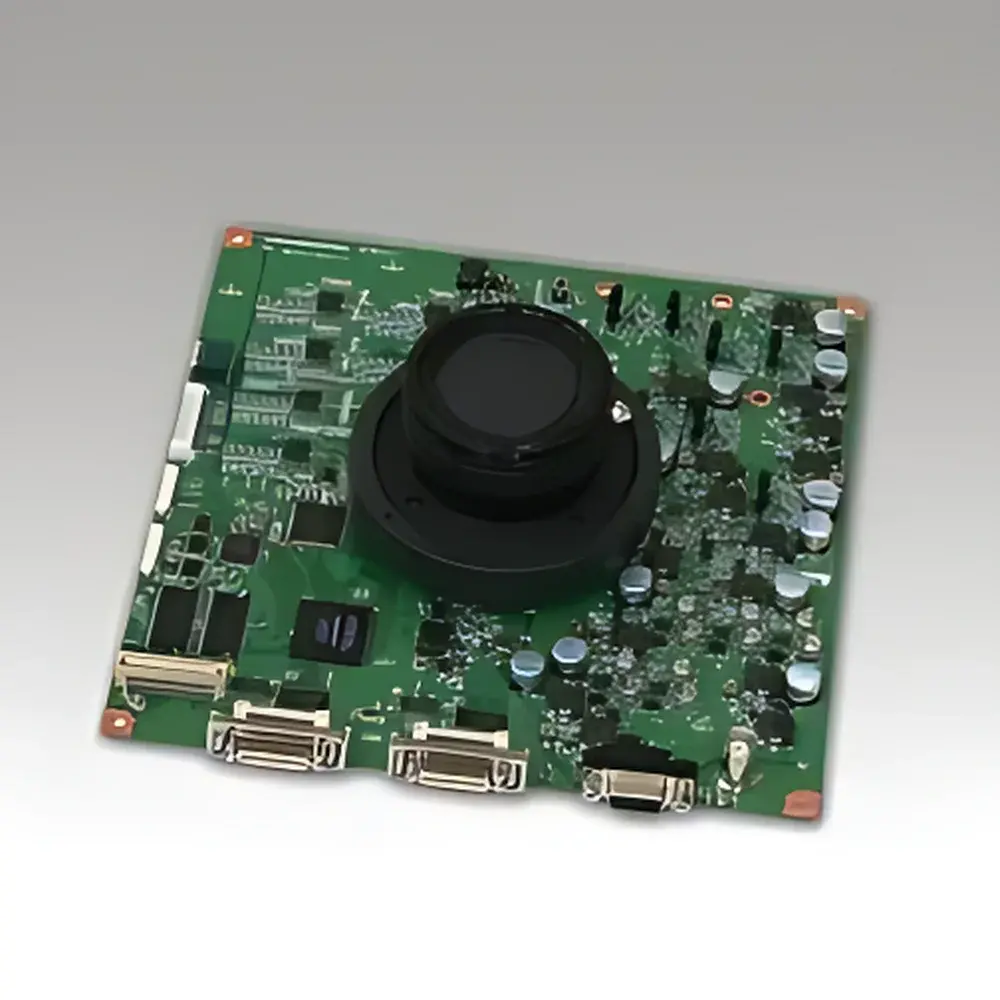
Hamamatsu C10000-201 TDI CCD Camera
| Brand | Hamamatsu |
|---|---|
| Origin | Japan |
| Manufacturer | Hamamatsu Photonics K.K. |
| Product Type | Back-illuminated TDI CCD Imaging Camera |
| Model | C10000-201 |
| Sensor Format | 2048 × 128 pixels |
| Pixel Size | 12 µm × 12 µm |
| Effective Area | 24.58 mm × 1.536 mm |
| TDI Line Rate | 0.45 kHz to 50 kHz |
| Readout Modes | TDI or Frame Readout |
| TDI Transfer Direction | Bidirectional |
| Overflow Protection | Lateral overflow drain (100×) |
| Output Channels | 4-tap (512 × 4) |
| Pixel Clock Rate | 30 MHz/pixel |
| Full Well Capacity | 100,000 e⁻ (typ.) |
| Read Noise | 130 e⁻ rms (typ.) |
| Dynamic Range | 770:1 |
| Analog Gain | 1×–10× (16 steps) |
| A/D Resolution | 8-bit or 12-bit selectable |
| Interface | Camera Link (Medium Configuration) |
| Power Supply | DC +15 V & +5 V |
| Power Consumption | 20 W |
| Operating Temperature | 0 °C to +40 °C |
| Storage Temperature | −10 °C to +50 °C |
| Relative Humidity | ≤70 % non-condensing |
| Lens Mount | F-mount |
Overview
The Hamamatsu C10000-201 is a high-performance, back-illuminated Time-Delay Integration (TDI) CCD camera engineered for demanding industrial and scientific imaging applications where simultaneous high sensitivity, high speed, and exceptional signal-to-noise ratio are critical. Unlike conventional line-scan or area-scan sensors, the C10000-201 leverages TDI architecture—a synchronized charge-transfer technique in which photogenerated electrons are shifted row-by-row across the sensor in precise temporal alignment with the motion of the target object. This enables continuous integration over multiple rows (128 stages), effectively amplifying weak optical signals without sacrificing spatial resolution or frame rate. The result is a robust solution for low-light, high-throughput scanning scenarios—particularly where subject motion is linear, consistent, and predictable, such as in semiconductor wafer inspection, flat-panel display (FPD) metrology, PCB automated optical inspection (AOI), and fluorescence-based life science assays requiring extended dwell time under limited illumination.
Key Features
- Back-illuminated CCD architecture delivering quantum efficiency exceeding 90 % across UV (200 nm) to near-infrared (1000 nm) wavelengths
- 2048 × 128 pixel array with 12 µm square pixels and 100 % fill factor—optimized for maximum photon collection efficiency
- Programmable TDI line rates from 0.45 kHz to 50 kHz, supporting both internal serial command configuration and external trigger synchronization
- Bidirectional TDI transfer capability, enabling flexible integration into conveyor-based or stage-driven inspection systems
- Lateral overflow drain structure providing 100× anti-blooming protection—critical for maintaining image fidelity during high-contrast inspections
- Dual readout modes: high-speed TDI mode for quantitative measurement and frame-readout mode for real-time focusing and system alignment
- 4-tap parallel output architecture with 30 MHz/pixel clock rate, ensuring minimal readout latency and high data throughput
- Selectable 8-bit or 12-bit digitization via Camera Link serial interface—balancing speed, dynamic range, and downstream processing requirements
- Integrated analog gain control (1×–10×, 16 discrete steps) for adaptive signal conditioning under variable illumination conditions
Sample Compatibility & Compliance
The C10000-201 is compatible with standard F-mount optics and supports mechanical and optical integration into ISO/IEC 17025-aligned metrology platforms. Its spectral response, noise floor, and linearity characteristics comply with key performance benchmarks referenced in ASTM E2720 (Standard Guide for Evaluation of Line-Scan Cameras) and ISO 15739 (Imaging Sensors — Noise Measurements). While not certified as a medical device, its stability, repeatability, and audit-ready configuration options—including deterministic exposure timing and hardware-triggered acquisition—support GLP-compliant workflows in R&D laboratories and GMP-regulated production environments. The camera’s sealed, fanless enclosure and wide operating temperature range (0–40 °C) ensure reliable operation in controlled cleanroom settings typical of semiconductor fabrication and display manufacturing facilities.
Software & Data Management
The C10000-201 interfaces natively via Camera Link (Medium Configuration), supporting full bandwidth data streaming at up to 50 kHz line rate with minimal jitter. Hamamatsu provides the HCImage Live software suite for acquisition, real-time histogram analysis, and basic calibration (dark frame subtraction, flat-field correction). For integration into custom machine vision architectures, the camera supports GenICam-compliant register-level control through the Camera Link serial channel, enabling seamless interoperability with third-party frameworks such as HALCON, OpenCV, and National Instruments Vision Builder. All acquisition parameters—including TDI stage count, line rate, gain, offset, and A/D bit depth—are programmable and persistently stored in non-volatile memory. Audit trails of configuration changes can be logged externally via host-side timestamping, satisfying traceability requirements under FDA 21 CFR Part 11 when deployed in regulated quality assurance processes.
Applications
- High-resolution, low-light inspection of silicon wafers, reticles, and photomasks in semiconductor front-end process control
- Automated defect detection on large-area substrates including TFT-LCD, OLED, and microLED panels
- Fluorescence lifetime imaging (FLIM) and time-resolved spectroscopy where photon-starved conditions necessitate integrated signal accumulation
- High-speed sorting and grading of biological samples (e.g., cell suspensions, microbeads) in flow cytometry-adjacent instrumentation
- Precision dimensional metrology of continuously moving components—such as wire, foil, or extruded profiles—in metal and polymer manufacturing
- Scientific applications requiring long-exposure line-scan data with sub-pixel registration stability, including astronomical slit spectroscopy and synchrotron beamline diagnostics
FAQ
What is the primary advantage of TDI over conventional line-scan imaging?
TDI improves signal-to-noise ratio by integrating charge across multiple rows synchronized to object motion—effectively increasing effective exposure time without motion blur, unlike static line-scan sensors that require higher illumination or slower scan speeds.
Can the C10000-201 operate in true area-scan mode?
No—it does not support full-frame integration like an area-scan CCD. The “frame readout mode” is a diagnostic mode for focus verification only; it reads all 128 rows simultaneously but does not perform TDI charge transfer and is unsuitable for quantitative measurement.
Is cooling available for extended exposure applications?
The C10000-201 is air-cooled and operates at ambient temperature. For applications requiring sub-zero sensor temperatures to reduce dark current, Hamamatsu offers thermoelectrically cooled variants (e.g., C10000-202 series) upon request.
How is synchronization achieved between camera and motion stage?
Synchronization is supported via TTL-compatible external trigger input (BNC), allowing precise alignment of TDI line rate with encoder-derived position feedback from motorized stages or conveyors.
Does the camera support ROI readout or binning?
No—the C10000-201 implements fixed-format readout. Region-of-interest extraction and pixel binning must be performed in post-processing or by downstream FPGA-based preprocessing units.



