
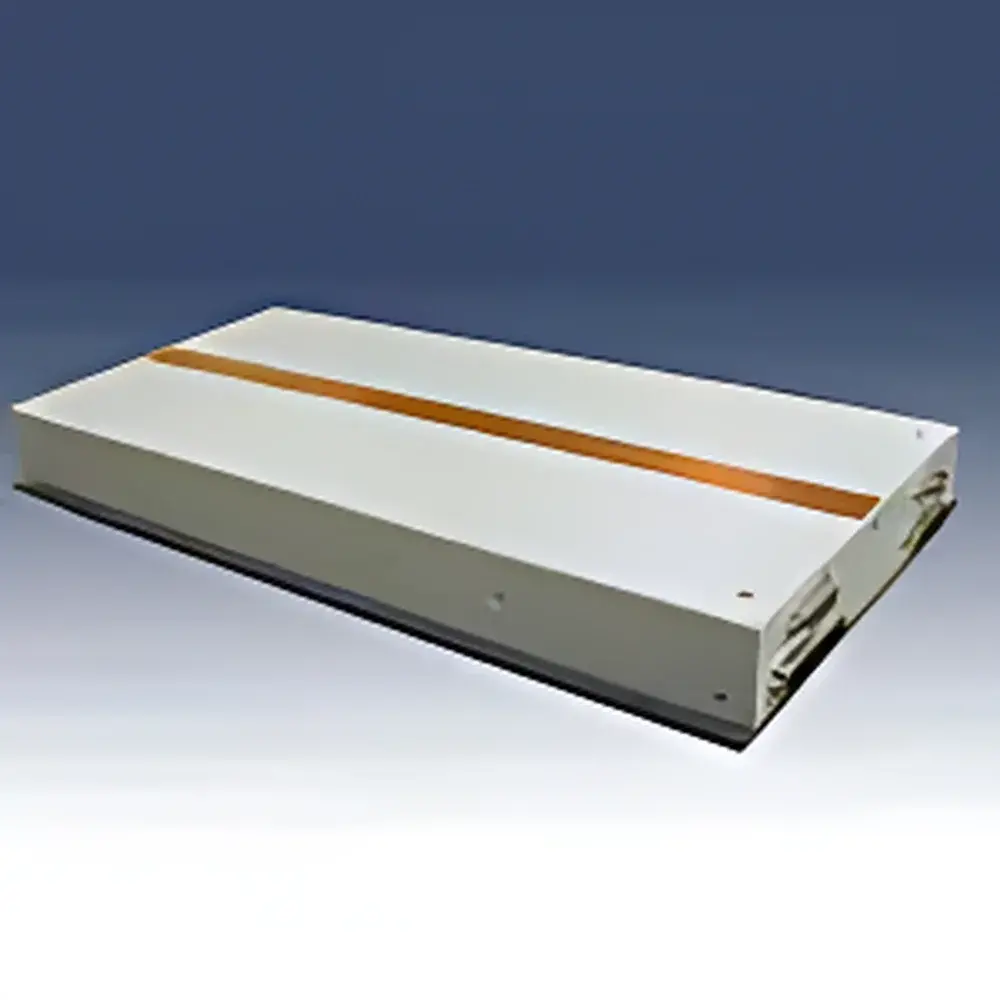
Hamamatsu C10800 Dual-Energy Line-Scan X-ray Camera
| Brand | Hamamatsu |
|---|---|
| Origin | Japan |
| Manufacturer Type | Original Equipment Manufacturer (OEM) |
| Import Status | Imported |
| Model | C10800 |
| Pricing | Available Upon Request |
Overview
The Hamamatsu C10800 Dual-Energy Line-Scan X-ray Camera is a high-performance, OEM-integrated imaging sensor engineered for industrial and security applications requiring material-specific discrimination via dual-energy X-ray absorption spectroscopy. Unlike conventional single-energy radiography systems, the C10800 employs synchronized, time-resolved acquisition of two distinct X-ray energy spectra—typically achieved through pulsed X-ray sources or rapid kV switching—to generate spatially registered low- and high-energy line-scan image pairs. By analyzing differential attenuation coefficients across energies, the system enables quantitative estimation of effective atomic number (Zeff) and electron density, facilitating robust material decomposition (e.g., organic/inorganic/metal differentiation) without reliance on prior spectral calibration libraries. Its linear array architecture—comprising custom-designed, radiation-hardened CMOS or CCD photodiode structures coupled with low-noise charge integration circuitry—ensures stable, high-fidelity signal capture under continuous conveyor-based scanning conditions typical in automated inspection lines.
Key Features
- Dual-energy spectral acquisition architecture supporting real-time material classification based on Zeff and mass attenuation contrast
- 12-bit digital output interface (LVDS or Camera Link) ensuring high dynamic range (>70 dB) and quantization fidelity for low-contrast feature detection
- Precision optical and geometric registration between low- and high-energy channels, minimizing misalignment-induced decomposition artifacts
- Radiation-tolerant sensor design optimized for sustained operation under industrial X-ray flux (up to 150 kVp, pulsed or continuous)
- Modular mechanical footprint compatible with standard line-scan integration rails and thermal management subsystems
- OEM-ready firmware architecture supporting user-defined trigger synchronization, exposure timing, and gain/offset calibration routines
Sample Compatibility & Compliance
The C10800 is designed for non-destructive evaluation of heterogeneous bulk materials conveyed at speeds up to 1.2 m/s, including packaged food products, pharmaceutical blister packs, luggage, scrap metal streams, and mineral ore belts. It complies with IEC 61000-6-3 (EMC emission limits) and IEC 61000-6-2 (immunity requirements) for industrial environments. While not a standalone medical device, its performance characteristics align with ASTM F792 (Standard Practice for Characterizing Performance of X-ray Security Inspection Systems) and supports traceable calibration per ISO/IEC 17025 when integrated into accredited inspection platforms. The sensor housing meets IP54 ingress protection specifications and operates within ambient temperatures of 0–40 °C with controlled humidity (≤80% RH, non-condensing).
Software & Data Management
Hamamatsu provides the C10800 with SDKs for Windows/Linux (C/C++, Python bindings) enabling direct memory-mapped frame acquisition, hardware-level synchronization control, and pixel-level gain/offset correction. Raw dual-energy line data can be streamed to host systems for real-time material decomposition using proprietary or third-party algorithms—including ratio-based Z-discrimination, basis material decomposition (BMD), or machine learning–enhanced classification pipelines. All acquired metadata (exposure time, energy mode, temperature, sensor ID) are embedded in compliant TIFF or HDF5 containers. When deployed in regulated environments (e.g., pharmaceutical QC or customs screening), the system supports audit-trail logging and user-access controls compatible with FDA 21 CFR Part 11–compliant software frameworks.
Applications
- Food safety inspection: Detection of foreign bodies (bone, stone, plastic) and compositional anomalies (fat/water ratio mapping in meat products)
- Pharmaceutical quality assurance: Identification of tablet coating defects, counterfeit drug detection via density/Z-profile deviation
- Security screening: Automated threat recognition (explosives, narcotics) in baggage and cargo using atomic number thresholds
- Recycling & resource recovery: Real-time sorting of aluminum, copper, stainless steel, and rare-earth-containing components from mixed e-waste streams
- Mineralogical analysis: Discrimination of hematite, ilmenite, and monazite in raw ore feed based on characteristic attenuation signatures
- Automotive component verification: Validation of composite brake pad composition and absence of metallic contaminants
FAQ
What X-ray source configurations are compatible with the C10800?
The camera supports both pulsed dual-kV sources (e.g., 60/120 kVp alternating pulses) and single-source systems with fast kV switching or energy-selective filters; Hamamatsu provides timing reference signal specifications for precise synchronization.
Does the C10800 include on-board material decomposition processing?
No—it delivers calibrated dual-energy line data for external processing; real-time decomposition requires integration with a dedicated host system running validated algorithms.
Can the C10800 be operated in single-energy mode?
Yes; users may configure either energy channel independently for conventional radiographic imaging or use one channel as a reference for scatter correction.
What is the typical spatial resolution achievable with the C10800 series?
Effective resolution depends on focal spot size, source-to-detector geometry, and pixel pitch (e.g., 0.4 mm or 0.2 mm variants); under optimal magnification, MTF50 exceeds 2.5 lp/mm.
Is factory recalibration required after long-term deployment?
Periodic gain/offset and linearity verification is recommended every 6 months; Hamamatsu offers NIST-traceable calibration services and reference test patterns for in-house validation.




