
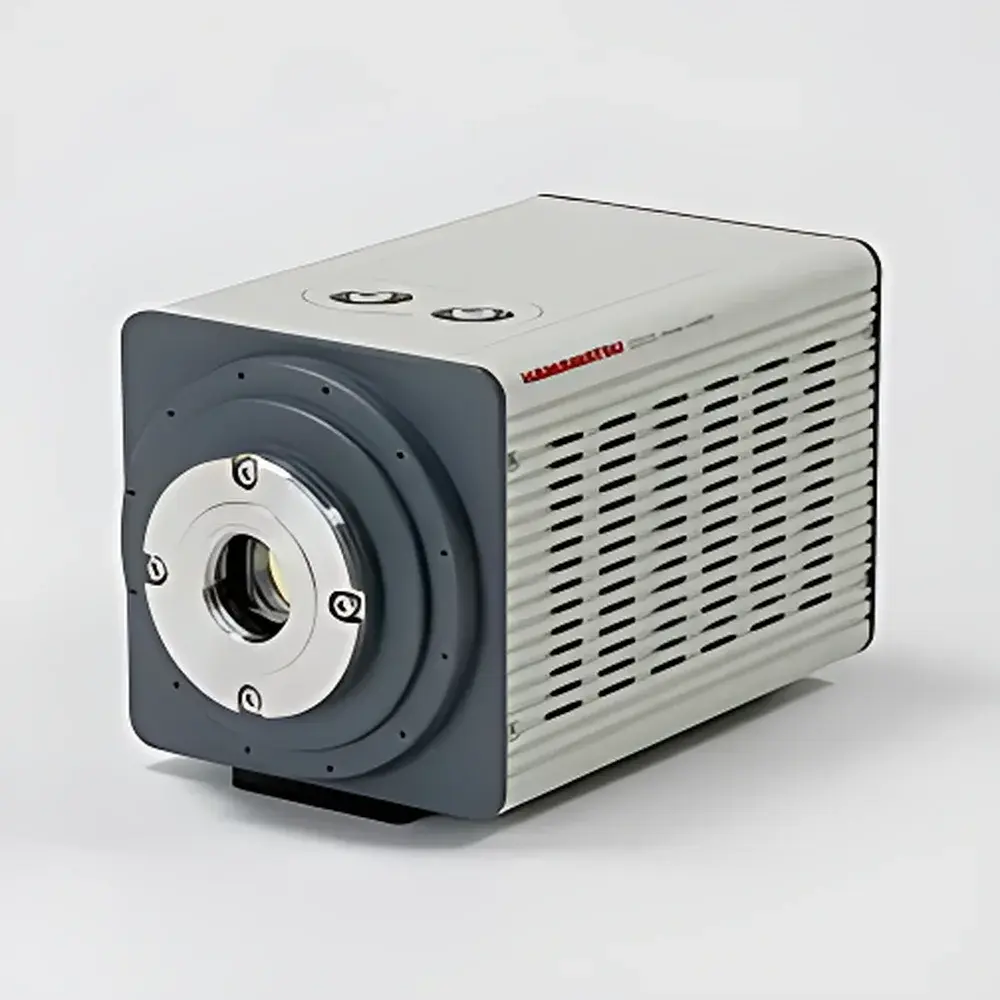
Hamamatsu C12741-11 InGaAs Near-Infrared Camera
| Brand | Hamamatsu |
|---|---|
| Origin | Japan |
| Manufacturer | Hamamatsu Photonics K.K. |
| Type | Imported |
| Model | C12741-11 |
| Price | Upon Request |
| Effective Pixels | 640 (H) × 512 (V) |
| Pixel Size | 20 µm (H) × 20 µm (V) |
| Active Area | 12.8 mm (H) × 10.24 mm (V) |
| Full Well Capacity | 300,000 e⁻ |
| Cooling Method | Peltier (Forced Air: −60 °C |
| Water Cooling | −70 °C) |
| Readout Speed | 7.2 fps |
| Read Noise (rms, typical) | 500 e⁻ |
| Dark Current (typical) | 300 e⁻/pix/s (−60 °C, air-cooled) |
| Digital Output | 16-bit |
| Exposure Time | 138.5 ms – 10 s (rolling shutter) |
| Trigger Modes | Edge, Level, Start |
| Delay | 0–10 s (10 µs step) |
| Trigger I/O | SMA / CameraLink interface |
| Pixel Binning | 2×2, 4×4 |
| Interface | CameraLink Base Configuration |
| Lens Mount | C-mount |
| Power Supply | AC 100–240 V, 50/60 Hz |
| Power Consumption | ~150 VA |
| Operating Temp. | 10–40 °C |
| Humidity | 30–80% RH (non-condensing, forced-air mode) |
| Storage Temp. | −10–50 °C |
| Humidity | ≤90% RH (non-fogging) |
Overview
The Hamamatsu C12741-11 is a high-performance, thermoelectrically cooled InGaAs near-infrared (NIR) imaging camera engineered for quantitative scientific and industrial applications requiring stable, low-noise detection in the 900–1700 nm spectral range. Unlike silicon-based CCD or CMOS sensors, the indium gallium arsenide (InGaAs) focal plane array (FPA) delivers intrinsic quantum efficiency exceeding 70% across the SWIR band—enabling high-fidelity imaging of weak NIR emissions that are otherwise undetectable with visible-light sensors. Its 640 × 512 pixel format, coupled with 20 µm square pixels and a 12.8 mm × 10.24 mm active area, provides an optimal balance between spatial resolution and sensitivity for optical systems with moderate f-number optics. The integrated two-stage Peltier cooler achieves sensor stabilization at −70 °C under water-cooling conditions, suppressing dark current to 130 e⁻/pix/s—a critical capability for long-exposure applications such as photoluminescence mapping, low-light spectroscopy, or time-resolved NIR imaging.
Key Features
- High-sensitivity InGaAs sensor with extended spectral response from 900 nm to 1700 nm
- Deep-cooling architecture: dual-mode thermal management—switchable between forced-air (−60 °C) and water-cooling (−70 °C) configurations for adaptability across lab and industrial environments
- Low read noise (500 e⁻ rms, typical) and ultra-low dark current (130 e⁻/pix/s at −70 °C), ensuring high dynamic range and SNR stability over multi-second exposures
- Dual-shutter operation: configurable rolling shutter (138.5 ms – 10 s) and global shutter (100 µs – 10 s) modes for flexible synchronization with pulsed light sources or mechanical scanning stages
- Programmable trigger I/O suite including edge/level/start triggering, adjustable delay (0–10 s, 10 µs resolution), and three user-defined timing outputs for integration into automated test benches or synchronized multi-camera systems
- CameraLink Base interface with Mini-CameraLink connector ensures deterministic, low-latency data transfer compatible with standard frame grabbers used in machine vision and research-grade acquisition platforms
- C-mount lens interface supports wide compatibility with off-the-shelf NIR objectives, telecentric lenses, and custom optical assemblies
Sample Compatibility & Compliance
The C12741-11 is designed for non-destructive, label-free NIR imaging of optically translucent or semi-transparent samples. It is routinely deployed in semiconductor metrology (e.g., electroluminescence and photoluminescence inspection of GaAs, InP, and perovskite solar cells), preclinical small-animal imaging (e.g., NIR-II fluorescence angiography), and fiber-optic component characterization (e.g., laser diode far-field profiling, waveguide coupling efficiency). While not certified for medical device use under FDA 510(k) or IEC 62304, its hardware architecture and firmware design support GLP/GMP-aligned workflows when integrated into validated systems—including audit-trail-capable acquisition software, timestamped metadata embedding, and deterministic trigger logging. All operational parameters adhere to IEC 61000-6-2 (immunity) and IEC 61000-6-3 (emission) standards for laboratory equipment.
Software & Data Management
Hamamatsu provides the DCAM-SDK (v4.x), a cross-platform C/C++ and .NET API supporting Windows and Linux, enabling full control over exposure, gain, binning, ROI selection, and trigger configuration. Third-party compatibility includes MATLAB Image Acquisition Toolbox, Python (via PyHamamatsu or OpenCV bindings), and National Instruments LabVIEW through CameraLink drivers. Raw 16-bit image streams preserve full photon-counting fidelity for post-acquisition calibration—essential for radiometric quantification in reflectance, transmission, or emission measurements. Metadata (exposure time, sensor temperature, trigger source, binning mode) is embedded in each frame header using standardized TIFF or HDF5 container formats, facilitating traceability in regulated environments.
Applications
- Solar cell and semiconductor wafer evaluation: defect localization via electroluminescence (EL) and photoluminescence (PL) imaging at 1000–1400 nm
- Preclinical NIR-II fluorescence imaging: real-time vascular dynamics and tumor targeting studies in murine models
- Optical communications: characterization of VCSELs, DFB lasers, and multimode fiber output profiles
- Astronomical instrumentation: adaptive optics wavefront sensing and low-light sky background monitoring in ground-based NIR observatories
- Industrial process monitoring: non-contact thermal mapping of composite curing, battery electrode drying, or polymer extrusion under ambient illumination
FAQ
What cooling method is required to achieve −70 °C sensor temperature?
Water cooling is mandatory; the −70 °C specification assumes a stable coolant inlet temperature of +25 °C and adequate flow rate (≥1.5 L/min). Forced-air cooling achieves only −60 °C.
Can the C12741-11 operate in global shutter mode at full resolution and maximum frame rate?
Yes—global shutter mode supports 7.2 fps at full 640 × 512 resolution, with minimum exposure of 100 µs. Frame rate remains constant regardless of exposure duration in this mode.
Is pixel non-uniformity correction (NUC) supported in real time?
Yes—the DCAM-SDK includes factory-calibrated offset/gain lookup tables, and users may acquire custom NUC frames (dark reference + flat-field) for application-specific correction routines.
Does the camera support GenICam compliance?
No—the C12741-11 uses Hamamatsu’s proprietary DCAM protocol over CameraLink; GenICam-compliant alternatives require migration to Hamamatsu’s newer ORCA-Fusion BT or INFINITY series.
What is the recommended lens mount adapter for infinity-corrected NIR objectives?
A standard C-mount to infinity-corrected tube lens adapter (e.g., Thorlabs SM1A9 or equivalent) is required; working distance and magnification must be verified against the 12.8 mm × 10.24 mm sensor diagonal.





