
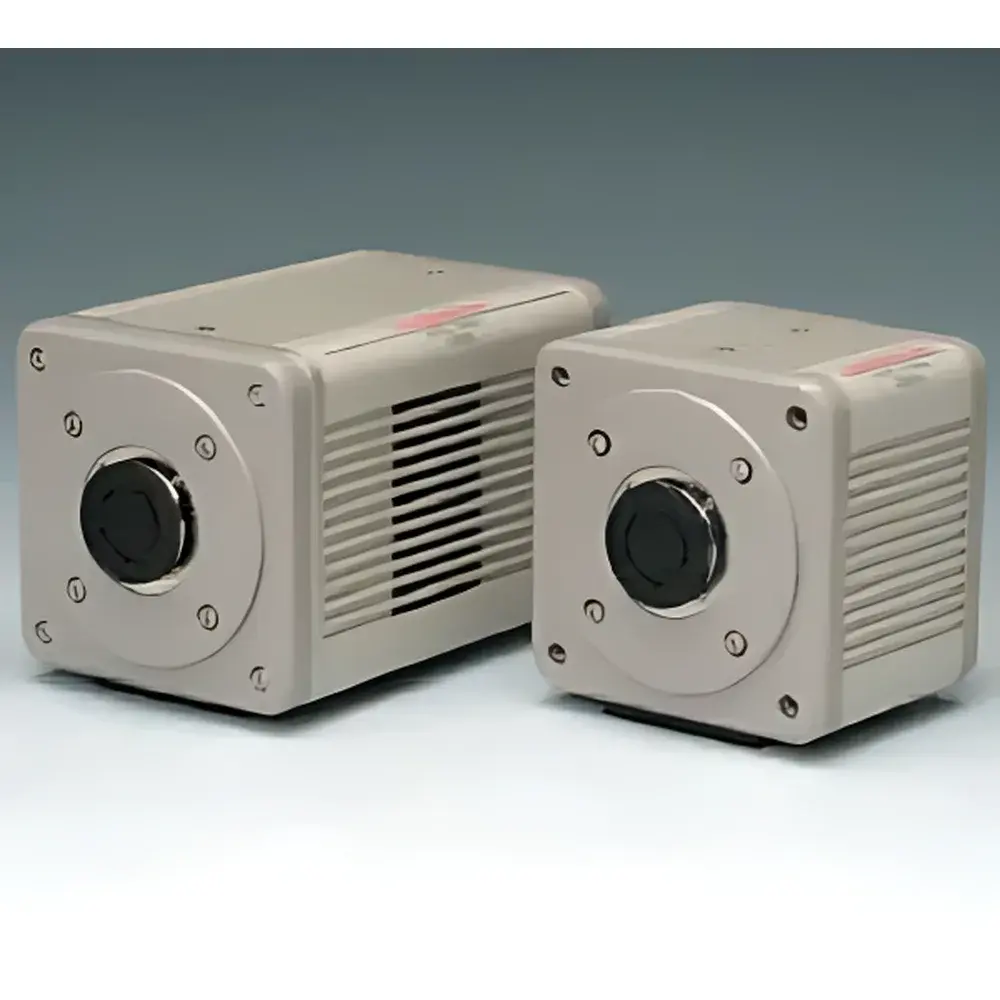
Hamamatsu C8800 Scientific-Grade Cooled CCD Camera for Continuous High-Speed Imaging
| Origin | Japan |
|---|---|
| Manufacturer Type | Authorized Distributor |
| Origin Category | Imported |
| Model | C8800 |
| Pricing | Available Upon Request |
| Sensor Type | Frame-Transfer CCD |
| Resolution | 1000 × 1000 pixels |
| Pixel Size | 8 µm × 8 µm |
| Active Area | 8 mm × 8 mm |
| Pixel Clock Frequency | 40 MHz per channel |
| Frame Rate | 33 fps (full resolution, binning off) |
| Read Noise | 25 e⁻ rms |
| Full Well Capacity | 23,000 e⁻ |
| Dynamic Range | 920:1 (typical) |
| A/D Conversion | 12-bit |
| Exposure Time Range | 500 µs – 1 s (C8800-01C) |
| Contrast Enhancement | 1× to 5× (programmable) |
| Cooling Method | Forced-gas thermoelectric cooling (C8800-21C) |
| Operating Sensor Temperature | −20 °C (C8800-21C) |
| Dark Current | 25 e⁻/pixel/s (at −20 °C, C8800-21C) |
| Spectral Response | 400 nm – 1100 nm |
| Lens Interface | Vacuum-sealed lens mount (C8800-21C) |
| Mechanical Shutter | Not integrated |
Overview
The Hamamatsu C8800 is a scientific-grade, thermoelectrically cooled frame-transfer CCD camera engineered for continuous high-speed imaging under low-light and time-resolved conditions. Based on a 1000 × 1000 pixel monochrome CCD sensor with 8 µm square pixels, the C8800 delivers high quantum efficiency across a broad spectral range—from 400 nm in the visible to 1100 nm in the near-infrared (NIR). Its architecture supports sustained acquisition at 33 full-frame frames per second without image smearing, enabled by true frame-transfer readout and optimized clocking at 40 MHz per channel. Two variants are available: the C8800-01C, optimized for general-purpose high-speed applications, and the C8800-21C, featuring vacuum-sealed optical interface and active forced-gas thermoelectric cooling to −20 °C—critical for suppressing dark current and enabling long-exposure NIR imaging with high signal fidelity.
Key Features
- High-speed frame-transfer CCD architecture enabling true 33 fps full-resolution imaging without mechanical shutter dependency
- Broad spectral sensitivity (400–1100 nm) with peak QE >60% in visible and >35% at 1000 nm—ideal for NIR-sensitive applications such as silicon wafer inspection and fluorescence lifetime studies
- Low-noise performance: 25 e⁻ rms read noise and 25 e⁻/pixel/s dark current (at −20 °C), supporting quantitative intensity measurements over extended integration periods
- 12-bit analog-to-digital conversion with 920:1 dynamic range, preserving contrast across weak and saturated signal regions within a single frame
- Programmable contrast enhancement (1×–5×) applied in real time during acquisition—useful for visualizing low-contrast features without post-processing latency
- Vacuum-sealed lens mount (C8800-21C) ensures stable optical alignment and eliminates condensation or outgassing in vacuum or controlled-environment chambers
- No integrated mechanical shutter—reducing moving parts, improving reliability, and eliminating timing jitter; exposure control is fully electronic via programmable integration gates
Sample Compatibility & Compliance
The C8800 is compatible with standard C-mount and F-mount optics via optional adapters, and its vacuum-compatible variant (C8800-21C) integrates seamlessly into ultra-high-vacuum (UHV) systems up to 10⁻⁷ Pa. The camera complies with CE marking requirements for electromagnetic compatibility (EMC Directive 2014/30/EU) and low-voltage safety (LVD Directive 2014/35/EU). While not certified for IEC 61000-4 immunity testing out-of-box, its shielded enclosure and differential signaling support robust operation in electromagnetically noisy laboratory environments typical of laser labs and synchrotron beamlines. Data integrity meets GLP-aligned acquisition standards when used with Hamamatsu’s HCImage Live software, which logs timestamped metadata—including exposure duration, temperature, gain, and sensor bias—for audit-ready traceability.
Software & Data Management
The C8800 operates natively with Hamamatsu’s HCImage Live—a Windows-based acquisition platform supporting real-time display, histogram analysis, region-of-interest (ROI) statistics, and multi-channel time-series logging. All acquired images are saved in TIFF or HDF5 format with embedded EXIF-style metadata (e.g., sensor temperature, exposure time, pixel clock rate). The SDK (HCImage SDK v5.x) provides C++, Python (via ctypes), and MATLAB interfaces for custom automation, including trigger-synchronized acquisition, external hardware synchronization (TTL/RS-422), and integration into LabVIEW or EPICS-based control systems. Raw 12-bit data can be exported losslessly, preserving full dynamic range for downstream quantitative analysis in ImageJ/Fiji, MATLAB, or Python-based pipelines (e.g., scikit-image, NumPy).
Applications
- NIR wafer metrology: Detection of subsurface defects and dopant distribution in silicon wafers using 900–1100 nm illumination
- Time-resolved microscopy: Long-duration, low-light observation of live-cell dynamics, bioluminescence, or phosphorescent decay kinetics
- Ballistics and fluid dynamics: Continuous imaging of supersonic projectiles or turbulent flow structures at fixed 33 fps with precise inter-frame timing
- Plasma diagnostics: Intensity mapping of transient emission spectra from pulsed plasma sources under gated or free-running modes
- Quantitative photometry: Calibration-enabled radiance measurement in optical test benches, requiring stable dark reference and linear response verification per ISO 15739
FAQ
Does the C8800 support hardware triggering for synchronized multi-camera acquisition?
Yes—the C8800 features TTL-compatible input/output trigger ports supporting start-trigger, exposure-gate, and frame-readout synchronization with sub-microsecond jitter.
Is the vacuum seal on the C8800-21C rated for bake-out procedures?
The C8800-21C is rated for static vacuum operation up to 10⁻⁷ Pa; however, it is not designed for in-situ bake-out above 60 °C. External baking of the chamber is recommended prior to mounting.
Can the 12-bit raw data be converted to 16-bit without interpolation?
No—data is inherently 12-bit. However, HCImage Live allows saving as 16-bit TIFF with zero-padding, preserving bit depth integrity for downstream tools that require uniform word length.
What is the maximum cable length supported between the camera head and controller unit?
The standard Camera Link interface supports up to 10 m with compliant cables; fiber-optic extenders (e.g., BitFlow Cyton FX-CL) enable distances beyond 100 m without signal degradation.
Is firmware update capability available remotely?
Firmware updates require local connection via USB and must be performed using Hamamatsu’s official Flash Programmer utility—no remote update functionality is implemented for security and stability reasons.





