
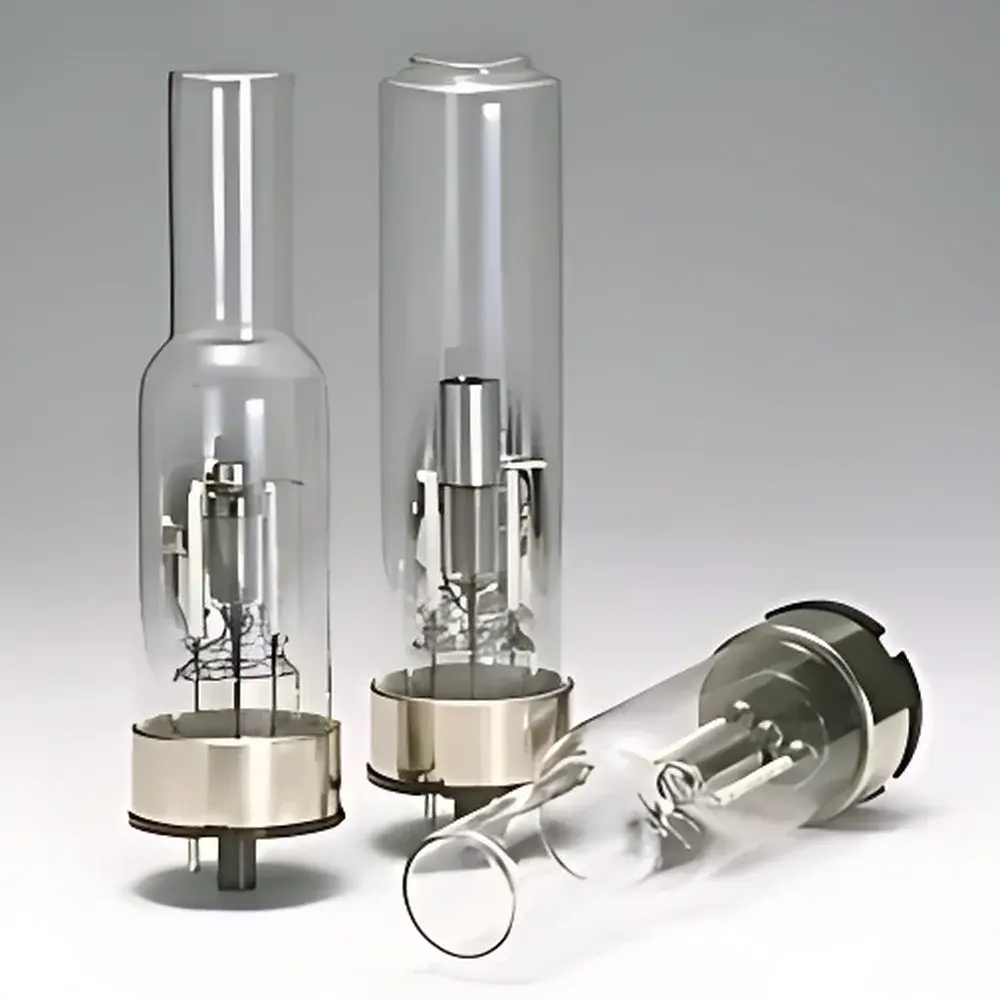
Hamamatsu Hollow Cathode Lamp L2 Series
| Brand | Hamamatsu |
|---|---|
| Origin | Japan |
| Manufacturer Type | Original Equipment Manufacturer (OEM) |
| Import Status | Imported |
| Model | L2 |
| Light Source Type | Hollow Cathode Lamp (HCL) |
| Illumination Mode | External Irradiation |
| Element Options | Single-element (66 types, e.g., Ag, Al, As, Na, K, Ca, Mg) and Multi-element (7 types, e.g., Na–K, Ca–Mg) |
| Spectral Output | Element-specific narrow emission lines (e.g., Na 589.0 nm, Mg 285.21 nm, Al 309.27 nm, Si 251.61 nm, K 766.49 nm, D₂ 241–400 nm continuum, Ca 422.67 nm, Sc 391.18 nm, Ti 364.27 nm, V 318.4 nm) |
Overview
The Hamamatsu Hollow Cathode Lamp (HCL) L2 Series is a precision-engineered spectral light source designed exclusively for atomic absorption spectroscopy (AAS). Operating on the principle of low-pressure gas discharge within a sealed quartz envelope, each lamp generates intense, narrow-linewidth emission at the characteristic resonance wavelengths of its cathode material—enabling highly selective and sensitive elemental quantification. The L2 platform integrates Hamamatsu Photonics’ decades of expertise in vacuum ultraviolet (VUV) to near-infrared (NIR) optoelectronic device fabrication, delivering exceptional spectral purity, long-term radiometric stability, and low background noise. These lamps serve as the primary radiation source in flame AAS (FAAS) and graphite furnace AAS (GFAAS) systems, where accurate line identification, minimal self-absorption, and reproducible intensity output are critical for trace metal analysis down to sub-pptr concentration levels.
Key Features
- High-purity sintered metal or alloy cathodes ensuring stable, low-noise emission with minimal spectral drift over extended operational life
- Optimized gas fill (typically Ne or Ar) and pressure control to maximize line intensity while minimizing continuum background and self-reversal effects
- Quartz or fused silica envelope with high UV transmission (>85% at 190 nm), supporting reliable operation across the full AAS wavelength range (185–900 nm)
- Robust mechanical design compliant with standard AAS lamp sockets (e.g., PerkinElmer, Thermo Fisher, Shimadzu, Agilent), enabling seamless integration without adapter modification
- Factory-calibrated spectral output verified via NIST-traceable spectroradiometric measurement; spectral profiles include full-width-at-half-maximum (FWHM) ≤ 0.002 nm for most elements
- D₂ continuum lamp variant (L233-1DQ) provided for background correction in deuterium arc mode, covering 241–400 nm with uniform irradiance profile
Sample Compatibility & Compliance
The L2 Series supports quantitative analysis of over 66 single elements—including Ag, Al, As, Ca, Cr, Cu, Fe, K, Mg, Mn, Na, Ni, Pb, Zn—and 7 multi-element combinations such as Na–K and Ca–Mg. Each lamp is validated for use with aqueous, acid-digested, and organic solvent-based samples under standard EPA Method 200.7, ISO 11885, ASTM D1688, and USP protocols. All units are manufactured in Hamamatsu’s ISO 9001-certified facilities in Japan and conform to IEC 61000-6-3 (EMC) and IEC 61010-1 (safety) standards. Traceability documentation—including batch-specific spectral data sheets and calibration certificates—is supplied with every shipment to support GLP/GMP audit readiness and laboratory accreditation (e.g., ISO/IEC 17025).
Software & Data Management
While the L2 lamp itself is a passive optical component, its performance is fully interoperable with modern AAS instrument control software platforms—including Thermo Fisher SOLAAR, PerkinElmer WinLab32, and Agilent AA Data Manager. Integrated lamp recognition protocols auto-identify element type and recommended operating current, reducing setup time and operator error. Instrument firmware logs lamp usage hours, ignition cycles, and spectral intensity trends—enabling predictive maintenance and alignment with FDA 21 CFR Part 11 requirements for electronic record integrity and audit trail generation. Raw spectral data can be exported in CSV or ASCII format for third-party chemometric analysis or LIMS integration.
Applications
- Environmental monitoring: Quantification of heavy metals (Pb, Cd, Hg, As) in drinking water, wastewater, and soil extracts per EPA 200.9 and ISO 17294-2
- Clinical toxicology: Measurement of essential (Ca, Mg, Zn) and toxic (Cu, Fe, Pb) elements in serum, whole blood, and urine matrices
- Pharmaceutical quality control: Elemental impurity testing in active pharmaceutical ingredients (APIs) and excipients aligned with ICH Q3D guidelines
- Food safety compliance: Screening for nutritional minerals and contaminant metals in dairy, cereals, infant formula, and dietary supplements
- Geological and metallurgical analysis: Multi-element determination in ore digests, slag, and alloy samples using sequential or simultaneous AAS configurations
FAQ
What is the typical lifetime of an L2-series hollow cathode lamp under standard operating conditions?
Under recommended current settings (typically 5–20 mA depending on element), the L2 lamp achieves ≥ 5,000 mAh total charge throughput, corresponding to approximately 1,000–2,000 hours of intermittent use.
Can L2 lamps be used interchangeably between different AAS instrument brands?
Yes—mechanical and electrical interfaces comply with international AAS lamp standards (e.g., DIN 1319-3, JIS K 0121); however, optimal spectral alignment requires verification via instrument-specific wavelength calibration routines.
Is spectral certification provided for each lamp unit?
Each L2 lamp ships with a factory-issued spectral verification report listing peak wavelength, relative intensity, FWHM, and background signal at 1 nm resolution—traceable to Hamamatsu’s internal reference spectroradiometer calibrated against NIST SRM 1930a.
How should L2 lamps be stored to preserve performance?
Store upright in original packaging at 15–25°C, <60% RH, away from direct UV exposure; avoid mechanical shock or thermal cycling prior to installation.
Does Hamamatsu offer custom multi-element lamp configurations beyond the standard 7 types?
Custom cathode formulations and dual/triple-element lamps are available under OEM agreement, subject to minimum order quantity and lead-time validation through Hamamatsu’s Technical Solutions Group.





