
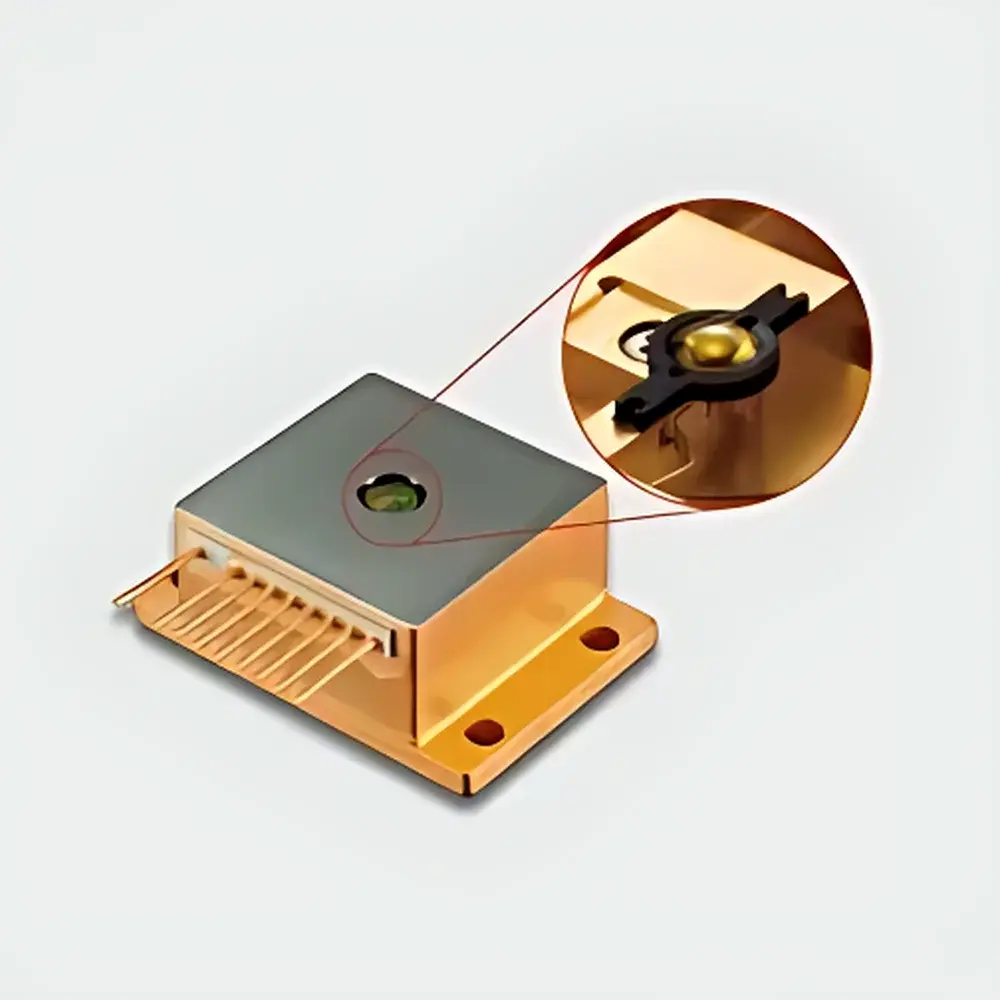
Hamamatsu L12004-2190H-E Quantum Cascade Laser (QCL) Module
| Brand | Hamamatsu |
|---|---|
| Origin | Japan |
| Manufacturer Type | Original Equipment Manufacturer (OEM) |
| Product Category | Imported |
| Model | L12004-2190H-E |
| Type | Distributed Feedback (DFB) Continuous-Wave (CW) QCL |
| Peak Emission Wavelength (Typ.) | 4.57 µm |
| Operating Temperature Range (QCL) | 10–50 °C |
| Spectral Linewidth (Max.) | 0.2 cm⁻¹ |
| Tuning Range (Min.) | ±1.0 cm⁻¹ |
| Output Power (Min.) | 20 mW |
| Laser Threshold Current (Max.) | 1 A |
| Side Mode Suppression Ratio (Min.) | 25 dB |
| Package | HHL (Hermetically Sealed High-Power Laser Housing) |
| Beam Divergence (Typ.) | 3 mrad |
| Beam Waist Location (Min.–Max.) | 50–1000 mm |
| Beam Waist Diameter (Typ.) | 1.5 mm |
| Integrated Components | Collimating Lens, Thermoelectric Cooler (TEC), Thermistor |
Overview
The Hamamatsu L12004-2190H-E is a fully integrated, continuous-wave (CW) distributed feedback (DFB) quantum cascade laser module engineered for high-stability mid-infrared spectroscopy applications. Based on epitaxially grown InP-based quantum cascade heterostructures, this device operates at a nominal emission wavelength of 4.57 µm — a spectral region critical for fundamental vibrational absorption bands of numerous gases (e.g., CO, NO, CH₄, N₂O) and organic functional groups. Unlike bare QCL chips requiring external collimation optics and active thermal stabilization, the L12004-2190H-E embeds a precision aspheric collimating lens directly within its hermetically sealed HHL package. This integration eliminates the need for manual alignment of invisible mid-IR radiation and significantly reduces optical setup complexity in benchtop or field-deployable gas sensing systems. Thermal management is achieved via an integrated thermoelectric cooler (TEC) and high-accuracy thermistor, enabling precise temperature control of the QCL chip within the 10–50 °C operational range — essential for wavelength stability and mode purity.
Key Features
- Monolithic integration of collimating optics: Delivers a collimated output beam with typical divergence of 3 mrad, eliminating external alignment requirements.
- On-board thermal regulation: Integrated TEC and thermistor enable closed-loop temperature control with sub-0.1 °C stability, supporting narrow-linewidth operation (≤0.2 cm⁻¹ FWHM).
- DFB grating architecture: Ensures single-mode CW emission with side mode suppression ratio ≥25 dB, minimizing spectral ambiguity in quantitative absorption measurements.
- Robust HHL packaging: Hermetic metal-ceramic housing rated for long-term reliability under industrial environmental conditions; compatible with standard C-mount or flange-based optical mounts.
- Wide beam waist adjustability: Effective Rayleigh range spans 50–1000 mm from the aperture, facilitating flexible integration into multi-pass cells, photoacoustic cells, or FTIR-compatible beam paths.
- OEM-ready interface: Electrical connections conform to industry-standard pinout configurations; analog modulation input supports direct current tuning (±1.0 cm⁻¹) for spectroscopic scanning without external wavelength controllers.
Sample Compatibility & Compliance
The L12004-2190H-E is designed for use in trace gas analysis, process monitoring, and environmental emission testing where compliance with international measurement standards is required. Its stable single-mode output supports quantitative detection protocols aligned with ISO 14064-3 (greenhouse gas verification), ASTM D6348 (gas chromatography–infrared spectrometry), and EPA Method 320 (FTIR stack testing). The module’s hermetic sealing and TEC-controlled thermal environment ensure repeatability across extended measurement cycles — a prerequisite for GLP-compliant calibration workflows. While not certified as a standalone analytical instrument, the laser meets RoHS Directive 2011/65/EU and complies with IEC 60825-1:2014 Class 3B laser safety requirements when operated within specified current and temperature limits.
Software & Data Management
As a core optical source rather than a turnkey analyzer, the L12004-2190H-E interfaces with third-party data acquisition and control platforms (e.g., National Instruments LabVIEW, MATLAB Instrument Control Toolbox, or custom Python-based DAQ systems). Hamamatsu provides comprehensive electrical and thermal operating guidelines, including drive current vs. temperature lookup tables and wavelength tuning coefficients referenced to wavenumber (cm⁻¹). For traceable calibration, users may integrate the module with NIST-traceable reference cells (e.g., CO in N₂) and employ least-squares spectral fitting algorithms compliant with ASTM E1421 for line shape deconvolution. Audit trails for laser operating parameters (current, TEC voltage, thermistor resistance) can be logged in accordance with FDA 21 CFR Part 11 requirements when paired with validated software environments.
Applications
- Industrial process gas monitoring: Real-time detection of combustion byproducts (CO, NO) in boiler flue streams or semiconductor etch chamber effluents.
- Environmental air quality networks: Mobile or stationary deployment for ambient methane (CH₄) and nitrous oxide (N₂O) flux quantification using open-path or extractive sampling configurations.
- Medical breath analysis research: Identification of biomarker volatiles (e.g., acetone, ammonia) in exhaled breath condensate via tunable diode laser absorption spectroscopy (TDLAS).
- Security screening: Standoff detection of explosive precursors (e.g., nitromethane, triacetone triperoxide) using backscattered mid-IR signatures.
- Academic spectroscopy labs: Source for cavity-enhanced absorption spectroscopy (CEAS), quartz-enhanced photoacoustic spectroscopy (QEPAS), and dual-comb spectroscopy development.
FAQ
What is the maximum allowable drive current for continuous operation?
The absolute maximum drive current is 1 A; however, optimal lifetime and spectral stability are achieved at ≤85% of threshold current under controlled thermal conditions.
Is external cooling required beyond the integrated TEC?
No — the built-in TEC is sufficient for maintaining chip temperature between 10–50 °C, provided the module’s baseplate is mounted to a heatsink with thermal resistance ≤0.5 K/W.
Can the output polarization be rotated or controlled?
The emitted beam exhibits linear polarization parallel to the epitaxial layer plane; rotation requires an external half-wave plate optimized for 4.57 µm.
Does Hamamatsu provide wavelength calibration certificates?
Calibration data (wavelength vs. temperature/current) is supplied in datasheet format; NIST-traceable certification requires user-performed validation using a calibrated wavemeter or reference gas cell.
Is the HHL package compatible with vacuum environments?
Yes — the hermetic seal supports operation under vacuum down to 10⁻⁶ mbar; bake-out above 80 °C is not recommended due to TEC material limitations.





