
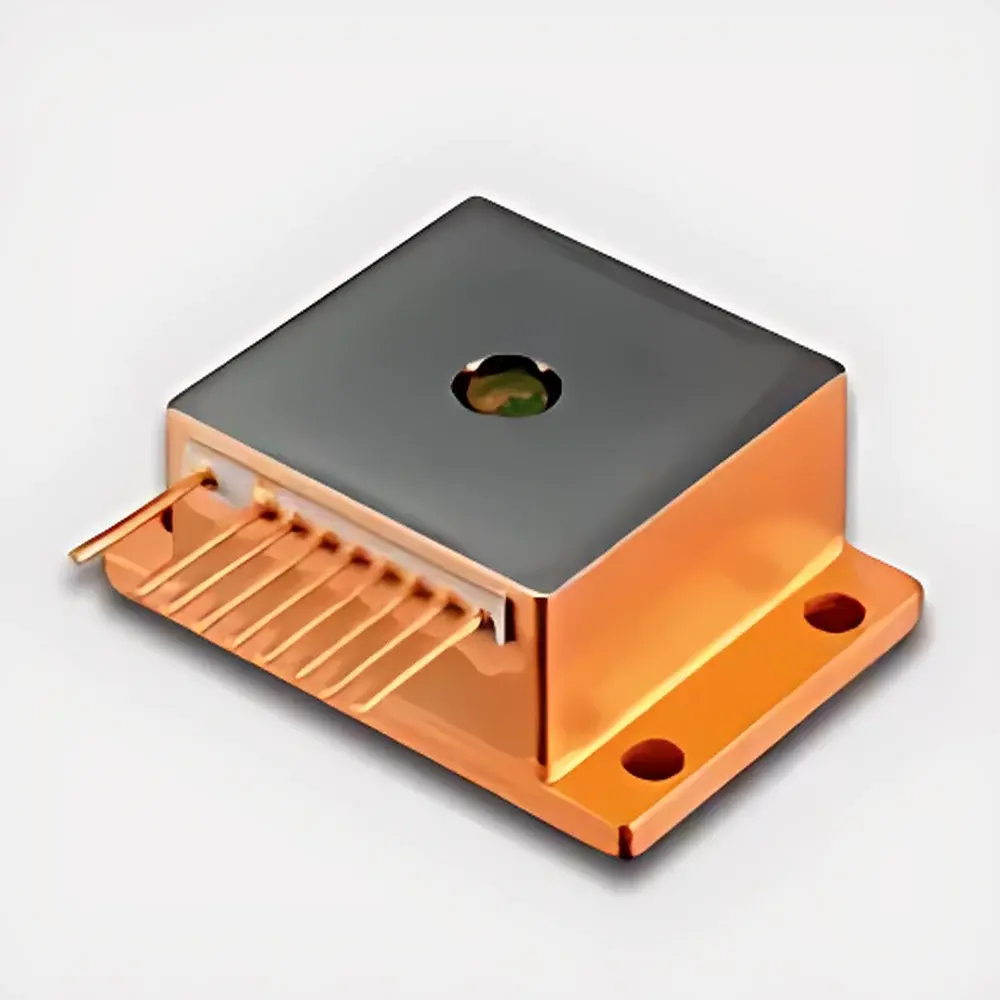
Hamamatsu L12004-2209H-C Distributed Feedback Quantum Cascade Laser (DFB-QCL)
| Brand | Hamamatsu |
|---|---|
| Origin | Japan |
| Manufacturer Type | Original Equipment Manufacturer (OEM) |
| Product Category | Imported Optical Instrument |
| Model | L12004-2209H-C |
| Laser Type | DFB Continuous-Wave (CW) QCL |
| Peak Emission Wavelength (Typ.) | 4.53 µm |
| Operating Temperature Range (QCL) | 10–50 °C |
| Spectral Linewidth (Max.) | 0.2 cm⁻¹ |
| Tuning Range (Min.) | ±1.0 cm⁻¹ |
| Output Power (Min.) | 20 mW |
| Threshold Current (Max.) | 1 A |
| Side Mode Suppression Ratio (Min.) | 25 dB |
| Package Type | Hermetically Sealed HHL (High-Heat-Load) Mount |
Overview
The Hamamatsu L12004-2209H-C is a distributed feedback quantum cascade laser (DFB-QCL) engineered for high-stability, narrow-linewidth continuous-wave (CW) operation in the mid-infrared spectral region. Unlike conventional interband semiconductor lasers (e.g., diode lasers based on GaAs or InP), QCLs operate on intersubband transitions within engineered quantum well heterostructures—enabling precise, wavelength-specific emission from ~4 µm to >12 µm. This device emits at a nominal wavelength of 4.53 µm, optimized for fundamental vibrational absorption bands of key trace gases including CO, NO, N₂O, CH₄, and volatile organic compounds (VOCs). Its monolithic DFB grating structure ensures single-mode operation without external cavity components, delivering intrinsic spectral purity essential for high-resolution gas spectroscopy. Designed for integration into portable or benchtop optical sensing platforms, the L12004-2209H-C features a hermetically sealed high-heat-load (HHL) package with integrated thermoelectric cooler (TEC) control interfaces and low-noise current drive compatibility.
Key Features
- Monolithic DFB architecture for stable single-longitudinal-mode (SLM) emission without mode hops across its operating temperature and current range
- Narrow spectral linewidth ≤ 0.2 cm⁻¹ (FWHM), enabling detection limits down to sub-ppb levels in direct absorption or wavelength modulation spectroscopy (WMS)
- Wide electrical tuning range of ±1.0 cm⁻¹ via current modulation—sufficient to scan across full rovibrational line profiles of target analytes
- Minimum output power of 20 mW at 20 °C heat sink temperature, supporting signal-to-noise ratios compatible with multipass cell (e.g., 10–100 m path length) and photoacoustic detection configurations
- Side mode suppression ratio ≥ 25 dB ensures minimal interference from adjacent longitudinal modes during quantitative spectral fitting
- HHL package integrates TEC, thermistor, and back-facet photodiode—facilitating closed-loop temperature stabilization and real-time power monitoring per GLP-compliant instrumentation design practices
- Qualified for continuous operation between 10 °C and 50 °C case temperature, with thermal management support for sustained duty cycles in field-deployable systems
Sample Compatibility & Compliance
The L12004-2209H-C is compatible with standard mid-IR optical components including ZnSe lenses, CaF₂ windows, diamond-turned off-axis parabolic mirrors, and thermopile or MCT photodetectors. Its 4.53 µm emission aligns with strong fundamental absorption lines of carbon monoxide (CO) near 2203 cm⁻¹ and nitric oxide (NO) near 1904 cm⁻¹—making it suitable for environmental monitoring, industrial process control, and combustion diagnostics per ASTM D6348 and ISO 12039 standards. The device meets RoHS Directive 2011/65/EU for hazardous substance restrictions and conforms to IEC 60825-1:2014 Class 3B laser safety requirements when operated within specified current and temperature limits. Full traceability documentation—including lot-specific test reports and calibration certificates—is provided for regulated applications requiring FDA 21 CFR Part 11–compliant audit trails.
Software & Data Management
Hamamatsu provides comprehensive driver software development kits (SDKs) for Windows and Linux environments, supporting USB and analog voltage-controlled interfaces for current and TEC setpoint programming. The SDK includes LabVIEW VIs, Python bindings (via ctypes), and C/C++ libraries with built-in safety interlocks, ramp-rate limiting, and over-temperature shutdown protocols. All operational parameters—including drive current, TEC voltage, thermistor resistance, and photodiode monitor output—are timestamped and loggable at ≥1 kHz sampling rates. Export formats include CSV and HDF5, ensuring interoperability with third-party spectral analysis tools such as MATLAB, Igor Pro, and commercial gas analysis platforms compliant with EN 15267-3 for automated emissions monitoring systems (CEMS).
Applications
- Open-path and extractive trace gas monitoring for ambient air quality networks (e.g., EPA Method TO-11A compliance)
- In-situ combustion exhaust analysis in gas turbines and internal combustion engines
- Pharmaceutical residual solvent detection in lyophilized products (ICH Q2(R2)-aligned method validation)
- Industrial leak detection in petrochemical refineries using tunable diode laser absorption spectroscopy (TDLAS) architectures
- Research-grade mid-IR spectroscopy for molecular dynamics studies in ultrafast pump-probe configurations
- Calibration source for Fourier-transform infrared (FTIR) spectrometers requiring narrowband reference lines
FAQ
What is the recommended drive current range for optimal lifetime and spectral stability?
Hamamatsu specifies a maximum threshold current of 1 A; continuous operation is recommended below 0.85 A at 20 °C heat sink temperature to ensure >10,000 hours MTTF under constant-current bias.
Can this QCL be modulated at frequencies above 100 kHz for wavelength modulation spectroscopy (WMS)?
Yes—the device exhibits <10 ns electrical rise time and supports direct current modulation up to 500 kHz, enabling second-harmonic (2f) WMS detection with lock-in amplifiers.
Does the HHL package include electrical isolation between the laser diode and TEC circuits?
Yes—galvanic isolation ≥1 kV DC is maintained between anode/cathode terminals and TEC leads, meeting IEC 61010-1 insulation requirements for measurement equipment.
Is factory recalibration available, and what is the recalibration interval recommendation?
Hamamatsu offers accredited recalibration services traceable to NMI-Japan (AIST); annual recalibration is recommended for GMP/GLP environments where spectral accuracy must remain within ±0.05 cm⁻¹ of certified value.
Are optical isolators required when coupling into single-mode mid-IR fibers?
Yes—due to the high facet reflectivity (~30%) of uncoated QCL waveguides, a minimum 30 dB optical isolator is recommended to prevent feedback-induced instability and mode partition noise.



