
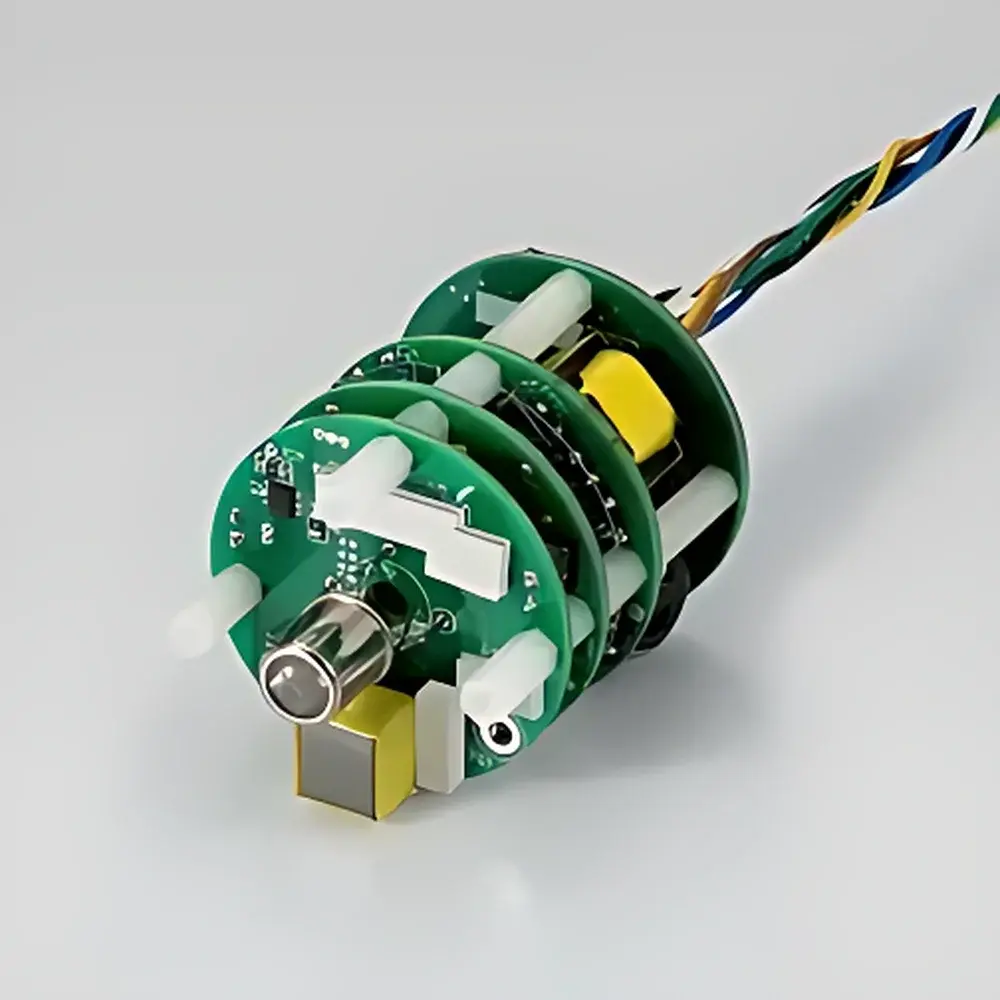
Hamamatsu L13821-01/-02/-03/-04 Flash Xenon Lamp Module
| Brand | Hamamatsu |
|---|---|
| Origin | Japan |
| Manufacturer Type | Original Equipment Manufacturer (OEM) |
| Product Category | Imported |
| Model | L13821-01/-02/-03/-04 |
| Light Source Type | Pulsed Xenon Lamp |
| Illumination Configuration | Internal Illumination |
| Spectral Range | 185–2500 nm (UV-VIS-NIR) |
| Arc Size | 1.0 mm |
| Window Material | UV-Grade Fused Silica / MgF₂ (model-dependent) |
| Operating Voltage | 4.75–5.5 V or 10.8–13.2 V DC |
| Trigger Signal | TTL-compatible rectangular pulse ≥10 µs, 2.5–5 V |
| Max. Repetition Rate | Up to 79 Hz (model- and condition-dependent) |
| Max. Average Power | 2.0 W |
| Pulse Energy | Up to 25.4 mJ/pulse |
| Light Output Stability | ≤2.0% CV (typ. 0.4% CV at ≥10 Hz) |
| Lifetime | ≥1 × 10⁹ flashes (defined as 50% radiant output decay in 190–1100 nm band under 2 W operation) |
| Operating Temperature | 0–+40 °C |
| Compliance | IEC/EN 61326-1 (EMC), IEC/EN 62471 (Photobiological Safety, Risk Group 3), IEC/EN 63000 (RoHS) |
Overview
The Hamamatsu L13821 series is a compact, high-reliability pulsed xenon lamp module engineered for integration into portable and benchtop optical instrumentation requiring stable, broadband ultraviolet–visible–near-infrared (UV-VIS-NIR) illumination. Unlike continuous-wave sources, the L13821 operates on a flash-based principle: electrical energy stored in an internal capacitor is discharged across a 1.0 mm xenon arc gap, generating intense, sub-millisecond light pulses with spectral continuity from 185 nm to 2500 nm—enabling applications demanding both deep-UV sensitivity and broad spectral coverage. Its cylindrical PCB architecture minimizes footprint while optimizing thermal dissipation and mechanical rigidity, making it suitable for space-constrained OEM designs. The module supports dual-input voltage ranges (4.75–5.5 V and 10.8–13.2 V DC), allowing direct compatibility with standard lithium-ion battery packs (e.g., 5 V nominal mobile power supplies), thereby eliminating the need for external AC–DC conversion in field-deployable analyzers.
Key Features
- Miniaturized Cylindrical Form Factor: Integrated circular PCB design enables seamless mounting in tight optical cavities; outer diameter <25 mm, height <30 mm (model-dependent).
- Broadband UV-VIS-NIR Emission: Spectral output spans 185–2500 nm (L13821-01/-02/-03 variants with fused silica window) or 160–7500 nm (MgF₂-window models); ideal for multi-wavelength absorbance, fluorescence excitation, and reflectance measurements.
- High Pulse-to-Pulse Stability: Radiant output stability ≤2.0% coefficient of variation (CV) under sustained operation at ≥10 Hz repetition rate; typical performance is 0.4% CV, ensuring reproducible photometric calibration in quantitative assays.
- OEM-Optimized Electrical Interface: Dedicated trigger input (2.5–5 V TTL), isolated return (RTN, not GND) to suppress noise coupling; separate control lines for main discharge voltage adjustment (3.2–4.8 V analog setpoint).
- Extended Operational Lifetime: Rated for ≥1 × 10⁹ flashes when operated at 2 W average power (e.g., 600 V, 0.141 µF, 79 Hz); lifetime defined per IEC/EN 62471 as time until 190–1100 nm radiant flux degrades to 50% of initial value.
- Passive Thermal Management: No active cooling required below 45 °C housing temperature; validated for continuous operation at ambient temperatures up to +40 °C with appropriate PCB-level heat sinking.
Sample Compatibility & Compliance
The L13821 module is designed for use with optically transparent or semi-transparent samples in reflection, transmission, or fluorescence geometries. Its internal illumination configuration allows direct coupling to flow cells, cuvettes, microfluidic channels, and solid-sample stages without external beam routing. The device complies with international regulatory frameworks essential for laboratory and industrial instrumentation: electromagnetic compatibility per IEC/EN 61326-1 (CISPR 11 Group 1 Class B emission limits and immunity requirements), photobiological safety per IEC/EN 62471 (Risk Group 3—requiring engineering controls to prevent acute UV exposure), and environmental compliance per IEC/EN 63000 (RoHS 3). While not intrinsically certified for medical devices, its traceable stability and documented lifetime support validation under ISO 13485 and FDA 21 CFR Part 820 when embedded in IVD platforms such as blood/urine analyzers or point-of-care spectrophotometers.
Software & Data Management
The L13821 operates as a hardware-peripheral light source and does not incorporate onboard firmware or digital communication interfaces (e.g., USB, I²C, SPI). System-level control—including trigger timing, repetition rate, and discharge voltage modulation—is implemented externally via host microcontroller or FPGA logic. For GLP/GMP-compliant deployments, users integrate the module into instrument control software that logs operational parameters (e.g., flash count, cumulative energy, thermal status) with audit-trail capability. Hamamatsu provides detailed timing diagrams, electrical interface specifications, and derating curves in the official datasheet (PN: S13821-01-DATA), enabling deterministic synchronization with CCD/CMOS detectors, lock-in amplifiers, or time-resolved spectrometers. No proprietary drivers or SDKs are required; all signal levels conform to industrial TTL and analog voltage standards.
Applications
- Water Quality Monitoring: UV-Vis absorption spectroscopy for nitrate, nitrite, organic carbon (TOC), and turbidity detection in handheld and online sensors.
- Gas & Atmospheric Analysis: Differential optical absorption spectroscopy (DOAS) and cavity-enhanced absorption for NO₂, SO₂, O₃, and VOC quantification.
- Colorimetric & Enzymatic Assays: Multi-parameter clinical chemistry analyzers using endpoint or kinetic absorbance measurement (e.g., ELISA, glucose oxidase).
- HPLC & Flow Injection Analysis (FIA): UV detection at 254 nm and variable-wavelength scanning across 200–400 nm.
- Material Inspection: UV-induced fluorescence imaging for semiconductor wafer defect mapping, gemstone authenticity verification, and polymer degradation analysis.
- Multiplexed Microplate Reading: High-throughput absorbance/fluorescence detection in 96-/384-well plates (MTP readers) with synchronized flash triggering per well row/column.
FAQ
What is the minimum recommended repetition rate for stable photometric output?
For optimal radiometric stability (≤0.4% CV), Hamamatsu specifies ≥10 Hz as the lower bound. Below this rate, thermal relaxation effects may increase pulse-to-pulse variance.
Can the L13821 be driven directly from a 5 V Li-ion battery pack without regulation?
Yes—the module accepts 4.75–5.5 V unregulated input. However, battery voltage sag under load must remain within this window; use of a low-dropout (LDO) regulator is recommended for long-duration field operation.
Is the spectral output calibrated per unit, and is NIST-traceable data available?
Hamamatsu provides typical spectral irradiance curves in the datasheet, but individual unit calibration is not standard. Customers requiring traceable radiometric certification must perform third-party calibration using a NIST-traceable spectroradiometer.
How is “lifetime” defined, and what failure mode occurs at end-of-life?
Lifetime is defined as the number of flashes until integrated radiant flux (190–1100 nm) drops to 50% of initial value under specified 2 W operating conditions. End-of-life manifests as progressive output decay—not catastrophic failure—and remains functional at reduced intensity.
Does the module include built-in overtemperature or overvoltage protection?
No. Protection circuitry (e.g., current limiting, thermal cutoff, voltage clamping) must be implemented at the system level per IEC 61000-4-x immunity requirements and application-specific safety policies.





