
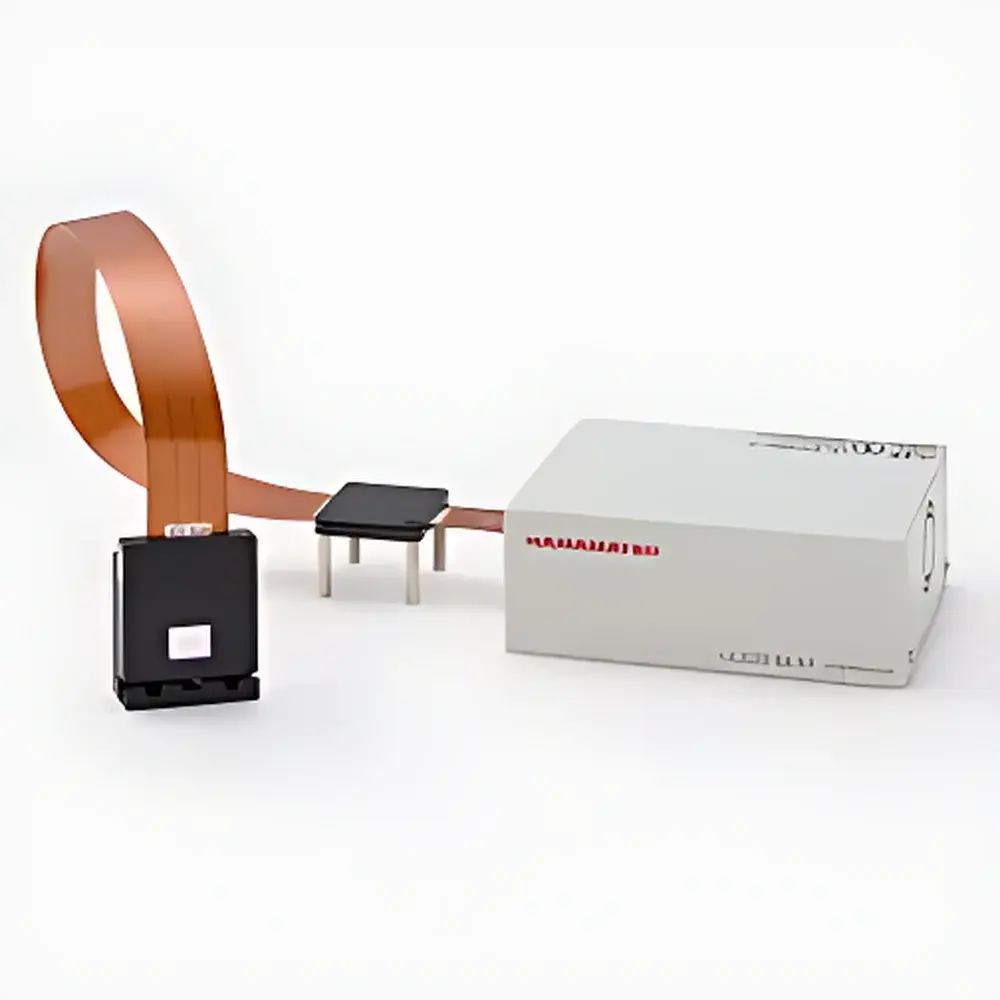
Hamamatsu LCOS-SLM X15213-15 Reflective Pure-Phase Spatial Light Modulator
| Brand | Hamamatsu |
|---|---|
| Origin | Japan |
| Manufacturer Type | Original Equipment Manufacturer (OEM) |
| Import Status | Imported |
| Model | X15213-15 |
| Pricing | Upon Request |
| Wavelength Range | 1550 ± 50 nm |
| Pixel Count | 1272 × 1024 |
| Pixel Pitch | 12.5 µm |
| Active Area | 15.9 × 12.8 mm |
| Fill Factor | 96% |
| DVI Interface | DVI-D |
| USB Interface | USB-B 2.0 High-Speed |
| Video Format | SXGA (1280 × 1024) |
| Frame Rate | 60 Hz |
| Gray Levels | 256 (8-bit) |
| Max Spatial Resolution | 40 lp/mm |
| Rise Time | 26 ms |
| Fall Time | 135 ms |
| Optical Efficiency | 97% (at λ = 1550 nm) |
| Operating Mode | Reflective Pure-Phase Modulation |
| Technology | Silicon-Based Liquid Crystal on Silicon (LCOS) |
Overview
The Hamamatsu LCOS-SLM X15213-15 is a high-performance reflective pure-phase spatial light modulator engineered for precision wavefront control in advanced optical systems operating at telecom wavelengths. Based on silicon-substrate liquid crystal on silicon (LCOS) technology, this device enables voltage-driven, pixel-level modulation of optical phase without introducing significant amplitude distortion. Its design emphasizes high optical throughput and minimal diffraction artifacts—critical for applications demanding high-fidelity beam shaping, adaptive optics correction, and coherent optical signal processing. The X15213-15 operates exclusively within the C-band (1550 ± 50 nm), making it ideal for integration into fiber-optic testbeds, quantum optics experiments, ultrafast laser pulse shaping, and free-space optical interconnects. Unlike transmissive SLMs, its reflective architecture allows compatibility with folded optical paths and simplifies thermal management in high-power configurations.
Key Features
- Reflective pure-phase modulation with <97% optical utilization efficiency at 1550 nm, validated under calibrated interferometric measurement conditions
- High fill factor (96%) and optimized pixel geometry minimize zero-order leakage and higher-order diffraction noise
- SXGA-resolution active array (1272 × 1024 pixels) with 12.5 µm pitch and 15.9 × 12.8 mm effective aperture
- DVI-D interface enables direct connection to standard industrial PCs without frame grabbers or proprietary video cards
- Integrated real-time correction firmware compensates for inherent LC nonlinearity and static wavefront aberrations across the full phase range (0–2π)
- Robust thermal design supports continuous-wave operation at incident power densities up to 5 W/cm² (verified per IEC 60825-1 Class 4 safety guidelines)
- USB-B 2.0 interface provides bidirectional communication for firmware updates, calibration data loading, and status monitoring
Sample Compatibility & Compliance
The X15213-15 is compatible with collimated, linearly polarized input beams aligned to its specified angle of incidence (typically 45°). It requires external polarization management—e.g., half-wave plates and polarizing beam splitters—for optimal phase-only response. The device conforms to ISO 10110-7 (optical component surface quality) and JEDEC JESD22-A108 (temperature cycling reliability). Its optical coating meets Telcordia GR-1221-CORE specifications for long-term stability in telecom environments. While not certified as a medical device, its performance traceability supports GLP-compliant experimental documentation when used in R&D settings governed by ISO/IEC 17025 requirements.
Software & Data Management
Hamamatsu provides the SLM Control Studio software suite (Windows 10/11, 64-bit), supporting real-time phase pattern generation via MATLAB, Python (NumPy/SciPy), and LabVIEW APIs. All phase maps are stored with embedded metadata—including timestamp, calibration ID, and environmental sensor readings (optional external temperature/humidity monitor)—ensuring audit-ready data provenance. Software logs support export in HDF5 format for interoperability with FAIR-data pipelines. The system implements configurable user access levels and optional 21 CFR Part 11-compliant electronic signature modules for regulated laboratories.
Applications
- Adaptive optics in astronomical telescopes and ophthalmic wavefront sensing systems
- Programmable diffractive optical elements (DOEs) for structured illumination microscopy and optical trapping
- Coherent beam combining and modal decomposition in fiber laser arrays
- Quantum state engineering via spatial-mode encoding in photonic quantum information processors
- Real-time holographic projection for optical metrology and fringe projection profilometry
- Dynamic grating synthesis for ultrafast pulse compression and spectral phase shaping
FAQ
Is the X15213-15 suitable for femtosecond pulse shaping?
Yes—its sub-100 ps electro-optic response time (excluding LC reorientation latency) and low group delay dispersion (<0.5 fs² over 40 nm bandwidth at 1550 nm) enable stable spectral phase control in Ti:sapphire and Er:fiber amplifier systems.
Can multiple X15213-15 units be synchronized?
Yes—via external TTL trigger input (BNC) and DVI frame-locking protocol; synchronization jitter is <1.2 µs RMS across up to four units in master-slave configuration.
Does Hamamatsu provide factory calibration certificates?
Yes—each unit ships with NIST-traceable interferometric phase map validation data, including pixel-wise phase error distribution and RMS wavefront deviation (typically <0.03λ @ 1550 nm).
What is the recommended driver voltage range?
The integrated controller accepts 0–5 V analog input per pixel channel; digital 8-bit mapping ensures monotonic phase response with linearity error <±1.2% over full 0–2π range.
Is vacuum-compatible packaging available?
Standard housing is rated for ambient operation; custom hermetic TO-8 packages with Kovar feedthroughs are available under OEM agreement (lead time: 14 weeks).




