
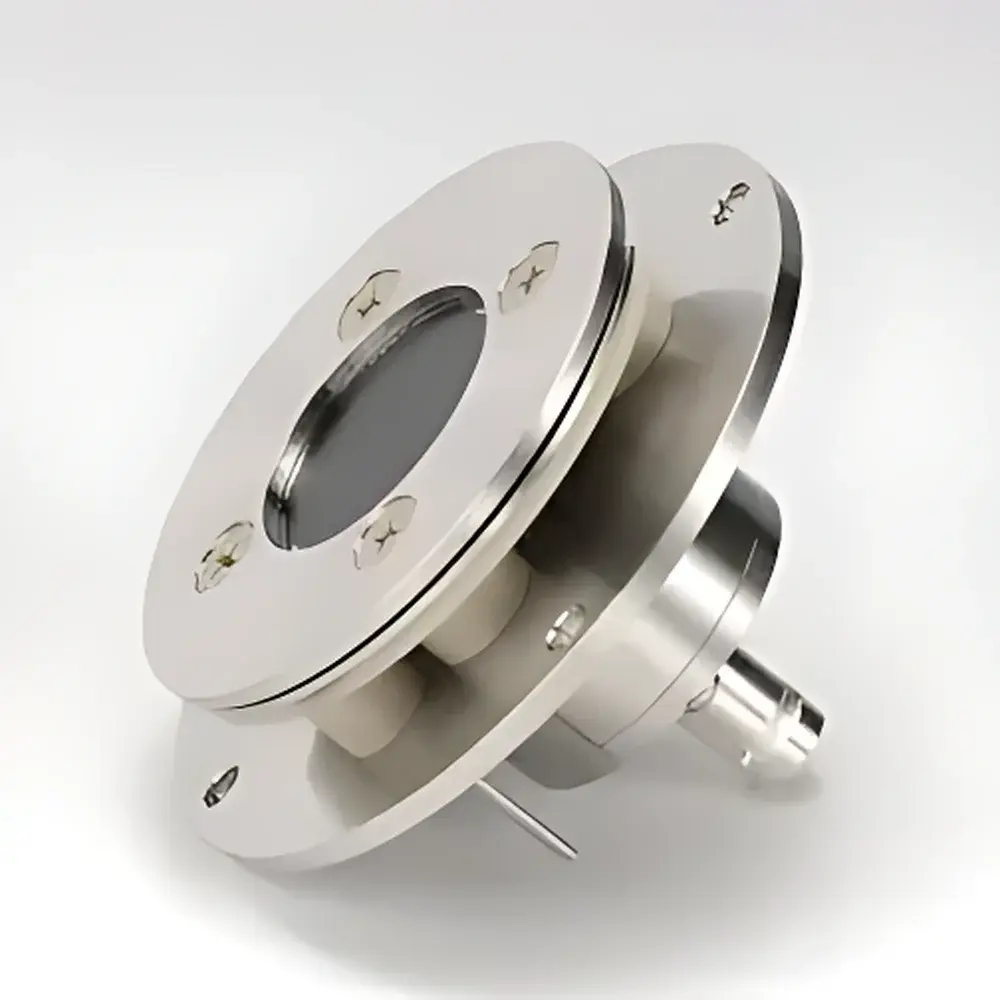
Hamamatsu Microchannel Plate (MCP) Detector F9890-12
| Brand | Hamamatsu |
|---|---|
| Origin | Japan |
| Manufacturer Type | Original Equipment Manufacturer (OEM) |
| Import Status | Imported |
| Model | F9890-12 |
| Pricing | Available Upon Request |
| MCP Configuration | Dual-stage (2-stage) |
| Effective Active Area | Ø27 mm |
| Overall Diameter | Ø81 mm |
| Geometry | Circular, Removable Mounting Design |
| Application | Time-of-Flight Mass Spectrometry (TOF-MS) Detector Assembly |
Overview
The Hamamatsu Microchannel Plate (MCP) Detector F9890-12 is a high-gain, low-noise electron multiplier engineered for integration into time-of-flight mass spectrometry (TOF-MS) detection systems. Based on proven dual-stage (2-stage) microchannel plate architecture, this component operates on the principle of secondary electron multiplication within millions of parallel glass capillaries—each acting as an independent continuous-dynode electron amplifier. When incident ions or electrons strike the input surface, they initiate cascading electron emission with typical gain values exceeding 10⁶ under standard bias conditions. Its Ø27 mm effective active area ensures uniform spatial response across the central detection region, while the compact Ø81 mm outer diameter facilitates mechanical compatibility with standard TOF-MS detector housings and vacuum flange interfaces (e.g., CF-63 or ISO-KF40). Designed and manufactured in Japan by Hamamatsu Photonics K.K., the F9890-12 adheres to stringent OEM quality control protocols for ultra-high vacuum (UHV) compatibility (<1×10⁻⁹ mbar operational tolerance), low outgassing rates, and long-term signal stability.
Key Features
- Dual-stage (2-stage) MCP configuration for enhanced gain linearity and reduced ion feedback compared to single-stage alternatives
- Ø27 mm circular active area optimized for focused ion beam detection in reflectron and linear TOF geometries
- Removable mechanical design enables field-replaceable installation without breaking main vacuum chamber integrity
- Low intrinsic background noise (<0.1 counts/sec at room temperature, typical) supporting high signal-to-noise ratio (SNR) acquisition
- UHV-compatible construction using low-outgassing borosilicate glass and metal-ceramic hermetic seals
- Integrated bias voltage distribution network ensuring uniform electric field across entire channel array
Sample Compatibility & Compliance
The F9890-12 is compatible with pulsed ion beams generated by orthogonal acceleration (oa-TOF), laser desorption/ionization (LDI), matrix-assisted laser desorption/ionization (MALDI), and electron ionization (EI) sources. It supports both positive- and negative-ion detection modes without hardware modification. From a regulatory standpoint, the device complies with ISO 9001:2015 manufacturing standards and meets material traceability requirements under IEC 61340-5-1 for electrostatic discharge (ESD)-sensitive components. While not a standalone instrument, its integration into final TOF-MS systems supports compliance with FDA 21 CFR Part 11 when paired with validated data acquisition software featuring audit trail, electronic signature, and secure user access controls.
Software & Data Management
As a passive detector component, the F9890-12 does not include embedded firmware or onboard processing. It interfaces directly with external fast-sampling digitizers (e.g., 1–5 GS/s oscilloscopes or time-to-digital converters) via standard 50 Ω coaxial output. Signal timing resolution is governed by system-level electronics rather than the MCP itself; however, its sub-nanosecond pulse rise time (<300 ps, typical) preserves temporal fidelity essential for high-resolution mass assignment. When integrated into validated analytical platforms, raw pulse data can be processed using vendor-neutral formats (e.g., mzML) and subjected to peak deconvolution, centroiding, and calibration routines compliant with ASTM E260-20 and ISO/IEC 17025:2017 documentation requirements.
Applications
- High-mass-resolution TOF-MS detection in proteomics and metabolomics workflows
- Ultrafast ion imaging in MALDI-TOF imaging mass spectrometry (IMS)
- Pulsed laser ablation time-of-flight mass spectrometry (LA-TOF-MS) for solid-state elemental analysis
- Spacecraft-based mass analyzers requiring radiation-hardened, low-power electron multipliers
- Development of next-generation hybrid detectors combining MCPs with delay-line anodes or pixelated anode arrays
FAQ
What vacuum level is required for optimal operation of the F9890-12?
The MCP must operate under ultra-high vacuum conditions (≤1×10⁻⁹ mbar) to prevent channel poisoning and maintain gain stability over extended duty cycles.
Can the F9890-12 be used in magnetic fields?
Yes—its all-glass/metal construction exhibits negligible magnetic susceptibility, making it suitable for integration near superconducting magnets or in combined MS/NMR environments.
Is bake-out capability supported?
The F9890-12 is rated for vacuum bake-out up to 150 °C for ≤24 hours, provided thermal gradients remain below 2 °C/min to avoid microfracture risk.
Does Hamamatsu provide aging performance data?
Lifetime testing per IEC 60068-2-60 indicates >5 C/cm² total extracted charge before 10% gain degradation under continuous 1 kHz pulsed operation at 1 kV interplate bias.
How is alignment verified during installation?
A reference pin-hole collimator and phosphor screen test assembly are recommended for optical centering verification prior to final UHV sealing.




