
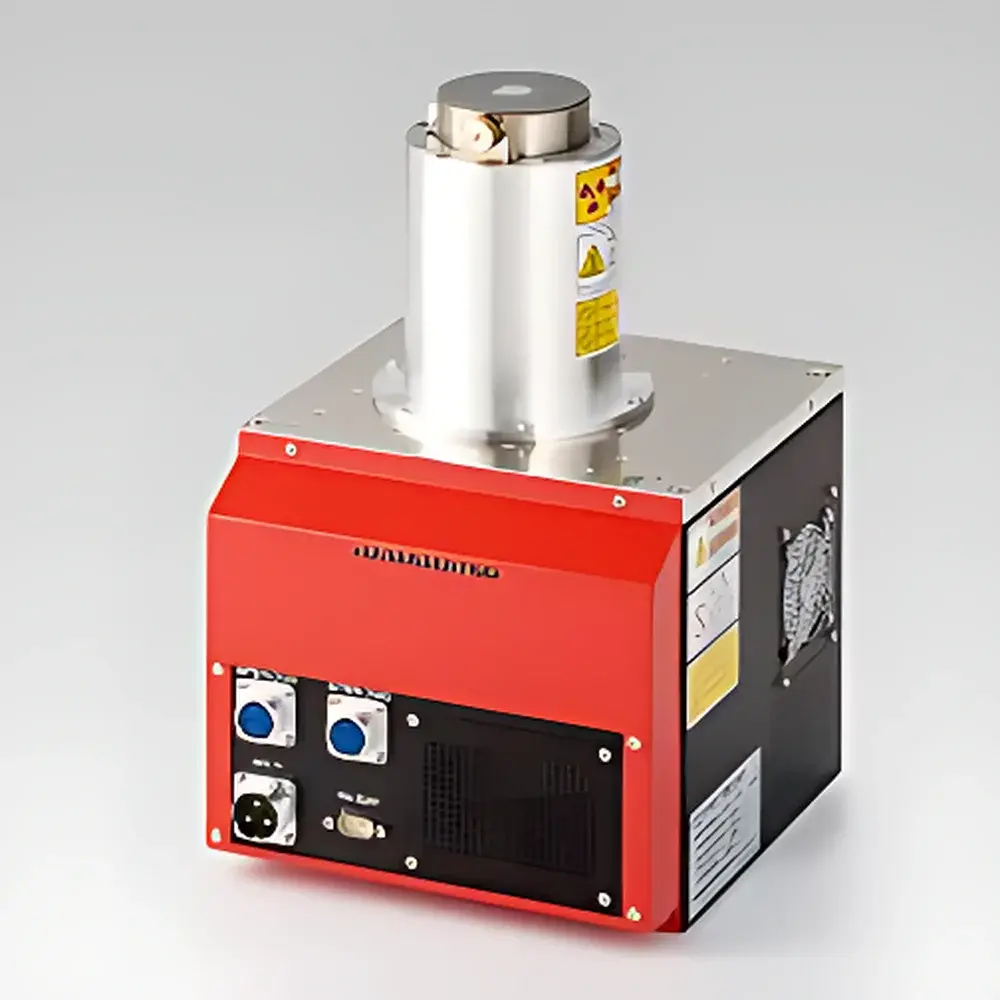
Hamamatsu Microfocus X-ray Source L12531-01
| Brand | Hamamatsu |
|---|---|
| Origin | Japan |
| Manufacturer Type | Original Equipment Manufacturer (OEM) |
| Product Category | Imported |
| Model | L12531-01 |
| Voltage Range | 40–110 kV |
| Maximum Output Power | 16 W |
| Minimum Focal Spot Size | 2 µm (at 2 W) |
| Focus-to-Object Distance (FOD) | 1 mm |
| X-ray Beam Cone Angle | 120° |
| Interface | RS-232C |
| Tube Type | Sealed Transmission Target |
Overview
The Hamamatsu Microfocus X-ray Source L12531-01 is a high-performance, sealed transmission-target X-ray generator engineered for precision non-destructive testing (NDT) and micro-computed tomography (micro-CT) applications. Operating on the principle of electron bombardment of a thin metal target (typically tungsten or molybdenum), this source produces a highly collimated, conical X-ray beam with exceptional spatial coherence and minimal focal spot blur. Its design prioritizes geometric magnification capability—enabled by an ultra-short focus-to-object distance (FOD) of just 1 mm—making it ideal for high-magnification radiography where detector-limited resolution must be complemented by source-limited sharpness. The unit delivers stable output across a wide voltage range (40–110 kV), supporting material penetration requirements from low-Z polymers to mid-Z alloys without requiring hardware reconfiguration.
Key Features
- Microfocus performance: Achieves a minimum focal spot size of 2 µm at 2 W—an industry benchmark for transmission geometry sources—ensuring high spatial resolution in projection imaging and CT reconstruction.
- Optimized geometric magnification: With an FOD of only 1 mm, the L12531-01 enables magnifications exceeding 100× when paired with standard flat-panel detectors, minimizing system footprint while maximizing detail visibility.
- Broad spectral tunability: Adjustable tube voltage (40–110 kV) allows optimization of X-ray photon energy for specific material contrast, absorption edge targeting, and dose efficiency—critical for multi-material inspection workflows.
- Sealed tube architecture: Eliminates vacuum pump dependency and gas refilling cycles, ensuring long-term operational stability and zero scheduled maintenance over typical laboratory or industrial NDT lifetimes.
- Wide cone-beam geometry: 120° full-cone X-ray emission angle supports large field-of-view acquisition with single exposures, reducing scan time and mechanical complexity in CT setups.
- RS-232C serial interface: Enables deterministic, low-latency integration into automated inspection platforms, synchronized motion control systems, and OEM CT gantries compliant with IEC 61508 functional safety guidelines.
Sample Compatibility & Compliance
The L12531-01 is routinely deployed for high-fidelity inspection of heterogeneous assemblies including printed circuit boards (PCBs), semiconductor packages, plastic housings with embedded metallic traces, and lightweight cast aluminum or magnesium components. Its 2 µm focal spot meets ASTM E2737-22 requirements for microfocus X-ray system classification and supports ISO 17025-accredited laboratories performing dimensional metrology per ISO/IEC 17025:2017 Annex B. While not a standalone certified device, the source complies with IEC 60601-1 (medical electrical equipment safety) and IEC 61000-6-3 (EMC emissions) when integrated into properly shielded host systems. It is compatible with lead-equivalent shielding configurations meeting national radiation protection regulations (e.g., NRC 10 CFR Part 20, EU Directive 2013/59/Euratom).
Software & Data Management
The L12531-01 does not include embedded firmware-based imaging software but provides standardized RS-232C command protocol documentation (Hamamatsu Part No. L12531-01-SDS) for integration with third-party acquisition suites such as VGStudio MAX, Octopus Reconstruction, or custom LabVIEW- or Python-controlled frameworks. All communication commands support parameter logging (kV, µA, exposure time), status polling (tube temperature, interlock state), and fault reporting—enabling full audit trails required under GLP and GMP environments. When used in regulated manufacturing QA/QC lines, its deterministic trigger response and repeatable output stability facilitate compliance with FDA 21 CFR Part 11 through validated host-system electronic record architectures.
Applications
- High-resolution PCB solder joint inspection (void detection, bridging, tombstoning)
- Plastic component integrity analysis (weld seam porosity, insert misalignment, internal delamination)
- Automotive casting porosity mapping and inclusion characterization (ISO 10993-12 context)
- Electronics encapsulation quality assessment (glob-top cracking, wire bond lift-off)
- Battery cell electrode coating uniformity and separator defect screening
- Preclinical micro-CT sample scanning (small-animal bone morphology, scaffold porosity quantification)
FAQ
What is the expected service life of the L12531-01 under continuous operation?
Hamamatsu specifies a minimum operational lifetime of 5,000 hours at rated power (≤16 W), assuming ambient temperature ≤35°C and adequate thermal management per datasheet cooling recommendations.
Can the L12531-01 be operated in pulsed mode?
Yes—via external TTL or RS-232C command triggering; pulse width down to 10 ms is supported with full kV/µA reproducibility, enabling dose reduction in time-resolved tomography.
Is radiation shielding included with the unit?
No—shielding must be designed and installed separately per local regulatory requirements; Hamamatsu provides detailed leakage radiation maps and recommended lead thickness tables in the technical manual.
Does the source support dual-energy acquisition?
Not natively; dual-energy capability requires two independently controlled X-ray sources or a rapidly switching kV supply—neither is integrated into the L12531-01’s architecture.
How is thermal drift managed during extended acquisitions?
The unit incorporates a thermally stabilized anode mount and integrated temperature sensor; closed-loop feedback to external HV supplies is supported via analog monitoring outputs specified in the interface manual.
Related Products




