
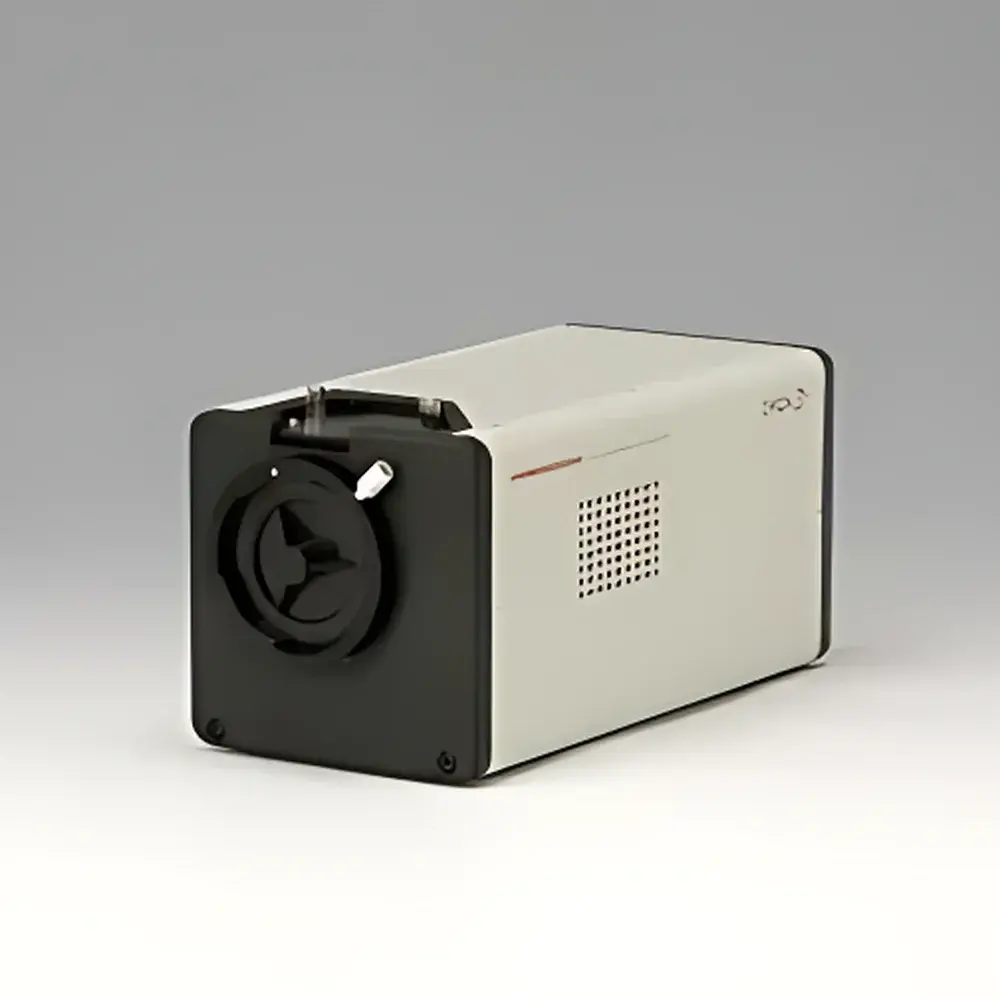
Hamamatsu ORCA-D2 Dual-CCD Scientific Camera
| Brand | Hamamatsu |
|---|---|
| Origin | Japan |
| Manufacturer | Hamamatsu Photonics K.K. |
| Type | Imported Scientific Imaging Device |
| Model | C11254-10B |
| Sensor | Dual ER-150 Interline CCD |
| Effective Pixels | 1280 × 960 × 2 |
| Pixel Size | 6.45 µm × 6.45 µm |
| Full Well Capacity | 18,000 e⁻ (typ.) |
| Read Noise | 8 e⁻ rms (typ.) |
| Frame Rate | 11.2 fps (1×1 binning) up to 50.5 fps (8×8 binning) |
| Exposure Time | 117 µs – 60 s |
| Cooling | Thermoelectric + Forced Air, −10 °C (ambient +20 °C) |
| Dark Current | 0.01 e⁻/pixel/s (−10 °C) |
| Dynamic Range | 2250:1 (typ.) |
| A/D Resolution | 12-bit |
| Interface | IEEE 1394b (IIDC v1.32) |
| Mount | 2/3″ C-mount (flange back 48 mm) |
| Spectral Response | 350–1100 nm (peak QE >70% at ~600 nm) |
Overview
The Hamamatsu ORCA-D2 (Model C11254-10B) is a high-performance dual-sensor scientific camera engineered for precision-synchronized, multi-wavelength fluorescence imaging in demanding life science and biomedical microscopy applications. Unlike conventional setups requiring optical beam splitters, mechanical alignment of multiple cameras, or post-acquisition software registration—each introducing spatial drift, temporal latency, and photometric inconsistency—the ORCA-D2 integrates two identical, vacuum-sealed ER-150 interline CCD sensors within a single rigid optomechanical housing. This architecture enables true hardware-level synchronization of exposure timing, readout, and pixel-level spatial registration across both channels. Each sensor delivers 1280 × 960 active pixels with 6.45 µm pitch, optimized for high quantum efficiency (>70% peak between 550–650 nm) and low read noise (8 e⁻ rms), supporting quantitative intensity measurements from visible through near-infrared (350–1100 nm). Its thermoelectric cooling to −10 °C (at +20 °C ambient) suppresses dark current to 0.01 e⁻/pixel/s, ensuring high signal fidelity during extended exposures required for low-light modalities such as FRET, ratiometric Ca²⁺ imaging, or dual-channel FISH.
Key Features
- Dual-sensor hardware synchronization: Independent exposure control per channel enables optimal SNR balancing across fluorophores with disparate brightness—e.g., dim far-red dyes versus bright GFP—without compromising temporal resolution or introducing inter-frame jitter.
- Sub-pixel spatial registration: Factory-aligned optical path and integrated software-assisted calibration ensure x-, y-, and z-axis co-registration at the single-pixel level; calibration parameters are stored and recalled automatically for repeatable experimental conditions.
- Z-axis dual-plane imaging capability: Compatible with optional 50/50 dichroic “optical bricks,” the ORCA-D2 supports simultaneous acquisition of two focal planes—enabling rapid, drift-free z-series capture at half the time required by sequential scanning methods.
- Two sensitivity modes: Dedicated weak-light mode enhances near-infrared response (e.g., 700 nm sensitivity ≈ 2× that of ICX285-based systems), while strong-light mode maintains linearity and dynamic range under high-flux illumination.
- Robust thermal and electronic architecture: Vacuum-sealed sensor chamber, forced-air-assisted Peltier cooling, and 12-bit digitization ensure long-term stability and repeatability compliant with GLP/GMP documentation requirements.
Sample Compatibility & Compliance
The ORCA-D2 is designed for integration into regulated and research-grade optical platforms including inverted and upright epifluorescence microscopes, TIRF systems, confocal scanners, and widefield high-content screening stations. Its IEEE 1394b (IIDC v1.32) interface ensures deterministic trigger timing and interoperability with third-party acquisition engines (e.g., Micro-Manager, NIS-Elements, MetaMorph). The camera meets CE marking requirements for electromagnetic compatibility (EMC Directive 2014/30/EU) and low-voltage safety (LVD Directive 2014/35/EU). While not FDA-cleared as a medical device, its performance characteristics—including stable dark current, calibrated linearity, and audit-trail-capable firmware logging—support validation under ISO 13485-aligned quality systems and 21 CFR Part 11-compliant data integrity workflows when deployed in preclinical assay development or QC environments.
Software & Data Management
Hamamatsu provides the ORCA-D2-compatible HCImageLive acquisition suite, which implements hardware-triggered dual-channel capture, real-time background subtraction, and non-linear flat-field correction. Calibration data—including sensor offset maps, gain profiles, and geometric transformation matrices—are embedded in TIFF and HDF5 metadata headers, enabling traceable image provenance. Export formats include lossless 16-bit TIFF, BigTIFF, and OME-TIFF compliant with the Open Microscopy Environment specification. For automated workflows, a documented C++ SDK and Python bindings (via PyHamamatsu) support integration into custom analysis pipelines, including machine learning–based segmentation or ratiometric quantification. All acquisition logs—including exposure duration, temperature setpoint, binning mode, and trigger source—are timestamped and exportable as CSV for audit purposes.
Applications
- Ratiometric ion imaging (e.g., Fura-2, Indo-1)
- Fluorescence resonance energy transfer (FRET) with donor/acceptor pair separation
- Multi-color fluorescence in situ hybridization (FISH) with spectral overlap mitigation
- Simultaneous transmission + fluorescence imaging for morphological context
- Two-plane TIRF for membrane-proximal vs. cytosolic protein dynamics
- High-speed dual-channel calcium or voltage imaging in primary neurons or cardiac myocytes
- Quantitative colocalization analysis without channel crosstalk artifacts
FAQ
Can the ORCA-D2 be used with non-Hamamatsu microscope systems?
Yes. It interfaces via standard IEEE 1394b and supports generic trigger protocols (edge, level, sync-readout), making it compatible with Nikon, Olympus, Zeiss, and Leica microscope controllers when configured per IIDC v1.32 specifications.
Is z-axis calibration performed automatically or manually?
Z-axis alignment is user-initiated via software-guided stage movement and focus sweep, but once completed, the system stores the offset relationship between sensors—eliminating need for re-calibration unless mechanical disturbance occurs.
Does the camera support region-of-interest (ROI) readout?
Yes. ROI acquisition is fully supported in all binning modes and reduces frame time proportionally, enabling higher temporal resolution for subcellular event capture.
What is the maximum sustained frame rate in dual-channel mode?
At full resolution (1280 × 960 × 2), the sustained rate is 11.2 fps; with 8×8 binning, it reaches 50.5 fps—maintaining synchronized exposure and readout across both sensors.
Are optical bricks included with the base system?
No. The 50/50 dichroic optical bricks are optional accessories, available separately in three spectral configurations (e.g., 400–550/570–700 nm, 480–560/600–750 nm, 550–650/700–900 nm) to match common fluorophore pairs.





