
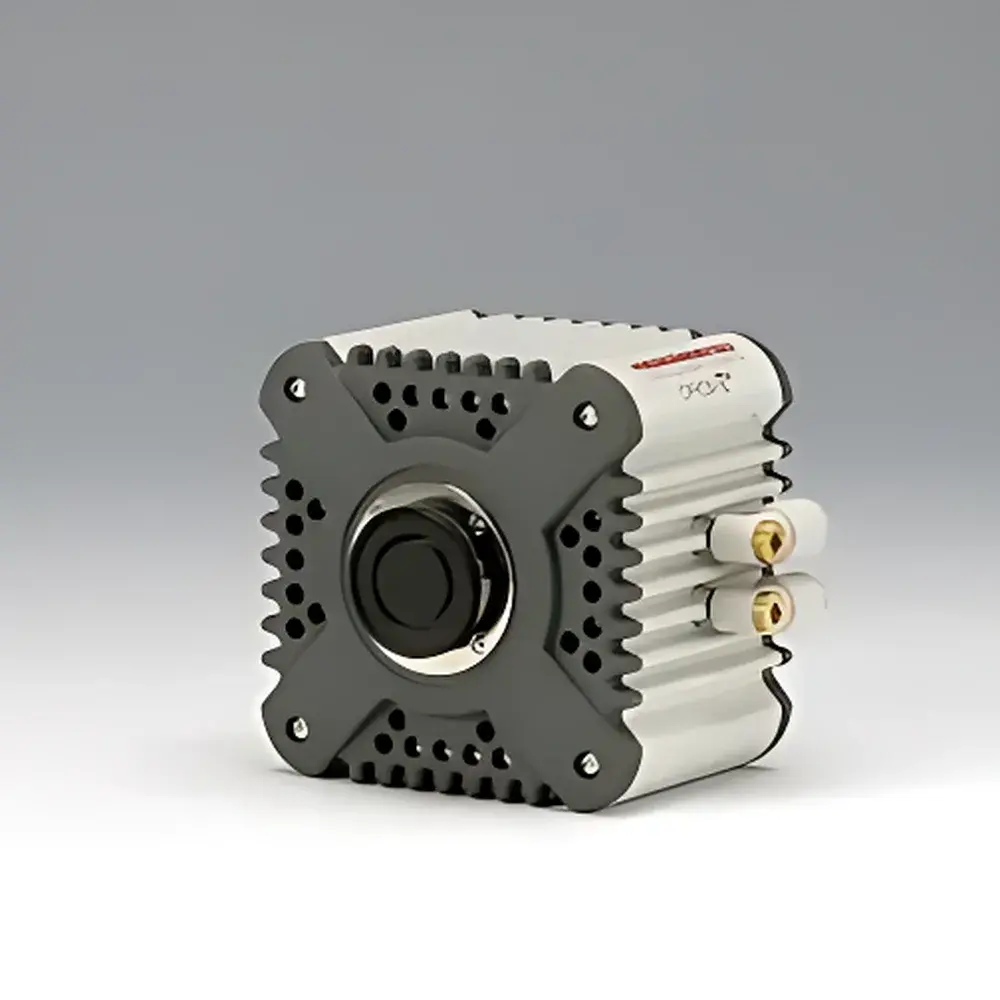
Hamamatsu ORCA-R2 Cooled Scientific CCD Camera C10600-10B
| Brand | Hamamatsu |
|---|---|
| Origin | Japan |
| Manufacturer | Hamamatsu Photonics K.K. |
| Type | Cooled Interline CCD Camera |
| Model | C10600-10B |
| Sensor | Hamamatsu ER-150 |
| Resolution | 1344 × 1024 pixels |
| Pixel Size | 6.45 µm × 6.45 µm |
| Full-Well Capacity | 18,000 e⁻ (standard), 36,000 e⁻ (HDR mode) |
| Read Noise | 6 e⁻ rms (standard scan), 10 e⁻ rms (fast scan) |
| Quantum Efficiency | >70% peak (visible–NIR), 56% @ 670 nm |
| Dark Current | 0.0005 e⁻/pixel/s @ −40 °C |
| Cooling | Thermoelectric (Peltier), air-cooled to −35 °C, water-cooled to −40 °C |
| Frame Rate | 16.2 fps (full frame, standard scan), up to 115.1 fps (8×8 binning + subarray) |
| Dynamic Range | 3000:1 (standard), 6000:1 (HDR mode) |
| Analog Gain | Up to 10× |
| Interface | IEEE 1394b (FireWire 800) |
| ADC | 16-bit |
| Lens Mount | C-mount |
| Power | AC 100–240 V, 50/60 Hz, ~60 W |
Overview
The Hamamatsu ORCA-R2 (model C10600-10B) is a high-performance, thermoelectrically cooled interline CCD camera engineered for quantitative low-light scientific imaging. Built around Hamamatsu’s proprietary ER-150 sensor—a sealed, vacuum-packaged, back-illuminated CCD—the ORCA-R2 delivers exceptional quantum efficiency (>70% across 400–800 nm), low read noise (6 e⁻ rms in standard scan mode), and ultra-low dark current (0.0005 e⁻/pixel/s at −40 °C). Its dual-scan architecture supports both high-fidelity quantitative acquisition (standard scan) and high-speed dynamic observation (fast scan), making it suitable for time-resolved fluorescence microscopy, calcium imaging, FISH, TIRF, and live-cell assays requiring photometric accuracy and temporal fidelity. Unlike front-illuminated sensors, the ER-150’s optimized anti-reflection coating and deep-depletion structure yield superior red/NIR response—critical for Cy5, mCherry, and IR-DIC applications—while maintaining excellent UV sensitivity down to 300 nm.
Key Features
- High quantum efficiency (>70% peak) with extended spectral response from 300 nm (UV) to 900 nm (NIR)
- Dual-scan operation: Standard scan (8.5–16.2 fps, 6 e⁻ read noise) and fast scan (up to 115.1 fps with 8×8 binning and subarray readout)
- Thermoelectric cooling to −35 °C (air-cooled) or −40 °C (water-cooled), enabling long-exposure stability without liquid nitrogen
- Hermetically sealed vacuum chamber eliminates condensation, outgassing, and sensor degradation over time
- True 16-bit digitization with programmable analog gain (up to 10×) and offset control for optimal signal-to-noise ratio across illumination conditions
- Configurable binning (2×2, 4×4, 8×8), region-of-interest (ROI) subarray readout, and hardware-triggered acquisition (edge, level, synchronous, start modes)
- Fan-silencing mode: Refrigeration fan can be temporarily disabled during exposure to eliminate mechanical vibration and EMI interference
Sample Compatibility & Compliance
The ORCA-R2 is compatible with all major widefield, spinning-disk, and TIRF microscope platforms via C-mount interface and standard DCAM-SDK API support. Its calibrated linearity, stable gain/offset characteristics, and reproducible dark-frame behavior meet requirements for GLP-compliant quantitative imaging workflows. While not certified to ISO 17025 as a standalone metrology instrument, its performance aligns with ASTM E2820 (Standard Guide for Evaluating Performance of Scientific Cameras) and supports audit-ready data acquisition under FDA 21 CFR Part 11 when integrated into validated software environments (e.g., NIS-Elements, MetaMorph, μManager with appropriate audit-trail plugins). The camera operates within IEC 61000-6-3 (EMC emissions) and IEC 61010-1 (safety) compliance boundaries for laboratory instrumentation.
Software & Data Management
The ORCA-R2 is fully supported by Hamamatsu’s DCAM-SDK v4.x, a cross-platform (Windows/macOS/Linux), royalty-free API compatible with over 50 third-party imaging applications—including MicroManager, ImageJ/Fiji (via DCAM plugin), Bitplane Imaris, Olympus cellSens, and Nikon NIS-Elements. All metadata (exposure time, gain, temperature, binning, ROI coordinates, trigger settings) are embedded in TIFF headers per TIFF/EP (ISO 12234-2) conventions. Raw 16-bit image streams are acquired without on-camera compression or gamma correction, preserving photon-counting integrity. Time-stamped trigger logs and hardware-synced frame timing enable precise correlation with electrophysiology or environmental control systems. Firmware updates are delivered via Hamamatsu’s secure download portal and applied through the DCAM Configurator utility.
Applications
- Fluorescence microscopy: GFP, RFP, mCherry, Cy5, and Cy7 imaging with high SNR and minimal photobleaching-induced artifacts
- Live-cell functional imaging: Calcium dynamics (e.g., GCaMP), membrane potential dyes, and pH-sensitive probes requiring high temporal resolution and low noise
- Molecular cytogenetics: Fluorescence in situ hybridization (FISH) with multiplexed probe detection and quantitative colocalization analysis
- Neuroscience: Widefield and spinning-disk confocal imaging of neuronal activity across organotypic slices and dissociated cultures
- Materials science: X-ray scintillator readout, semiconductor defect inspection, and luminescence mapping under controlled thermal conditions
- Developmental biology: Long-duration timelapse imaging (hours to days) enabled by stable dark-current suppression and drift-compensated cooling
FAQ
What cooling method does the ORCA-R2 use, and what temperatures are achievable?
The ORCA-R2 employs a two-stage thermoelectric (Peltier) cooler. With forced-air cooling, it reaches −35 °C; with recirculating water cooling (inlet temperature ≤20 °C), it achieves −40 °C.
Is the camera compatible with Linux-based acquisition software?
Yes—DCAM-SDK provides native Linux support (x86_64, kernel ≥3.10) and is integrated into open-source platforms including Micro-Manager and Python-based acquisition frameworks (e.g., pycromanager).
Does the ORCA-R2 support hardware triggering for synchronization with external devices?
Yes—it offers four trigger input modes (edge, level, synchronous readout, start) and three trigger output signals (integration pulse, programmable timing pulse, trigger-ready status).
Can the camera operate in true photon-counting mode?
No—the ORCA-R2 is an analog-integrating CCD and does not perform single-photon event discrimination. However, its sub-10 e⁻ read noise and linear response support quantitative intensity measurements down to ~10 photons/pixel/frame.
What is the warranty and service support structure outside Japan?
Hamamatsu Photonics offers a standard 24-month limited warranty. Global technical support and authorized calibration services are available through regional subsidiaries in North America, Europe, and Asia-Pacific, with firmware and driver updates maintained for ≥7 years post-product discontinuation.




