
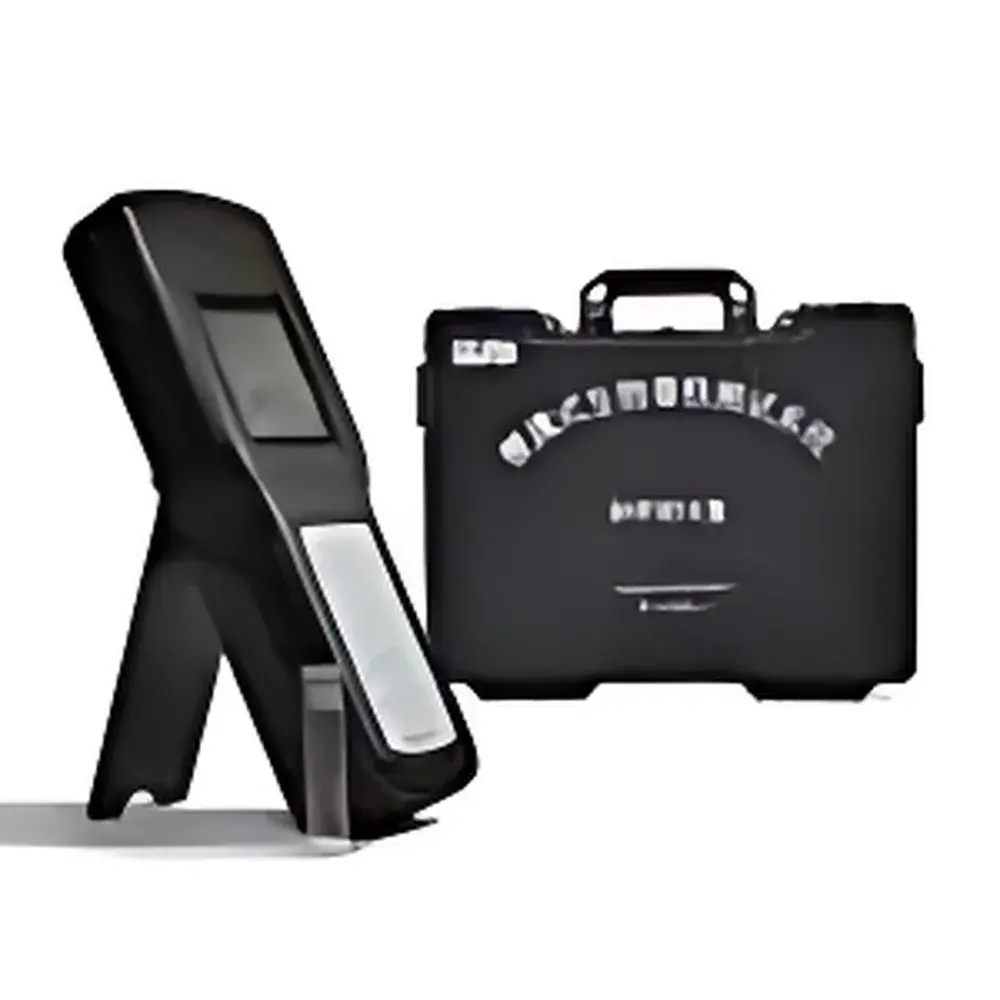
Hamamatsu Photonics BHP9515 Portable Bioluminescence Toxicity Analyzer
| Brand | Hamamatsu Photonics (BHP) |
|---|---|
| Model | BHP9515 |
| Type | Portable bioluminescence-based toxicity analyzer |
| Biological indicator | *Aliivibrio fischeri* (formerly *Vibrio fischeri*) |
| Detection principle | Inhibition of bacterial bioluminescence |
| Fastest assay time | 5 min |
| Continuous operation | ≥8 h on battery |
| Data storage | 1000 measurements per mode (3 modes total) |
| Spectral response range | 320–1000 nm |
| Measurement range | 0–65535 RLU (Relative Light Units) |
| Instrument weight | ~258 g (including batteries) |
| Dimensions | 202 × 78 × 30 mm |
| Power supply | 3 V DC (AA alkaline batteries) |
| Operating temperature | 5–40 °C |
| Operating humidity | 10–90% RH (at 25 °C) |
| Compliance | Designed for field-deployable GLP-aligned environmental screening |
| Software interface | USB data export, optional PC software for trend analysis and report generation |
Overview
The Hamamatsu Photonics BHP9515 Portable Bioluminescence Toxicity Analyzer is an engineered field instrument designed for rapid, on-site assessment of acute aquatic toxicity using the standardized bioluminescent bacterium Aliivibrio fischeri. This device operates on the internationally recognized principle of bioluminescence inhibition: healthy, metabolically active *A. fischeri* emit stable blue-green light (λmax ≈ 490 nm) via the luciferase enzyme system; exposure to toxicants—including heavy metals (e.g., Cu²⁺, Hg²⁺), organic pollutants (e.g., phenols, pesticides), disinfectants, and complex industrial effluents—disrupts cellular respiration and ATP synthesis, resulting in measurable, dose-dependent suppression of luminescence. The BHP9515 quantifies this inhibition as Relative Light Units (RLU) within a calibrated dynamic range (0–65535 RLU), enabling semi-quantitative estimation of sample toxicity relative to reference standards. Its compact architecture and battery-powered operation support deployment in remote or resource-limited settings without reliance on laboratory infrastructure.
Key Features
- Field-optimized optical detection module with photodiode sensor covering 320–1000 nm spectral sensitivity—optimized for native *A. fischeri* emission while rejecting ambient interference.
- Three configurable measurement modes: single-point rapid screening (5 min), kinetic time-series (up to 30 min), and multi-sample batch mode—each supporting independent data logging of up to 1000 records.
- Integrated real-time toxicity alert system: automatically flags samples exceeding user-defined RLU inhibition thresholds (e.g., EC20, EC50 equivalents) with visual and audible indicators.
- Dual-purpose portable case: functions both as protective housing and stable benchtop platform with integrated sample well alignment guide and ambient light shield.
- Robust mechanical design: IP54-rated enclosure; operating range validated across 5–40 °C and 10–90% RH (non-condensing); weighs only 258 g including standard AA batteries.
- No reagent cartridges required—compatible with commercially available freeze-dried *A. fischeri* test kits (e.g., Microtox®-compatible formats) and standardized saline dilution protocols per ISO 11348-3.
Sample Compatibility & Compliance
The BHP9515 is validated for direct analysis of aqueous matrices including raw and treated wastewater, surface water, groundwater, leachates, and industrial process streams. It accommodates turbid or colored samples through built-in background subtraction algorithms and optional pre-filtration (0.45 µm). While not a regulatory compliance instrument per se, its methodology aligns with ISO 11348-3 (water quality—determination of the inhibitory effect of water samples on the light emission of *Vibrio fischeri*), ASTM D5660-22 (Standard Test Method for Measuring Acute Toxicity to *Vibrio fischeri*), and EPA Method 100.2 (for preliminary hazard screening). Data output supports traceability requirements for emergency response documentation under national environmental incident protocols.
Software & Data Management
Data are stored internally in non-volatile memory with timestamp, operator ID (manual entry), and mode-specific metadata. Export is supported via USB 2.0 to Windows-compatible PCs using Hamamatsu’s BHP-DataLink utility, which generates CSV/Excel reports compliant with internal QA workflows. Audit trail functionality includes automatic logging of calibration events, battery status, and measurement anomalies. Optional firmware updates maintain alignment with evolving international test guidelines. The system does not require network connectivity or cloud services—ensuring data sovereignty and suitability for secure government or pharmaceutical field operations.
Applications
- Rapid triage during environmental emergencies (e.g., chemical spills, pipeline ruptures) to prioritize sampling and remediation efforts.
- Wastewater treatment plant monitoring: real-time evaluation of influent toxicity (indicative of industrial discharge violations) and effluent safety prior to discharge.
- Pharmaceutical manufacturing: verification of antimicrobial agent residuals in purified water systems per USP and EU GMP Annex 1 guidance.
- Oil & gas sector: assessment of produced water and drilling mud toxicity prior to reinjection or disposal.
- Food & beverage industry: validation of cleaning-in-place (CIP) efficacy and rinse water safety.
- Public health surveillance: field-based screening of drinking water sources in disaster-affected regions where lab access is unavailable.
FAQ
What biological indicator organism does the BHP9515 use?
The instrument is optimized for use with freeze-dried *Aliivibrio fischeri* (previously classified as *Vibrio fischeri*), supplied in lyophilized vials compatible with ISO 11348-3 test protocols.
Does the BHP9515 require external calibration standards?
Yes—routine performance verification requires periodic testing with zinc sulfate or phenol reference solutions to confirm instrument sensitivity and reproducibility per ISO 11348-3 Annex A.
Can it measure solid-phase samples such as sediments or soils?
Only after aqueous extraction (e.g., pore water elution or TCLP-like leaching) per ISO 13843; direct solid-phase analysis is not supported.
Is the device suitable for GLP or GMP-regulated environments?
It supports GLP-aligned field data collection (with manual audit trails); however, formal GMP validation requires site-specific IQ/OQ documentation and integration into a validated laboratory information management system (LIMS).
How is battery life affected by ambient temperature?
Alkaline battery performance declines below 10 °C; for extended low-temperature operation, lithium AA batteries are recommended and validated down to 5 °C.
Related Products







