
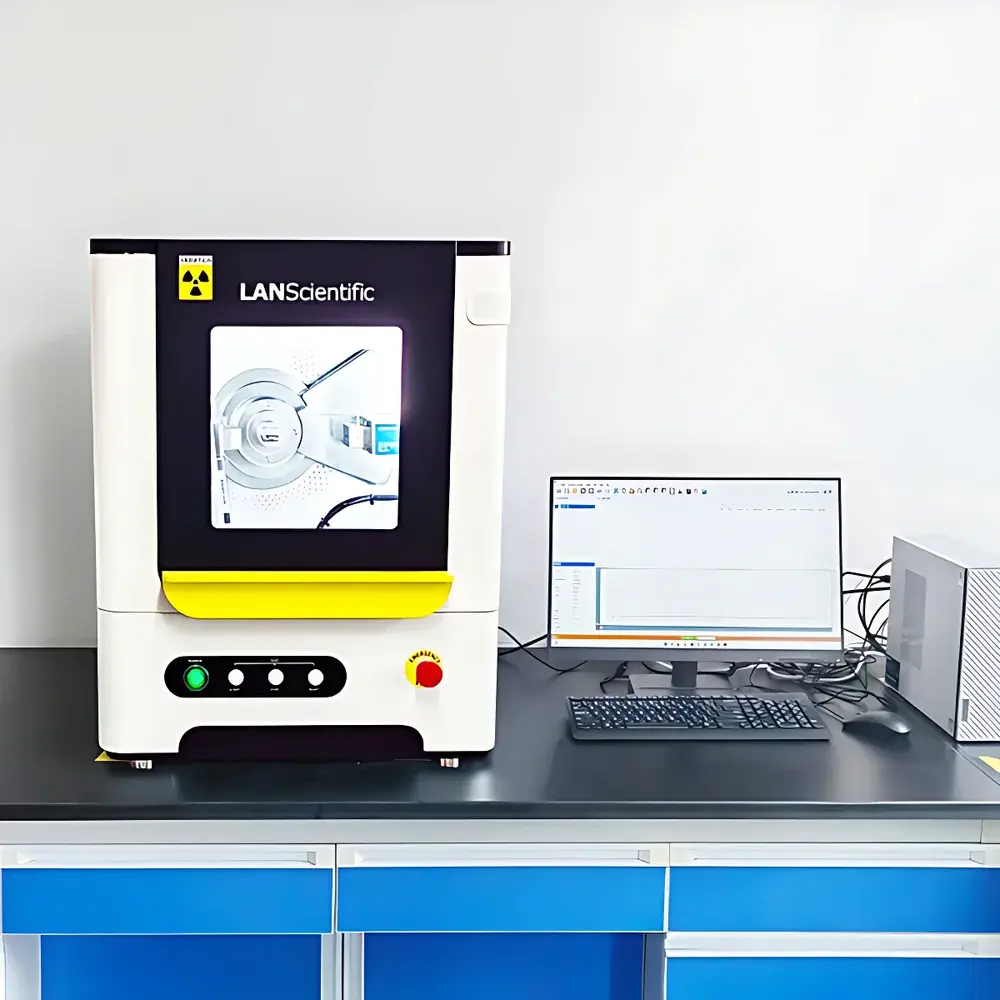
LANScientific FRINGE EV Desktop X-ray Diffractometer for Residual Stress Analysis in Metallic Materials
| Brand | LANScientific |
|---|---|
| Origin | Jiangsu, China |
| Manufacturer Type | Original Equipment Manufacturer (OEM) |
| Instrument Type | Powder X-ray Diffractometer |
| Geometry | Bragg–Brentano reflection (θs–θd) |
| Detector | Digital Pulse Processing Counter (DPPC), ≥1×10⁷ cps |
| Power | kW-class (integrated high-power microfocus X-ray source) |
| Compliance | CE-marked, IEC 61000-6-3/6-4, EN 62471 (UV/X-ray safety) |
| Sample Stage | Motorized goniometer with air-spring assisted large-window lift door |
Overview
The LANScientific FRINGE EV is a benchtop X-ray diffractometer engineered specifically for quantitative residual stress analysis, phase identification, and crystallographic characterization of metallic materials. It operates on the Bragg–Brentano θ–2θ reflection geometry, where monochromatic Cu Kα radiation (λ = 0.15406 nm) is collimated through integrated Soller slits and incident divergence slits onto the sample mounted at the center of a precision goniometer. When lattice planes satisfy Bragg’s law (nλ = 2d sinθ), diffracted beams are collected by a high-throughput Digital Pulse Processing Counter (DPPC) detector—eliminating the need for secondary monochromators while simultaneously enabling energy-dispersive spectral acquisition. The system’s kW-class microfocus X-ray source delivers enhanced photon flux without compromising thermal stability or beam coherence, enabling robust measurement of low-intensity diffraction peaks from textured or anisotropic metal alloys—including steel, aluminum, titanium, and nickel-based superalloys.
Key Features
- Integrated Soller slit assembly with zero-moving-parts design—ensures long-term angular reproducibility and minimizes mechanical drift during extended data collection.
- Air-spring assisted large-window lift door—provides full-sample access while maintaining Class I radiation shielding integrity; optimized footprint (≤0.8 m²) for integration into standard laboratory desks or mobile analytical platforms.
- DPPC detector with ≥1×10⁷ counts per second (cps) throughput—supports rapid scanning (≤3 min per 2θ scan from 10° to 90°) and concurrent acquisition of diffraction patterns and energy-dispersive X-ray spectra (EDS).
- Automated safety interlock system: real-time monitoring of chamber door status, automatic beam shutter closure upon door opening, and visual/audio alerts via touchscreen interface compliant with IEC 61508 functional safety principles.
- Ruggedized goniometer architecture with <0.001° step resolution—designed for repeatable positioning under vibration-prone environments, including vehicle-mounted or field-deployable laboratories.
Sample Compatibility & Compliance
The FRINGE EV accommodates solid metallic specimens in bulk, thin-film, and cross-sectional forms—including machined coupons, weld zones, shot-peened surfaces, and additive-manufactured parts. Its fixed-χ geometry supports both sin²ψ and cos²ψ stress evaluation protocols per ASTM E915-22 and ISO 21917:2021. All hardware and firmware comply with EU Directive 2014/30/EU (EMC), 2014/35/EU (LVD), and radiation safety requirements outlined in IEC 62495. Data acquisition workflows meet GLP/GMP documentation standards, with audit-trail-enabled software logging of operator actions, instrument parameters, and calibration history.
Software & Data Management
CrystalX™ analytical suite provides automated phase identification using ICDD PDF-4+ database (2023 edition), Rietveld refinement (TOPAS engine), crystallinity index calculation (Segal method), and residual stress mapping via peak shift analysis. Raw .raw and .xy files are exportable in CIF, CSV, and GSAS-II compatible formats. Software supports 21 CFR Part 11-compliant user authentication, electronic signatures, and role-based access control—validated for regulated QC/QA environments in aerospace, nuclear, and medical device manufacturing.
Applications
- Residual stress profiling in heat-treated, cold-worked, or welded structural components.
- Phase quantification in multi-phase alloys (e.g., ferrite/martensite ratio in dual-phase steels).
- Texture analysis of rolled or extruded metals using pole figure reconstruction.
- In-process quality verification for powder metallurgy and laser powder bed fusion (LPBF) builds.
- Corrosion product identification on pipeline steels or marine-grade aluminum alloys.
FAQ
Does the FRINGE EV support in-situ stress measurements under mechanical loading?
Yes—optional tensile/compression stages with synchronized encoder feedback enable real-time diffraction monitoring during uniaxial loading, compliant with ASTM E1426-21.
Can CrystalX software perform quantitative texture analysis?
Yes—it integrates ODF (orientation distribution function) calculation using WIMV and harmonic expansion methods, with output compatible with MTEX MATLAB toolbox.
Is remote operation supported for networked labs?
The system includes VNC-enabled secure remote desktop access and RESTful API endpoints for integration with LIMS and MES platforms.
What maintenance intervals are recommended for the X-ray tube?
The sealed-tube source requires annual vacuum integrity verification and filament emission testing; typical service life exceeds 15,000 operating hours under standard duty cycles.
How is radiation safety verified during installation?
Pre-commissioning survey reports must be generated by an accredited health physicist; LANScientific provides shielding validation templates aligned with NCRP Report No. 148 and local regulatory authority requirements.



