
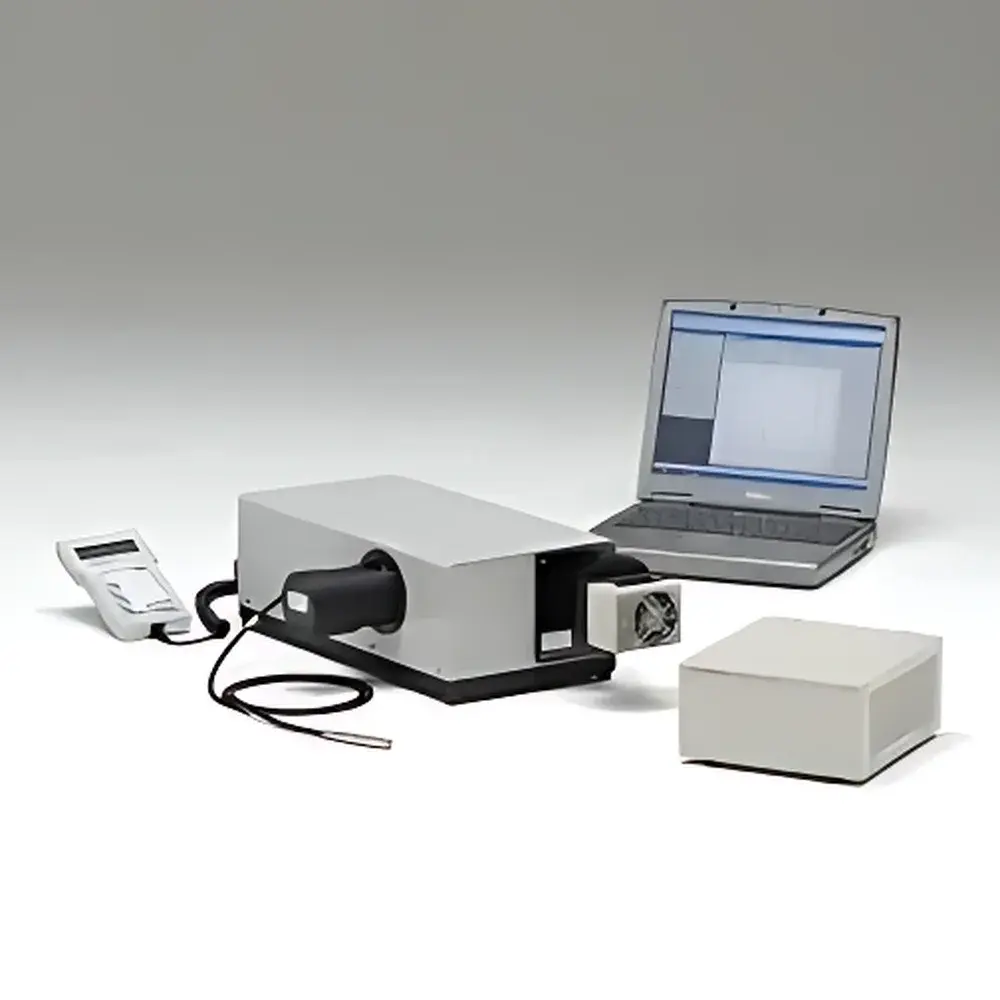
Hamamatsu PMA-50 Series Czerny-Turner Grating Spectrometer Monochromator
| Brand | Hamamatsu |
|---|---|
| Origin | Japan |
| Manufacturer Type | Original Equipment Manufacturer (OEM) |
| Product Category | Imported Instrument |
| Model | PMA-50 Series |
| Pricing | Available Upon Request |
| Wavelength Range (BT-CCD) | 200–1100 nm |
| Detector Channels (BT-CCD) | 1024 ch |
| Wavelength Range (InGaAs System 1) | 900–1700 nm |
| Detector Channels (InGaAs System 1) | 512 ch |
| Wavelength Range (InGaAs System 2) | 1200–2600 nm |
| Detector Channels (InGaAs System 2) | 256 ch |
| Optical Design | Czerny-Turner |
| Focal Length | 250 mm |
| f-number | f/4 |
| Linear Dispersion | 2.5 nm/mm (at 1200 gr/mm) |
| Grating Capacity | Up to 3 interchangeable gratings (50–1200 gr/mm) |
| Spectral Bandwidth | 61–737 nm (BT-CCD), 46–384 nm (InGaAs) |
| Spectral Resolution | 0.21–2.5 nm (BT-CCD), 0.23–2.0 nm (InGaAs System 1), 0.36–3.0 nm (InGaAs System 2) |
| Detector Cooling | −15 °C (BT-CCD), −10 °C (InGaAs Sys 1), −20 °C (InGaAs Sys 2) |
| Read Noise | 10 e⁻ (BT-CCD), 12,500 e⁻ (InGaAs) |
| Dark Current | 75 e⁻/scan (BT-CCD, −15 °C, 20 ms), 6750 e⁻/scan (InGaAs Sys 1, −10 °C, 5 ms), 6.25×10⁶ e⁻/scan (InGaAs Sys 2, −20 °C, 5 ms) |
| Integration Time | 5 ms – 64 s |
| A/D Resolution | 16 bit |
Overview
The Hamamatsu PMA-50 Series is a high-performance, modular Czerny-Turner grating spectrometer monochromator engineered for precision spectral analysis across ultraviolet, visible, and near-to-mid-infrared domains. Its optical architecture leverages a 250 mm focal length, f/4 imaging configuration with optimized aberration correction—enabling high throughput and spatial fidelity in both monochromatic and broadband acquisition modes. The system operates on the principle of angular dispersion: incident polychromatic light is collimated, diffracted by a ruled or holographic grating, and refocused onto a multi-channel linear detector array. Wavelength selection is achieved either via fixed grating configuration (for dedicated applications) or motorized grating turret (supporting up to three user-swappable gratings ranging from 50 to 1200 grooves/mm). This design ensures flexibility in resolution-bandwidth trade-offs without mechanical realignment, making it suitable for laboratory-based R&D, process monitoring, and OEM integration into analytical platforms.
Key Features
- Modular detector interchangeability: Supports three distinct detection configurations—BT-CCD (200–1100 nm), InGaAs System 1 (900–1700 nm), and InGaAs System 2 (1200–2600 nm)—each optimized for quantum efficiency, dark current suppression, and dynamic range in its respective spectral window.
- Thermoelectrically cooled detectors: BT-CCD operates at −15 °C; InGaAs System 1 at −10 °C; InGaAs System 2 at −20 °C—reducing thermal noise to enable low-light spectroscopy and extended integration times (down to 5 ms, up to 64 s).
- High-fidelity Czerny-Turner optical bench: Precision-machined aluminum housing with kinematic mirror mounts ensures long-term alignment stability and minimal thermal drift (<0.05 pixels/°C).
- 16-bit analog-to-digital conversion: Delivers >96 dB dynamic range and quantization steps of ≤0.0015% full scale—critical for resolving weak emission lines adjacent to strong background features.
- Grating turret with automated wavelength calibration: Integrated reference LED and onboard photodiode enable traceable wavelength validation per ASTM E275 and ISO 17025-compliant workflows.
- Standardized mechanical and electrical interfaces: Includes SMA905 fiber input, kinematic mounting flanges (per SEMI E10), and USB 3.0 + TTL trigger I/O for synchronization with pulsed lasers or external detectors.
Sample Compatibility & Compliance
The PMA-50 accommodates free-space, fiber-coupled (core diameters 50–600 µm), and liquid light guide inputs. It is routinely deployed in transmission, fluorescence, reflectance, and absorbance geometries—including integrating sphere coupling for diffuse reflectance measurements per ASTM E308 and ISO/CIE 11664-4. All detector modules meet RoHS Directive 2011/65/EU and are CE-marked for EMC Directive 2014/30/EU. Firmware supports audit-trail logging compliant with FDA 21 CFR Part 11 requirements when used with validated third-party data acquisition software. Calibration certificates (NIST-traceable wavelength and radiometric) are available upon request for GLP/GMP-regulated environments.
Software & Data Management
Hamamatsu provides the proprietary PMA Control Software (Windows 10/11, 64-bit), offering real-time spectrum visualization, multi-curve overlay, peak identification (with Gaussian/Lorentzian fitting), and export to CSV, HDF5, or JCAMP-DX formats. SDKs for C++, Python (PyHamamatsu), and LabVIEW facilitate custom automation in QC/QA pipelines. Raw frame data retain full 16-bit depth and metadata (exposure time, grating ID, detector temperature, slit width), enabling post-acquisition reprocessing without loss of fidelity. Time-resolved mode supports burst acquisition at up to 100 spectra/s (BT-CCD) or 200 spectra/s (InGaAs System 1), with hardware timestamping referenced to GPS-synchronized PPS signals for cross-platform temporal correlation.
Applications
- Photoluminescence quantum yield (PLQY) measurement in perovskite and quantum dot research
- In-line NIR monitoring of polymer crystallinity and moisture content in extrusion processes
- Gas-phase absorption spectroscopy for CH₄, CO, and NH₃ detection using tunable diode laser absorption spectroscopy (TDLAS) backend processing
- Plasma diagnostics in semiconductor etch chambers via O, N₂⁺, and Ar line intensity ratio analysis
- UV-Vis-NIR reflectance profiling of anti-reflective coatings and thin-film solar cells (per IEC 61215 and ASTM E903)
- Time-resolved fluorescence lifetime spectroscopy when synchronized with picosecond pulsed LEDs or lasers
FAQ
Can the PMA-50 be operated in scanning monochromator mode?
Yes—the grating turret supports manual or motorized selection of discrete wavelengths; scanning is implemented via software-controlled grating rotation with closed-loop encoder feedback and real-time wavelength interpolation.
Is vacuum purging supported for UV operation below 200 nm?
No; the standard optical path is air-filled. For sub-200 nm applications (e.g., 185 nm D₂ lamp lines), optional nitrogen purge adapters and MgF₂-coated optics are available as factory-configured options.
What is the typical wavelength repeatability over 8 hours of continuous operation?
≤±0.05 nm (RMS) under ambient temperature variation of ±2 °C, verified using Hg/Ne spectral lamp lines and internal reference channel monitoring.
Are calibration files compatible across different PMA-50 detector modules?
Wavelength calibration is grating-specific and detector-specific; however, the software maintains separate calibration tables per module-grating combination and auto-selects the appropriate one during initialization.
Does the system support external triggering with TTL-compatible devices?
Yes—dedicated IN/OUT BNC ports provide programmable exposure gating, frame synchronization, and shutter control with ≤100 ns jitter, fully compatible with National Instruments DAQ systems and Thorlabs T-Cube controllers.




