
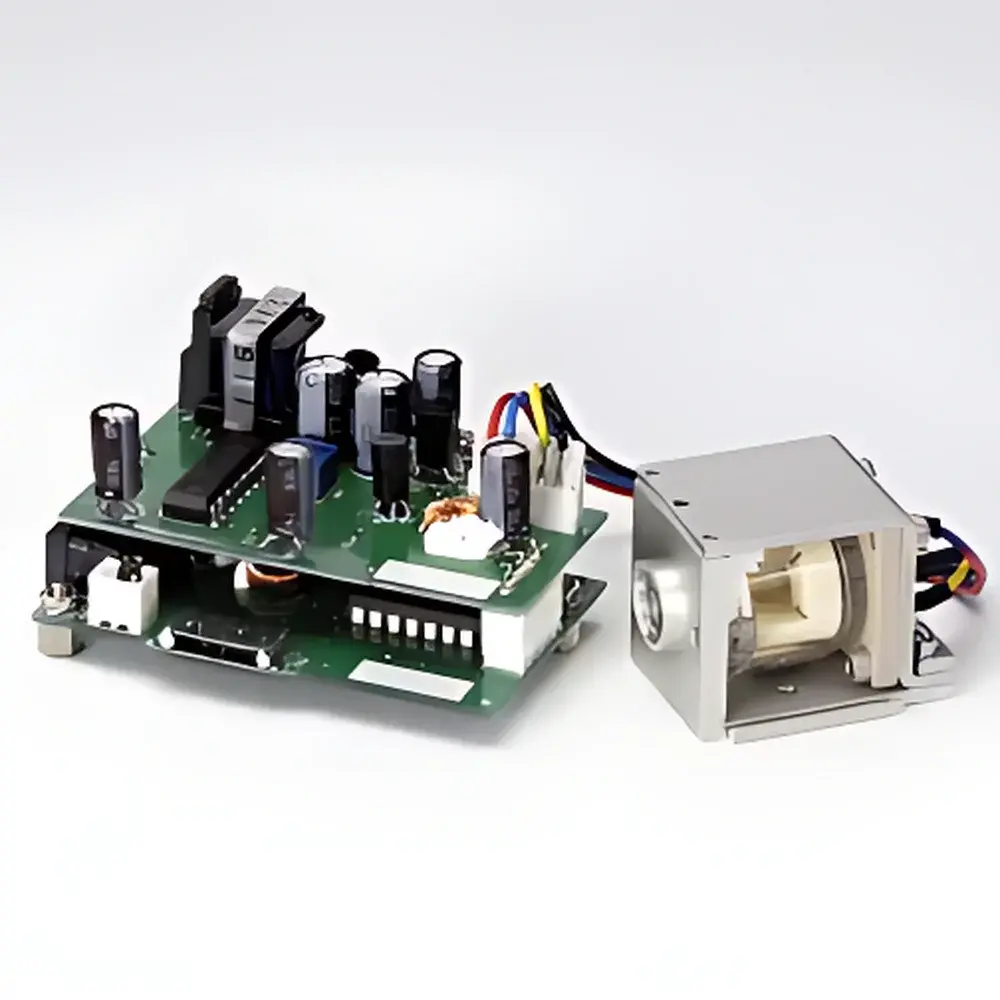
Hamamatsu S2D2 Compact Deuterium Lamp Module (L10671D / L10671P / L10671H)
| Brand | Hamamatsu |
|---|---|
| Origin | Japan |
| Manufacturer Type | Original Equipment Manufacturer (OEM) |
| Product Category | Imported |
| Models | L10671D (lamp), L10671P (power supply), L10671H (lamp housing) |
| Light Source Type | Continuous-wave deuterium lamp |
| Illumination Mode | External illumination |
| Stability | ±0.005% p-p (typical, equivalent to 2 × 10⁻⁵ A.U.) |
| Spectral Range | 190–400 nm (UV-Vis continuum) |
| Power Consumption | <15 W (lamp + driver, typical) |
| Lifetime | ≥2,000 hours (defined as time until 230 nm output drops to 50% of initial intensity or stability degrades beyond ±0.05% p-p) |
| Control Interface | TTL-compatible external trigger (±5 V, 200 ms toggle interval) |
| Cooling Requirement | Conduction-cooled only |
Overview
The Hamamatsu S2D2 Compact Deuterium Lamp Module is an engineered UV point source designed for integration into analytical and optical instrumentation where space constraints, spectral stability, and long-term reliability are critical. Based on a miniaturized deuterium arc discharge principle, the S2D2 generates a continuous, high-radiance spectrum from 190 nm to 400 nm—covering the deep and near ultraviolet region essential for absorption spectroscopy, HPLC detection, and spectrophotometric calibration. Unlike conventional deuterium lamps, the S2D2 employs an optimized electrode geometry and sealed quartz envelope to achieve exceptional radiometric stability (±0.005% peak-to-peak, typical) without compromising compactness. Its modular architecture comprises three interoperable components: the lamp head (L10671D), a dedicated constant-current DC power supply (L10671P), and a thermally managed lamp housing (L10671H). This tripartite design enables precise thermal control, electromagnetic isolation, and seamless OEM integration—making it suitable for embedded applications in benchtop spectrometers, environmental analyzers, pharmaceutical QC systems, and semiconductor metrology platforms.
Key Features
- Ultra-compact form factor: Lamp head dimensions ≤ Ø12.7 mm × 38 mm (L10671D), enabling installation in confined optical paths and portable instruments.
- High spectral stability: Radiometric fluctuation maintained at ≤0.005% p-p (typical) over 8-hour continuous operation—validated per Hamamatsu internal test protocol (JIS Z 8103 compliant methodology).
- OEM-optimized interface: TTL-compatible external control input allows synchronized lamp activation/deactivation with detector acquisition cycles, supporting time-resolved absorbance measurements.
- Low-power operation: Total system power draw <15 W under nominal conditions, reducing thermal load and simplifying thermal management in enclosed instruments.
- Extended operational lifetime: Rated ≥2,000 hours based on 230 nm output decay to 50% of initial irradiance or degradation of stability beyond ±0.05% p-p—aligned with ISO/IEC 17025 traceable aging criteria.
- Conduction-only thermal design: Lamp housing (L10671H) features integrated aluminum heatsinking; forced-air cooling is explicitly prohibited to prevent arc instability and quartz envelope stress.
Sample Compatibility & Compliance
The S2D2 module is compatible with standard UV-grade optical components including fused silica lenses, MgF₂ windows, and broadband diffraction gratings. It meets RoHS Directive 2011/65/EU requirements and conforms to IEC 61000-6-3 (EMC emission limits) and IEC 61000-6-2 (immunity standards) when operated within specified voltage (8.5–13.2 V DC) and ambient temperature (15–35 °C) ranges. For regulated environments—including pharmaceutical QC labs operating under USP , FDA 21 CFR Part 11, and ISO/IEC 17025—system integrators must implement audit-trail-capable firmware to log lamp runtime, control signal timestamps, and intensity calibration events. The lamp’s stable UV output supports compliance with ASTM E275 (standard practice for UV-Vis spectrophotometer qualification) and ISO 6425 (spectral bandwidth verification protocols).
Software & Data Management
While the S2D2 hardware operates autonomously, full system-level data integrity requires integration with host instrument software capable of timestamped event logging. Hamamatsu provides pinout documentation and electrical interface specifications (including 3-pin TTL trigger mapping and analog monitoring outputs) for seamless incorporation into LabVIEW, Python-based DAQ frameworks, or proprietary embedded firmware. When deployed in GLP/GMP-compliant instruments, the external trigger signal must be recorded alongside spectral data to ensure traceability of lamp-on timing relative to detector readout—supporting ALCOA+ principles (Attributable, Legible, Contemporaneous, Original, Accurate, Complete, Consistent, Enduring, Available). No proprietary drivers or cloud services are required; all communication remains hardware-level and deterministic.
Applications
- HPLC-UV detectors requiring stable, low-noise baseline performance across 190–360 nm.
- Microplate readers (MTP) for enzyme-linked immunosorbent assays (ELISA) and nucleic acid quantification.
- Environmental water quality analyzers measuring nitrate, nitrite, and organic carbon via UV absorption.
- In-line process spectrophotometers for semiconductor wafer cleaning validation and photoresist thickness monitoring.
- Benchtop UV-Vis spectrophotometers used in academic research and materials characterization laboratories.
- Calibration sources for NIST-traceable reference spectroradiometers and radiometric transfer standards.
FAQ
What defines end-of-life for the L10671D lamp?
End-of-life is reached when radiant output at 230 nm falls to 50% of its initial value—or when peak-to-peak intensity fluctuation exceeds ±0.05% under stabilized operating conditions. This criterion aligns with Hamamatsu’s internal lifetime qualification protocol.
Can the S2D2 lamp be air-cooled?
No. Direct forced-air cooling is strictly prohibited. Thermal management must rely solely on conduction through the L10671H housing baseplate to a thermally anchored chassis or heatsink.
Is the L10671P power supply compatible with third-party controllers?
Yes—provided the controller delivers clean, ripple-free DC voltage within 8.5–13.2 V and implements proper grounding per Hamamatsu’s EMC guidelines. Pinout diagrams and timing specifications are publicly available in the technical datasheet.
Does the S2D2 module support analog intensity modulation?
No. Intensity control is binary (on/off) via TTL trigger. Analog dimming is not supported due to arc physics constraints inherent to deuterium discharge lamps.
How is spectral calibration performed with the S2D2?
Users typically employ NIST-traceable holmium oxide or didymium filters for wavelength verification, and calibrated photodiodes or spectroradiometers for irradiance calibration—following procedures outlined in ISO/IEC 17025-accredited laboratories.




