
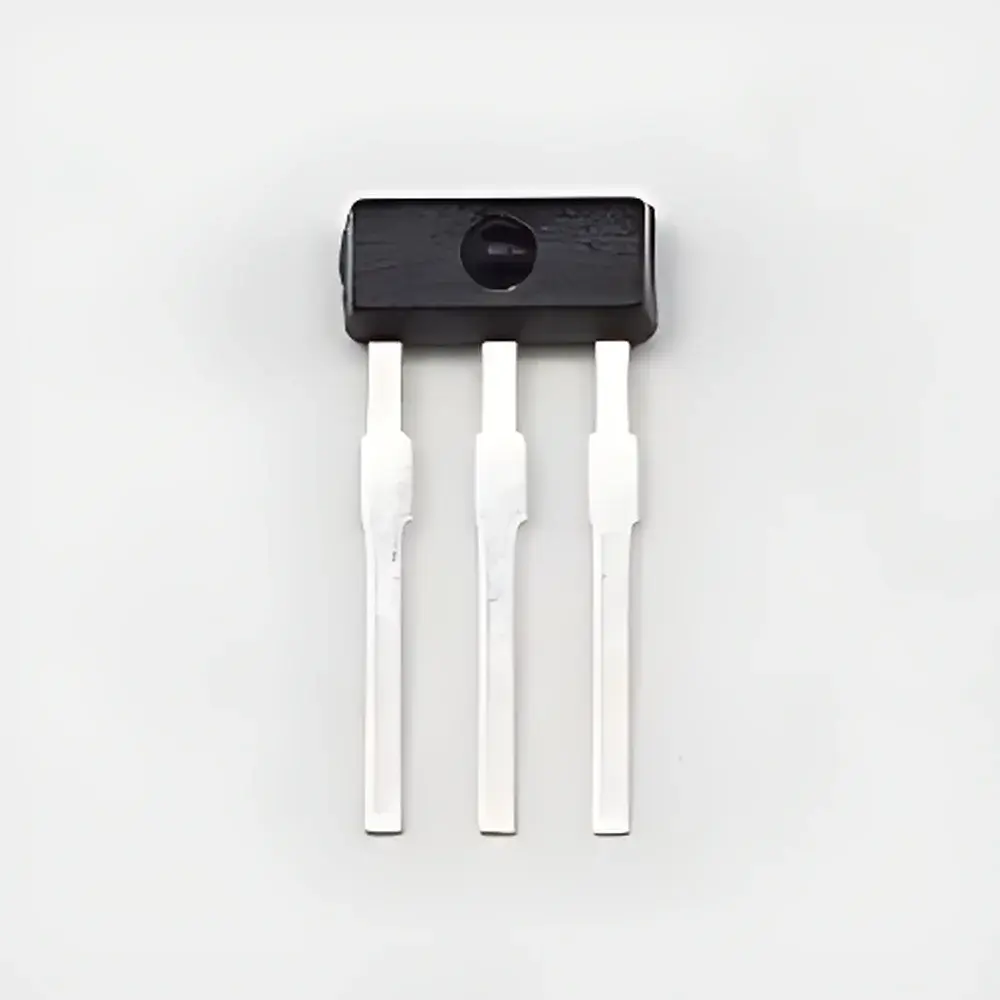
Hamamatsu S4810 Schmidt-Trigger Optical Integrated Circuit (Opto-IC)
| Brand | Hamamatsu |
|---|---|
| Origin | Japan |
| Manufacturer Type | Original Equipment Manufacturer (OEM) |
| Import Status | Imported |
| Model | S4810 |
| Component Category | Optical Component |
| Package | Plastic with Integrated Lens |
| Spectral Rejection | Visible-Light Shielded |
| Operating Voltage | Low-Voltage (Typ. 3.3–5 V DC) |
| Output Configuration | Open-Collector |
| Logic Polarity | High-Level Output on Illumination |
Overview
The Hamamatsu S4810 Schmidt-Trigger Optical Integrated Circuit (Opto-IC) is a monolithic, high-reliability photoelectric sensor designed for precise digital light detection in industrial control, laboratory instrumentation, and automated optical gating applications. Engineered using Hamamatsu’s proprietary silicon photodiode fabrication process, the device integrates three functional blocks on a single die: a visible-light-shielded photodiode, a hysteresis-equipped Schmitt trigger comparator circuit, and an NPN open-collector output transistor. This integration eliminates external signal conditioning components—such as amplifiers, comparators, or pull-up resistors—reducing board space, improving noise immunity, and enhancing long-term stability. The built-in hysteresis (typically ±15% of threshold irradiance) prevents output oscillation under marginal illumination conditions, ensuring robust switching behavior even with slow-rising or noisy input light signals. Unlike analog photodetectors, the S4810 delivers clean, TTL/CMOS-compatible digital logic transitions—H-level output upon sufficient incident irradiance—making it ideal for edge-detection, position sensing, and optical interrupter systems in regulated environments.
Key Features
- Monolithic integration of photodiode, Schmitt trigger, and open-collector output transistor on a single silicon chip
- Visible-light shielding via on-chip optical filter, minimizing response to ambient room lighting (peak sensitivity at ~850 nm, aligned with standard IR LEDs)
- Low-voltage operation compatible with 3.3 V and 5 V logic families; typical supply current < 1.2 mA at VCC = 5 V
- Hysteresis width optimized for stable switching across temperature (−20 °C to +70 °C operating range) and supply voltage variation
- Plastic TO-18-style package with integrated collimating lens, providing directional sensitivity and improved signal-to-noise ratio
- Open-collector output supports wired-OR configuration, level shifting, and direct interfacing with microcontrollers, PLCs, and FPGA I/O banks
- AEC-Q200 stress-tested for reliability in continuous-duty instrumentation applications
Sample Compatibility & Compliance
The S4810 is intended for use with near-infrared (NIR) light sources—particularly 850 nm or 940 nm LEDs—and exhibits negligible response to wavelengths below 600 nm due to its integrated spectral filter. It complies with JIS C 5062 (Japanese Industrial Standard for optoelectronic devices) and meets RoHS Directive 2011/65/EU requirements for hazardous substance restriction. While not certified for safety-critical functions per IEC 61508, its design adheres to GLP-aligned traceability protocols for component-level documentation, including lot-specific photometric calibration data available upon request. Device-level ESD protection exceeds ±2 kV (HBM), supporting handling in ISO Class 5 cleanroom assembly lines.
Software & Data Management
As a passive, analog-to-digital signal conversion component, the S4810 does not incorporate embedded firmware or require driver software. Its output is directly compatible with standard digital acquisition hardware—including National Instruments DAQ modules, Keysight U2300A series, and Raspberry Pi GPIO inputs—enabling seamless integration into LabVIEW, Python (via RPi.GPIO or PyDAQmx), or MATLAB Data Acquisition Toolbox workflows. When deployed in validated systems, the device supports audit-trail-capable logging when paired with compliant data acquisition platforms that implement FDA 21 CFR Part 11-compliant electronic signatures and change-control mechanisms.
Applications
- Optical encoders and rotary position sensors in precision motion control systems
- Object presence detection in automated sample-handling stages (e.g., autosamplers, robotic arms)
- Beam-break detection in laser safety interlock circuits per IEC 61497-1
- Light-barrier-based particle counting in aerosol or liquid flow cells
- Reference-edge generation for time-of-flight (ToF) measurements in pulsed-light setups
- Non-contact limit switches in vacuum or chemically aggressive environments where mechanical wear is unacceptable
FAQ
What is the typical response time from light exposure to logic-level transition?
Rise/fall time is ≤ 1.5 µs at VCC = 5 V with 10 kΩ pull-up load, measured under standardized 10–90% irradiance step conditions.
Can the S4810 be used with AC-coupled light sources?
No—it responds only to DC or slowly varying irradiance; modulation frequencies above 10 kHz require dedicated photodiode+amplifier solutions.
Is there a recommended minimum load resistance for the open-collector output?
Yes: 1 kΩ to 10 kΩ pull-up resistor to VCC ensures optimal noise margin and switching speed while limiting power dissipation.
Does Hamamatsu provide radiometric calibration certificates for individual S4810 units?
Standard production units ship without unit-level calibration; however, batch-level spectral responsivity and threshold irradiance data are documented in the manufacturer’s test report (available upon order confirmation).






