
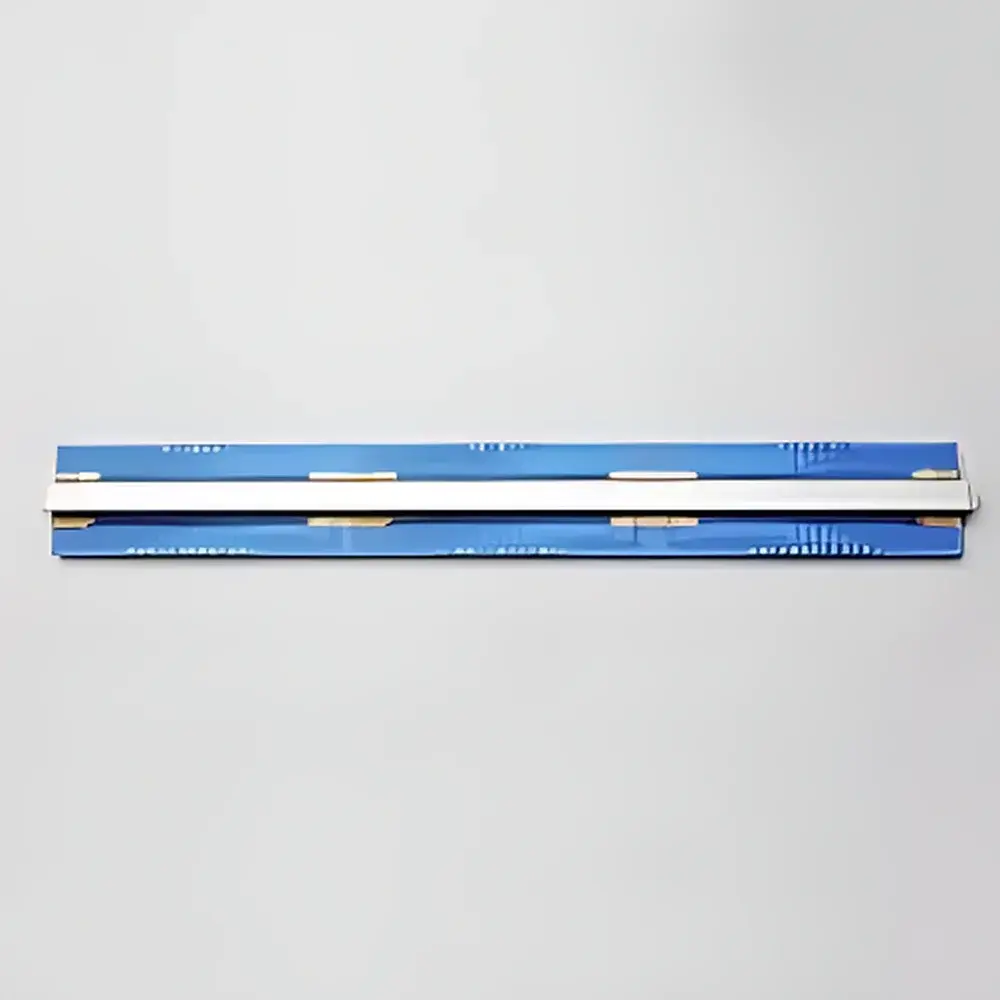
Hamamatsu S8658-01 / S8658-01F X-ray Line-Scan CCD Detector for Industrial Micro-CT and NDT Systems
| Brand | Hamamatsu |
|---|---|
| Origin | Japan |
| Manufacturer Type | Original Equipment Manufacturer (OEM) |
| Import Status | Imported |
| Model | S8658-01 / S8658-01F |
| Frame Rate (typ.) | 15 fps |
| Active Image Area (per chip) | 73.728 mm × 6.144 mm |
| Pixel Pitch | 48 µm |
| Total Pixels | 4608 × 128 (3 × 1536 × 128) |
| Pixel Size | 48 µm × 48 µm |
| Fill Factor | 100% |
| Scintillator | CsI(Tl) + Fiber Optic Plate (FOP) (S8658-01) / FOP only, no scintillator (S8658-01F) |
| Package | Ceramic |
| TDI Mode | Supported |
| Dynamic Range | Wide |
| Dark Current | Low |
| Operation Mode | MPP (Multi-Pinned Phase) |
Overview
The Hamamatsu S8658-01 and S8658-01F are high-performance, linear-array CCD-based X-ray detectors engineered for demanding industrial non-destructive testing (NDT) and micro-computed tomography (micro-CT) applications. Unlike conventional area-scan detectors, these devices employ a unique triple-CCD architecture arranged in precise abutment to form a continuous 220 mm active imaging length—ideal for high-throughput inline inspection of moving samples on conveyor systems. Each individual CCD chip features an optical format of 73.728 mm (H) × 6.144 mm (V), with 1536 × 128 pixels at a uniform 48 µm pitch. The detector operates on the principle of indirect X-ray detection: incident X-ray photons are first converted into visible light by a structured cesium iodide (CsI:Tl) scintillator coupled via a fiber optic plate (FOP), then imaged onto the CCD photosensitive surface. The S8658-01F variant omits the integrated scintillator, allowing users to select and bond custom phosphor screens (e.g., Gd₂O₂S:Tb or structured CsI) optimized for specific X-ray energy ranges (typically 20–150 kVp) and resolution requirements.
Key Features
- Triple-CCD linear array architecture delivering 220 mm effective field-of-view without mechanical stitching or image registration artifacts
- True Time-Delay Integration (TDI) operation enabling high-SNR imaging of continuously moving objects at line rates synchronized with conveyor velocity
- 100% fill factor pixel design ensures maximum quantum efficiency and eliminates spatial sampling gaps inherent in interline-transfer architectures
- Low dark current and multi-pinned phase (MPP) mode operation support extended integration times and high dynamic range (>70 dB typical)
- Ceramic hermetic packaging provides long-term stability under industrial environmental conditions including thermal cycling and humidity exposure
- Flexible configuration: S8658-01 includes integrated CsI(Tl)+FOP for rapid deployment; S8658-01F supports user-defined scintillator bonding for spectral optimization and resolution tuning
Sample Compatibility & Compliance
The S8658 series is compatible with standard industrial X-ray sources (microfocus to nanofocus tubes) and integrates seamlessly into OEM micro-CT gantries, laminography stations, and automated NDT lines. Its 48 µm pixel pitch enables effective spatial resolution down to ~100 µm (MTF₅₀) when paired with appropriate focal spot size and geometric magnification. The detector complies with IEC 61223-3-5 for medical-grade image quality validation protocols and supports traceable calibration per ASTM E2737 (Standard Practice for Digital Detector Array Performance Evaluation). For regulated manufacturing environments, raw image data output adheres to DICOM Supplement 145 (Digital Radiography) and supports audit-trail-enabled acquisition software compliant with FDA 21 CFR Part 11 requirements when deployed with validated host systems.
Software & Data Management
Hamamatsu provides the DCU-1000 driver SDK (Windows/Linux) supporting GenICam-compliant interface abstraction, enabling integration with third-party reconstruction engines (e.g., Octopus, VGStudio MAX, or custom CUDA-accelerated backprojectors). The detector outputs 16-bit linear grayscale frames at up to 15 fps in full-resolution mode, with programmable ROI readout and hardware binning options. All firmware updates, gain/offset calibration tables, and TDI timing parameters are stored in non-volatile memory and accessible via Ethernet or Camera Link interface. Raw frame metadata—including exposure time, temperature, and sensor bias state—is embedded in each image header to ensure GLP/GMP traceability during QA/QC workflows.
Applications
- High-speed inline inspection of castings, welds, and composite laminates in aerospace and automotive production lines
- High-resolution micro-CT scanning of electronic packages (PCBs, BGA solder joints, MEMS devices) requiring sub-100 µm defect localization
- Laminographic analysis of planar components such as solar cells, battery electrodes, and thin-film modules
- Preclinical small-animal imaging where longitudinal studies demand consistent SNR and geometric stability across repeated acquisitions
- Custom radiography systems requiring scalable FOV extension through modular detector tiling
FAQ
What is the difference between the S8658-01 and S8658-01F models?
The S8658-01 integrates a CsI(Tl) scintillator bonded directly to the fiber optic plate, providing out-of-the-box sensitivity for general-purpose X-ray imaging. The S8658-01F ships with the FOP only, permitting end-users to apply application-specific phosphors—including high-resolution structured CsI or fast-decay Gd₂O₂S—to optimize trade-offs among DQE, resolution, and frame rate.
Can this detector be used in computed tomography reconstruction?
Yes—its precise pixel pitch, low geometric distortion (<0.05% radial), and stable gain response across temperature make it suitable for fan-beam and cone-beam CT geometries. Calibration data (flat-field, dark-field, and pixel response nonuniformity maps) are provided to support accurate sinogram correction.
Is TDI mode supported in both models?
Yes—TDI functionality is implemented at the CCD clocking level and is independent of scintillator configuration. Both models support fully programmable TDI stages (1–128 lines) synchronized to external encoder signals.
What cooling options are available?
The detector operates in thermoelectrically stabilized mode (±0.1°C) using the optional C9810-01 cooling module. No forced-air or liquid cooling is required for standard industrial ambient conditions (15–35°C).
Does Hamamatsu provide radiometric calibration certificates?
Upon request, NIST-traceable quantum efficiency (QE) and modulation transfer function (MTF) characterization reports can be supplied, aligned to ISO 15708-2 and ASTM E2737 test methodologies.



