
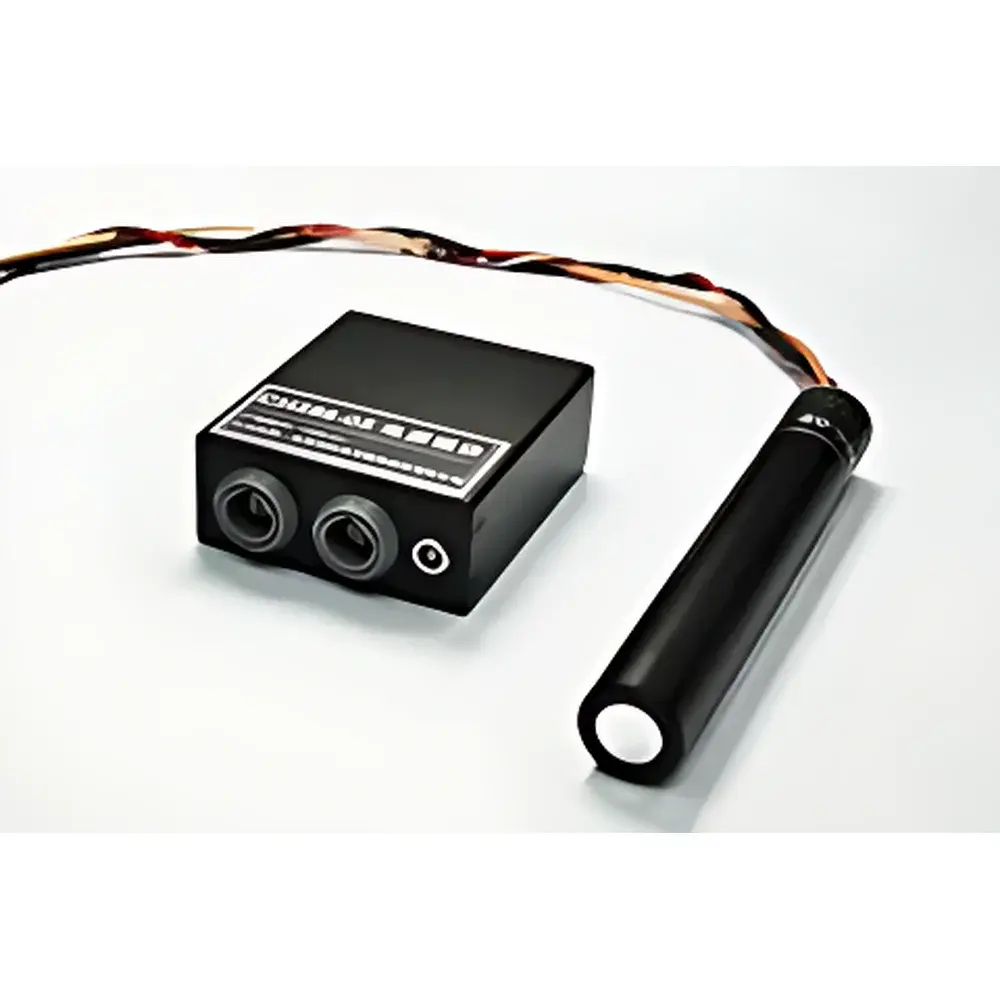
Hamamatsu Scintillation Detector CH286-05
| Brand | Hamamatsu Photonics (BHP) |
|---|---|
| Origin | Beijing, China |
| Manufacturer Type | Authorized Distributor |
| Country of Manufacture | China |
| Model | CH286-05 |
| Measurement Principle | Beta-ray Attenuation Method |
| Measured Parameters | PM10 and PM2.5 |
| Output Signal | TTL-compatible pulse output with fixed amplitude |
| Key Performance | Low-noise operation, wide dynamic range, high detection efficiency, robust mechanical and thermal stability |
Overview
The Hamamatsu Scintillation Detector CH286-05 is a precision solid-state radiation detector engineered for quantitative atmospheric particulate matter monitoring via the beta-ray attenuation (β-attenuation) method. Unlike optical scattering or gravimetric techniques, this detector leverages the controlled absorption of low-energy beta particles—typically emitted from a 14C or 85Kr source—as airborne aerosols accumulate on a filter tape. The scintillation crystal (typically plastic or organic scintillator) coupled to a photomultiplier tube (PMT) or silicon photomultiplier (SiPM) converts incident beta radiation into measurable light pulses. These pulses are then converted into standardized TTL-level digital signals with consistent amplitude and timing characteristics—enabling direct integration with industrial data acquisition systems without analog signal conditioning. Designed for continuous, unattended operation in ambient air quality monitoring stations, the CH286-05 delivers traceable mass concentration data for both PM10 and PM2.5 fractions in compliance with ISO 12103-1, EN 12341, and EPA EQOA-01 reference methodologies.
Key Features
- Optimized scintillation detection architecture for low-energy beta radiation (Emax ≈ 156 keV for 14C), ensuring high counting efficiency (>35% typical) and minimal background interference.
- TTL-compatible pulse output with fixed amplitude and <50 ns rise time—eliminates need for external discriminators or pulse-shaping circuits in OEM instrument designs.
- Low electronic noise floor (<0.5 mV RMS) and wide linear dynamic range (102–106 counts per second), supporting accurate quantification across urban, rural, and industrial particulate load conditions.
- Thermally stable housing with integrated temperature compensation circuitry, maintaining calibration integrity over –20 °C to +50 °C ambient operating range.
- Modular mechanical interface compatible with standard filter tape transport mechanisms (e.g., 40 mm wide polytetrafluoroethylene [PTFE] or glass fiber tapes) used in regulatory-grade β-attenuation monitors.
- No high-voltage bias required for operation—reducing power consumption and electromagnetic compatibility (EMC) concerns in multi-sensor environmental enclosures.
Sample Compatibility & Compliance
The CH286-05 is validated for use with certified filter media meeting ISO 21507 and ASTM D1357 specifications, including quartz fiber, Teflon-coated glass fiber, and PVC-membrane substrates. Its geometry and active area (12 mm diameter nominal) align with EPA Reference Method PS-11 and Chinese HJ 653–2013 requirements for β-attenuation-based PM analyzers. When integrated into a full-system monitor, the detector supports compliance with national and international air quality standards—including China’s GB 3095–2012, EU Directive 2008/50/EC, and WHO Air Quality Guidelines (2021). Data outputs are structured to support audit-ready logging under GLP and ISO/IEC 17025-accredited laboratory environments.
Software & Data Management
The detector operates as a hardware sensor node—requiring no embedded firmware or local processing. Raw TTL pulses are acquired via standard digital I/O interfaces (e.g., NI USB-6009, Advantech USB-4711A) and processed using configurable LabVIEW VIs, Python-based acquisition scripts (with PyDAQmx or libnidaqmx), or proprietary OEM firmware. Pulse counting intervals (e.g., 1-, 5-, or 60-minute bins) and background subtraction routines are implemented at the system level to meet US EPA 40 CFR Part 53 and ISO 20985:2017 data validation criteria. All timestamped count data may be exported in CSV or NetCDF format, with metadata fields compliant with CF-1.8 conventions for long-term environmental archives.
Applications
- Regulatory-grade ambient air quality monitoring networks (AQMNs) for real-time PM2.5/PM10 reporting to national environmental agencies.
- OEM integration into portable or mobile particulate monitors for roadside, industrial fence-line, and construction site monitoring.
- Research applications requiring high-temporal-resolution beta-counting data—e.g., aerosol hygroscopicity studies, filter loading kinetics, and source apportionment modeling.
- Calibration transfer verification between reference-grade and equivalent-method instruments in metrology laboratories.
- Long-term trend analysis in climate observatories where detector stability and interannual reproducibility are critical.
FAQ
Does the CH286-05 include a radioactive source?
No—the detector itself contains no radioactive material. It is designed to detect beta radiation emitted from an externally mounted sealed 14C or 85Kr source within the host monitor assembly.
Is factory calibration traceable to national standards?
Yes—each unit undergoes response uniformity testing against NIST-traceable beta sources and is supplied with a certificate of conformance referencing ISO/IEC 17025-accredited calibration procedures.
Can it operate in high-humidity environments?
When installed in a properly sealed and desiccated instrument housing with heated inlet and filter tape path, the detector maintains performance up to 95% RH non-condensing per IEC 60068-2-30.
What maintenance is required?
No routine maintenance is needed. Optical window cleaning is recommended only if particulate deposition is observed during annual system inspection—per manufacturer’s service manual.
Is software development support available?
Hamamatsu provides TTL timing specifications, pulse width tolerances, and electrical interface schematics under NDA; application-level SDKs are provided by OEM partners integrating the detector into complete monitoring systems.
Related Products







