
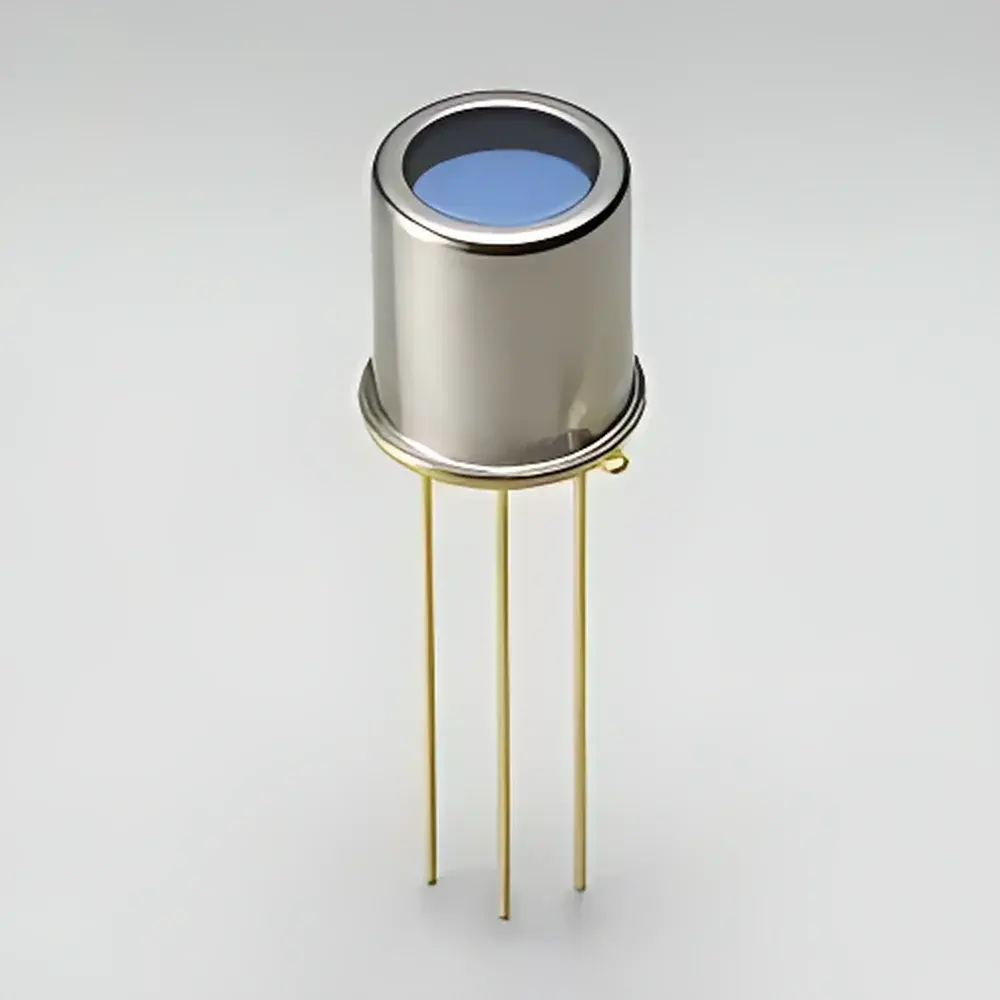
Hamamatsu Silicon Photodiode S12742-275
| Brand | Hamamatsu |
|---|---|
| Origin | Japan |
| Manufacturer Type | Original Equipment Manufacturer (OEM) |
| Product Category | Imported Optical Component |
| Model | S12742-275 |
| Component Type | UV-Optimized Photodetector |
| Spectral Range | 271–279 nm (Peak at 275 nm) |
| Active Area | 3.6 × 3.6 mm² |
| Photosensitivity (Typ.) | 0.01 A/W @ 275 nm |
| Dark Current (Max.) | 25 pA @ VR = 10 mV |
| Reverse Voltage (Max.) | 5 V |
| Rise Time (Typ.) | 1 µs |
| Junction Capacitance (Typ.) | 500 pF @ VR = 0 V, f = 10 kHz |
| Package | Hermetically Sealed Metal Can |
| Cooling | Non-cooled |
| Operating Temperature | Typical Ta = 25 °C |
Overview
The Hamamatsu S12742-275 is a high-stability, interference-filter-integrated silicon photodiode engineered for precise detection of ultraviolet radiation centered at 275 nm. Unlike broadband Si photodiodes, this device incorporates a hard-coated, narrowband interference filter directly deposited onto the active surface—eliminating external optical alignment and minimizing stray-light-induced measurement uncertainty. Its spectral response is tightly constrained to 271–279 nm (FWHM ≈ 8 nm), making it ideal for applications requiring selective UV-C monitoring where adjacent wavelength contributions must be suppressed—such as germicidal lamp output verification, ozone absorption spectroscopy, or UV photolysis reaction monitoring. The device operates on photovoltaic or photoconductive principles depending on bias configuration, with low dark current and fast temporal response enabling reliable integration into time-resolved UV intensity measurement systems.
Key Features
- Integrated interference filter: Monolithic 275 nm bandpass filter eliminates need for external optics and ensures long-term spectral stability under thermal cycling.
- Large active area (3.6 × 3.6 mm²): Facilitates efficient light collection from collimated or moderately divergent UV beams without demanding focusing optics.
- Low-noise metal-can package: Hermetically sealed TO-5 housing provides mechanical robustness and environmental protection against humidity-induced degradation—a critical factor for UV-sensitive Si surfaces.
- Fast dynamic response: 1 µs rise time supports pulse-width measurements of pulsed UV sources (e.g., flash lamps, UV LEDs) and real-time irradiance feedback control loops.
- Low junction capacitance (500 pF typical): Enables high signal-to-noise ratio in transimpedance amplifier configurations, especially when paired with low-noise op-amps optimized for UV photodiode interfacing.
- No active cooling required: Designed for stable operation at ambient temperatures up to +50 °C, reducing system complexity and power overhead in embedded or portable instrumentation.
Sample Compatibility & Compliance
The S12742-275 is compatible with standard UV-grade optical mounts (e.g., SM1-threaded adapters, kinematic platforms) and interfaces seamlessly with commercial transimpedance amplifiers, lock-in amplifiers, and data acquisition modules supporting ±5 V input ranges. It complies with JEDEC JESD22-A108 reliability standards for temperature cycling and humidity exposure. While not certified to IEC 61000-4-x immunity standards out-of-box, its metal-can construction and low-input-impedance design facilitate straightforward EMC-compliant integration into laboratory-grade spectrometers, UV dosimeters, and process-monitoring tools. For regulated environments (e.g., pharmaceutical UV sterilization validation), users may implement traceable calibration per ISO/IEC 17025-accredited protocols using NIST-traceable UV radiometric standards.
Software & Data Management
As a passive analog sensor, the S12742-275 does not embed firmware or digital interfaces. However, it is routinely integrated into systems compliant with FDA 21 CFR Part 11 requirements via validated analog front-end hardware and associated software layers. When used with Hamamatsu’s C12880MA evaluation board or third-party DAQ platforms (e.g., National Instruments PXIe-6363, Keysight 34972A), raw photocurrent signals can be logged with full audit trail metadata—including timestamp, gain setting, temperature compensation flag, and operator ID—enabling GLP/GMP-aligned documentation. Hamamatsu provides comprehensive SPICE models and spectral responsivity datasets (CSV format) for SPICE simulation and MATLAB-based calibration curve generation.
Applications
- UV-C source characterization: Quantitative output verification of low-pressure mercury lamps (253.7 nm) and excimer-based 275 nm emitters.
- Real-time UV dose monitoring in water/air disinfection systems, supporting compliance with EPA UV Disinfection Guidance Manual thresholds.
- Photochemical reactor control: Closed-loop intensity regulation in advanced oxidation processes (AOPs) involving TiO₂ photocatalysis or H₂O₂/UV systems.
- UV spectrophotometer reference detectors: Stable, narrowband reference channel in dual-beam UV-Vis instruments operating below 280 nm.
- Environmental UV-B/C monitoring networks: Deployed in solar-blind configurations for stratospheric ozone column estimation via differential optical absorption spectroscopy (DOAS).
FAQ
What is the recommended reverse bias voltage for optimal linearity and speed?
A reverse bias of ≤5 V is permissible; however, for lowest dark current and highest linearity across irradiance ranges up to 10 mW/cm², operation at 0 V (photovoltaic mode) or ≤1 V bias is advised.
Can this diode be used outside its specified 271–279 nm range?
Significant responsivity drops beyond ±5 nm from peak—spectral rejection exceeds 60 dB at 254 nm and 290 nm. Use outside this band is not recommended for quantitative measurement.
Is window transmission data available for the integrated filter?
Yes—Hamamatsu provides measured filter transmission curves (T vs. λ) and angular dependence data upon request under NDA, supporting optical design validation.
How does temperature affect dark current and photosensitivity?
Dark current approximately doubles per 10 °C rise above 25 °C; photosensitivity drift is <0.05 %/°C. For high-precision applications, ambient temperature stabilization or software-based correction using onboard thermistor readings is recommended.
What mounting torque is safe for the TO-5 package?
Maximum recommended screw torque is 0.25 N·m—exceeding this risks deforming the hermetic seal or cracking the filter coating.





