
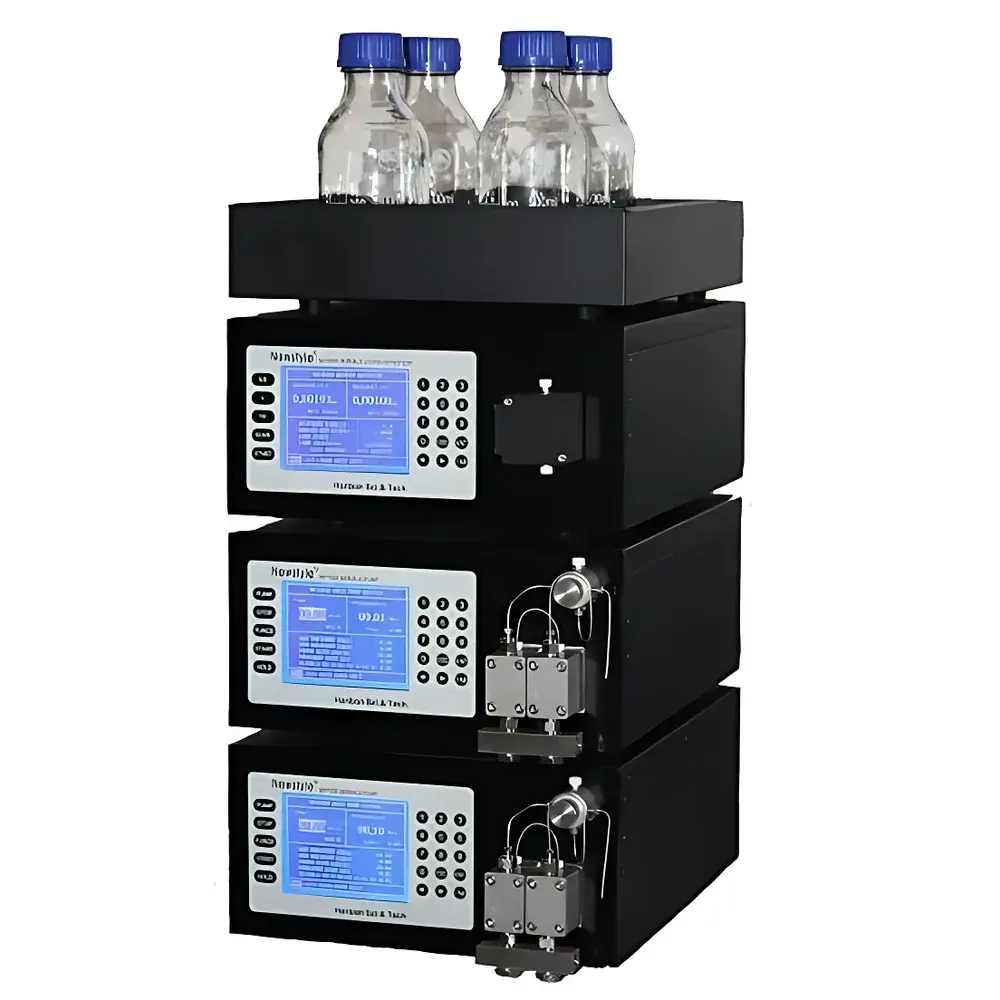
Hanbon NP-7000 Series High-Pressure Preparative LC Pump
| Brand | Hanbon |
|---|---|
| Model | NP-7000 Series |
| Type | High-Pressure Preparative Liquid Chromatography Pump |
| Flow Range (NP7030C) | 0.01–300.00 mL/min, Increment: 0.01 mL/min |
| Flow Range (NP7060C) | 0.01–600.00 mL/min, Increment: 0.01 mL/min |
| Flow Range (NP7100C) | 0.1–1000.0 mL/min, Increment: 0.1 mL/min |
| Flow Accuracy | ±1% |
| Flow Precision (RSD) | ≤0.5% |
| Pressure Pulsation | ≤0.5 MPa |
| Max Pressure (NP7030C) | 15 MPa |
| Max Pressure (NP7060C/NP7100C) | 10 MPa |
| Tubing Connection | 1/8″ Standard Fitting |
| Display | 320×240 LCD |
| Control Interface | Front-panel keypad + RS232/USB computer remote control |
| Power Input | 85–264 VAC |
| Power Consumption (NP7030C/NP7060C) | 500 W |
| Power Consumption (NP7100C) | 750 W |
Overview
The Hanbon NP-7000 Series High-Pressure Preparative LC Pump is an engineered solution for scalable purification workflows in pharmaceutical process development, natural product isolation, and synthetic chemistry laboratories. Designed around a dual-plunger, parallel-flow architecture with active pulse dampening, it delivers stable, low-pulsation solvent delivery across three distinct flow capacity variants—NP7030C (up to 300 mL/min), NP7060C (up to 600 mL/min), and NP7100C (up to 1000 mL/min). Each model maintains consistent pressure stability and flow fidelity under dynamic load conditions typical of preparative-scale columns (e.g., 20–100 mm ID, packed with 5–25 µm media), enabling reproducible fraction collection and high-throughput compound recovery. The pump operates on the principle of positive displacement via servo-controlled stepper motors and precision-machined ceramic plungers, ensuring minimal wear and long-term calibration retention.
Key Features
- Dual-piston reciprocating design with real-time pressure feedback loop for adaptive stroke compensation
- Three configurable models optimized for different throughput requirements: NP7030C (≤15 MPa), NP7060C (≤10 MPa), and NP7100C (≤10 MPa)
- High-resolution flow control with programmable increment steps (0.01 mL/min for NP7030C/NP7060C; 0.1 mL/min for NP7100C)
- Low-pressure pulsation (≤0.5 MPa) achieved through integrated passive damping and electronic flow smoothing algorithms
- Front-panel operation with intuitive 320×240 graphical LCD interface supporting multi-step gradient programming and real-time parameter monitoring
- Full bidirectional communication via RS232 and USB interfaces compliant with standard chromatography control software (e.g., Chromeleon, Empower, OpenLab)
- Robust 1/8″ stainless-steel fluidic path compatible with common HPLC solvents—including acetonitrile, methanol, THF, and chlorinated hydrocarbons—under sustained high-pressure operation
Sample Compatibility & Compliance
The NP-7000 Series accommodates a broad range of sample matrices including crude reaction mixtures, fermentation broths, plant extracts, and peptide libraries. Its chemically resistant wetted materials (316L stainless steel, sapphire seals, PEEK tubing) ensure compatibility with acidic, basic, and corrosive mobile phases used in reversed-phase, normal-phase, and ion-exchange preparative separations. The system meets mechanical safety standards per IEC 61010-1 and supports GLP/GMP-aligned operation through audit-trail-enabled software control. While not intrinsically 21 CFR Part 11 compliant, its remote control architecture enables integration with validated chromatography data systems that provide electronic signature, user access control, and change history logging.
Software & Data Management
The pump supports both standalone operation and full integration into laboratory automation environments. Local control allows manual method setup, real-time pressure/flow override, and alarm-triggered shutdown (e.g., overpressure, leak detection). When connected to external software, it accepts ASCII-based command protocols for synchronized gradient profiling, fraction triggering, and event logging. All operational parameters—including actual flow rate, delivered pressure, motor status, and error codes—are timestamped and exportable as CSV or XML for traceability. Firmware updates are performed via USB drive, with version rollback capability and checksum validation to maintain regulatory integrity.
Applications
- Gram-to-kilogram scale purification of active pharmaceutical ingredients (APIs) during preclinical and Phase I manufacturing
- Isolation of bioactive compounds from botanical sources using flash and medium-pressure preparative LC
- Chiral separation of racemic mixtures on polysaccharide-based columns (e.g., Chiralpak AD-H, OD-H)
- Method transfer from analytical to preparative conditions with linear flow-rate scaling and column volume normalization
- Automated fraction collection linked to UV/Vis or MS detectors for targeted compound recovery
- Support for multi-column switching valves and solvent recycling modules to reduce operational costs
FAQ
What is the maximum operating pressure for each NP-7000 model?
The NP7030C is rated for up to 15 MPa (2175 psi), while the NP7060C and NP7100C are rated for up to 10 MPa (1450 psi) to balance flow capacity and mechanical durability.
Can this pump be used with aqueous buffers containing >50% salt concentration?
Yes—provided the system is regularly flushed with water/methanol after use to prevent crystallization and seal fouling. Optional titanium-plunger configurations are available for extended saline compatibility.
Does the pump support gradient elution with two or more solvents?
The NP-7000 Series is a single-channel high-pressure pump; gradient formation requires an external low-pressure mixing module or a companion quaternary solvent manager configured upstream.
Is firmware update documentation available for internal QA review?
Yes—Hanbon provides release notes, validation test reports, and version-controlled firmware binaries upon request for regulated lab environments.
How is flow accuracy verified during routine qualification?
Users perform gravimetric flow verification per ASTM E2656 using certified volumetric flasks and analytical balances; recommended frequency is weekly for GMP applications and monthly for research use.





