
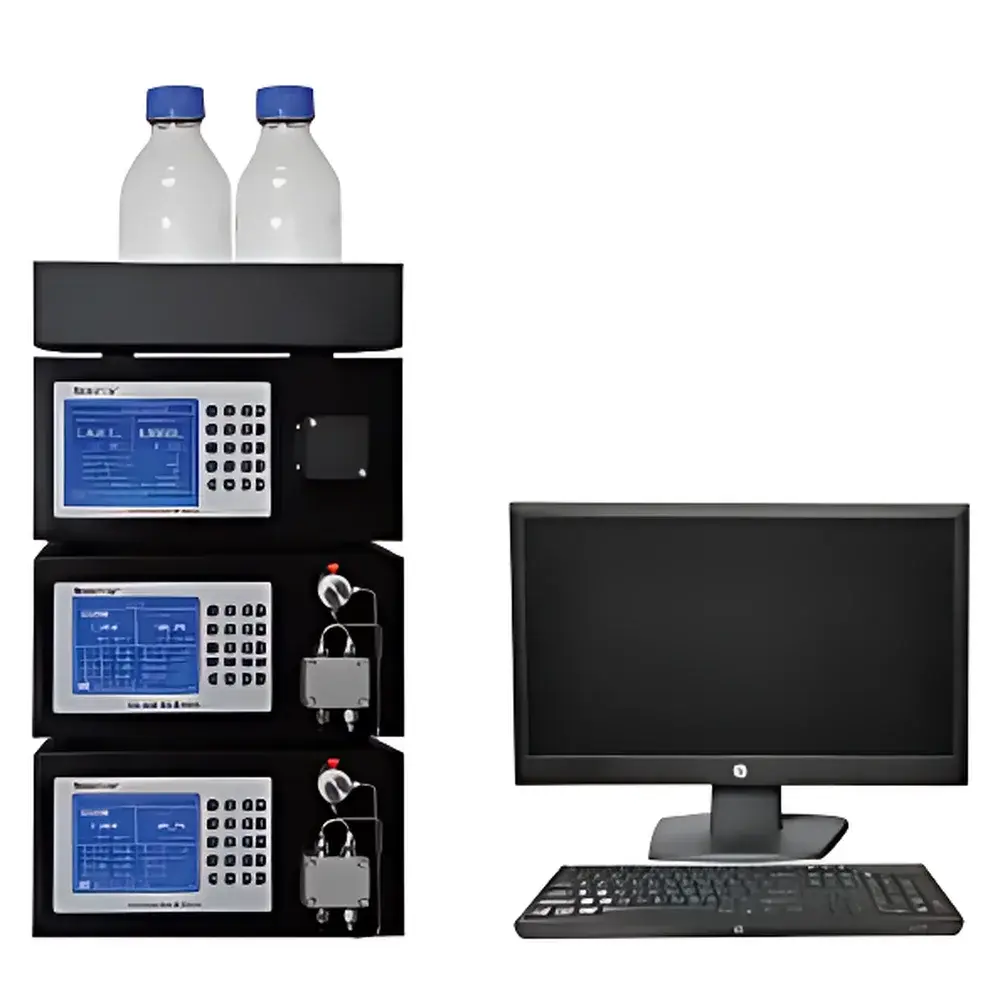
Hanbon NS4201 Analytical HPLC System
| Brand | Hanbon |
|---|---|
| Origin | Jiangsu, China |
| Manufacturer Type | OEM Manufacturer |
| Region of Origin | Domestic (China) |
| Model | NS4201 |
| Price Range | USD 7,000–14,000 (FOB) |
| Instrument Type | Conventional High-Performance Liquid Chromatograph |
| Application Scope | General-purpose analytical and preparative-scale development |
| Flow Rate Range | 0.001–9.999 mL/min |
| Maximum Operating Pressure | 42 MPa |
| Flow Accuracy | RSD ≤ 0.1% |
| Injection Mode | Manual injection valve (standard) |
| Injection Volume Range | 0–20 µL |
| Column Oven Temperature Control | Ambient only (no active temperature control) |
| UV-Vis Wavelength Range | 190–800 nm |
| Data Acquisition Rate | 5 Hz |
Overview
The Hanbon NS4201 Analytical HPLC System is a dual-pump, high-pressure liquid chromatography platform engineered for method development, analytical validation, and scalable purification workflows in pharmaceutical, biotechnology, and natural product laboratories. Built upon a modular architecture, the system implements gradient elution via two independently controlled reciprocating piston pumps, enabling precise binary solvent mixing and robust pressure stability up to 42 MPa (6,090 psi). Its core separation principle relies on differential partitioning of analytes between a mobile phase (liquid solvent gradient) and a stationary phase (packed column), with detection accomplished through dual-wavelength UV-Vis absorbance photometry. Designed for reproducibility in regulated environments, the NS4201 supports method transfer from analytical to semi-preparative scale—particularly relevant for fermentation-derived compounds, synthetic APIs, and botanical extracts where compound stability, polarity diversity, and batch-to-batch consistency are critical.
Key Features
- Electronic damping flow control technology ensures stable delivery across the full 0.001–9.999 mL/min range, delivering ≤0.1% RSD in flow precision under isocratic and gradient conditions.
- Float-piston pump design minimizes mechanical stress on seal assemblies, extending service intervals and reducing maintenance downtime without compromising pressure integrity.
- Dual-wavelength UV-Vis detector (190–800 nm) enables simultaneous monitoring at two user-defined wavelengths—ideal for co-elution resolution, peak purity assessment, and multi-analyte quantification without re-injection.
- Modular detector compatibility: Optional integration of refractive index (RI) or evaporative light scattering (ELSD) detectors expands detection capability for non-chromophoric or low-UV-absorbing compounds (e.g., carbohydrates, lipids, polymers).
- Standard manual injection valve (Rheodyne-type) supports loop-based injections from 0 to 20 µL; fully interoperable with third-party or Hanbon-branded autosamplers for unattended operation and sequence-based analysis.
- Pump fluidic path materials include SS316L stainless steel, titanium alloy, and PEEK—selected per application requirements to ensure chemical compatibility with aggressive solvents (e.g., TFA, HFIP, high-pH mobile phases) and minimize metal-catalyzed degradation.
Sample Compatibility & Compliance
The NS4201 accommodates standard 4.6 mm i.d. analytical columns as well as larger-diameter columns (up to 21.2 mm i.d.) when configured for early-stage purification. It supports reversed-phase (C18, C8), HILIC, ion-exchange, and size-exclusion chemistries. While the system lacks an integrated column oven, ambient-temperature operation remains suitable for methods validated per ICH Q2(R2) guidelines where thermal effects are negligible. Data acquisition at 5 Hz satisfies temporal resolution requirements for narrow peaks (<5 s wide) in fast-gradient applications. The system’s architecture permits audit-trail-enabled software upgrades to support FDA 21 CFR Part 11 compliance when deployed with validated chromatography data systems (CDS)—a prerequisite for GLP/GMP-regulated QC labs conducting stability studies or release testing.
Software & Data Management
Control and data processing are performed via Hanbon’s proprietary ChromoLink CDS v3.x, a Windows-based platform supporting instrument configuration, method building, real-time chromatogram visualization, peak integration (with baseline correction, tangent skim, and valley-to-valley algorithms), and report generation (PDF/CSV export). The software includes built-in tools for system suitability testing (SST), including calculation of theoretical plates (N), tailing factor (T), resolution (Rs), and %RSD for retention time and peak area—aligned with USP and EP 2.2.46 standards. Raw data files adhere to open-format conventions, facilitating import into third-party chemometric packages (e.g., Simca, MATLAB) for multivariate analysis or machine learning–driven method optimization.
Applications
- Pharmaceutical QC/QA: Assay and related substances testing of small-molecule APIs per USP monographs and internal specifications.
- Natural product isolation: Fraction-guided purification of alkaloids, flavonoids, and terpenoids from plant extracts using gradient UV-triggered fraction collection.
- Fermentation monitoring: Quantitative analysis of organic acids (e.g., citric, lactic), amino acids, and antibiotics in broth supernatants.
- Method development support: Rapid scouting of mobile phase pH, organic modifier type, and gradient slope prior to transfer to UHPLC or preparative HPLC platforms.
- Academic research: Teaching chromatographic principles—including retention mechanism, selectivity tuning, and detector response linearity—in undergraduate and graduate analytical chemistry curricula.
FAQ
Does the NS4201 support column oven temperature control?
No—the system operates at ambient temperature only. For temperature-sensitive separations or methods requiring strict thermal control (e.g., chiral resolutions), external column heaters or third-party ovens must be used.
Is the detector compliant with pharmacopeial wavelength accuracy requirements?
Yes—the UV-Vis detector is factory-calibrated using holmium oxide and didymium filters, meeting USP wavelength accuracy tolerances (±1 nm) across the 190–800 nm range.
Can the system be integrated into a LIMS environment?
Yes—ChromoLink CDS supports ASTM E1578-compliant instrument driver interfaces and provides ODBC connectivity for structured query access to result databases, enabling seamless LIMS synchronization.
What is the maximum injection volume when using an optional autosampler?
Autosampler compatibility extends the injection range to 100 µL using large-volume loops, subject to valve and needle wash configuration.
Are GMP-compliant electronic signatures available?
Electronic signature functionality is available via optional CDS validation packages, including role-based access control, audit trail logging, and electronic record archiving—fully aligned with Annex 11 and 21 CFR Part 11 requirements.
Related Products




