
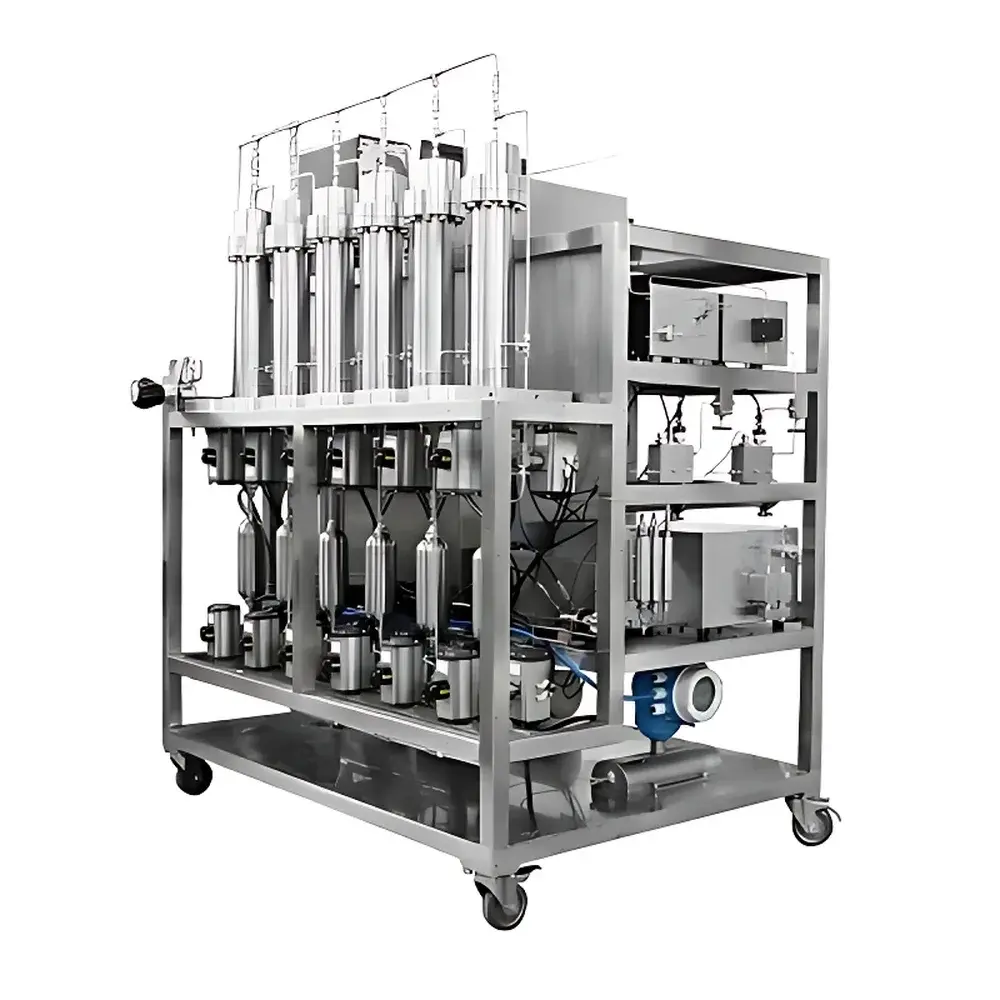
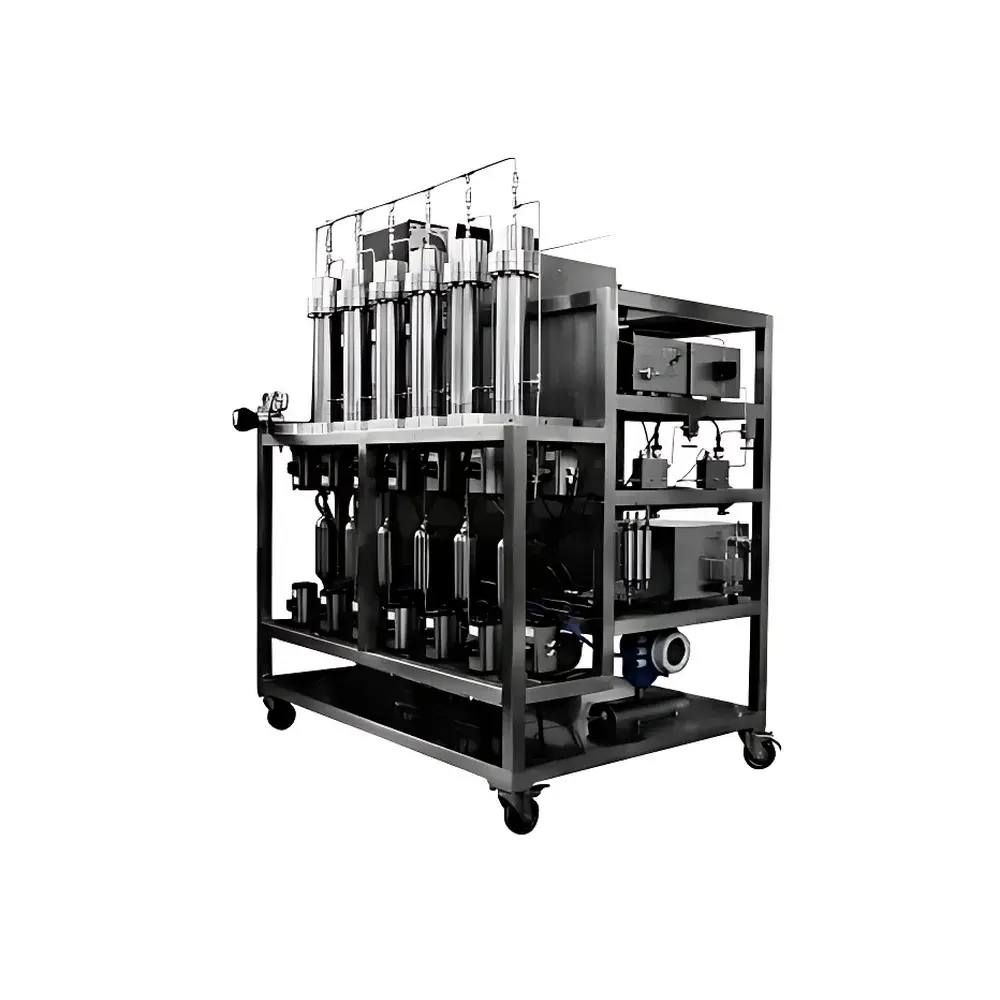
Hanbon NS8030A/B Preparative Supercritical Fluid Chromatography System
| Brand | Hanbon |
|---|---|
| Origin | Jiangsu, China |
| Manufacturer Type | Direct Manufacturer |
| Instrument Type | Preparative |
| Detector Type | UV |
| Maximum Operating Pressure | 20 MPa |
| Flow Rate Range | 0–3000 mL/min |
| Model Variants | NS8030A, NS8030B |
Overview
The Hanbon NS8030A/B Preparative Supercritical Fluid Chromatography (SFC) System is an engineered solution for high-throughput, gram-scale chiral and achiral compound purification in pharmaceutical R&D, natural product isolation, and fine chemical synthesis. Unlike analytical or semi-preparative SFC platforms, the NS8030 series operates on the fundamental principle of supercritical carbon dioxide (scCO₂) as the primary mobile phase—leveraging its low viscosity, high diffusivity, and tunable solvation strength to achieve rapid mass transfer and superior resolution under subcritical to supercritical conditions (typically 10–20 MPa, 35–60 °C). The system integrates five functionally decoupled modules: a high-pressure CO₂ delivery and co-solvent blending unit, a thermostatically controlled column management station with multi-column switching capability, a UV-based real-time detection module with variable-wavelength optics (190–400 nm), a precision active back-pressure regulator (BPR), and a cyclonic phase-separation collector enabling continuous, solvent-free fraction recovery. This architecture supports method translation from analytical SFC to preparative scale while maintaining retention time reproducibility and peak shape fidelity.
Key Features
- High-capacity fluid handling: Dual-pump architecture supports CO₂ flow rates from 0 to 3000 mL/min (liquid-equivalent at standard temperature and pressure), accommodating both narrow-bore and wide-bore columns (up to 50 mm ID) for linear scalability.
- Cyclonic fraction collector: Patented gas–liquid separation chamber utilizes centrifugal force to separate scCO₂ vapor from collected fractions in real time—eliminating post-run rotary evaporation and reducing sample drying time by >70% compared to conventional SFC systems.
- Intelligent active back-pressure regulation: Electromechanically actuated BPR maintains pressure stability within ±0.1 MPa across dynamic flow and temperature gradients, critical for retention time reproducibility and method robustness during multi-hour runs.
- Modular column oven: Temperature-controlled (ambient to 80 °C, ±0.5 °C) with programmable ramping and dual-zone heating, optimized for thermal management of packed-bed and SFC-optimized chiral stationary phases (e.g., cellulose- and amylose-derived CSPs).
- Integrated safety architecture: Redundant pressure relief valves, CO₂ leak detection sensors, and interlocked cabinet ventilation comply with ISO 13857 and IEC 61010-1 for laboratory-grade equipment.
Sample Compatibility & Compliance
The NS8030A/B accommodates a broad range of thermally labile, non-volatile, and moderately polar compounds—including chiral APIs, synthetic intermediates, peptides, and plant extracts—without derivatization. Its use of CO₂ as the primary mobile phase minimizes environmental impact and eliminates halogenated solvent waste streams. The system supports compliance with regulatory frameworks governing purification workflows: chromatographic data acquisition and method parameters are logged with electronic signatures and audit trails aligned with FDA 21 CFR Part 11 requirements when paired with validated LIMS or CDS software. Method documentation conforms to ICH Q5A(R2) and USP guidelines for chiral separations. Column hardware meets ASTM F2135 standards for high-pressure fluidic components.
Software & Data Management
Control and monitoring are executed via Hanbon’s proprietary SFC-Studio v3.x platform—a Windows-based application supporting method development, sequence scheduling, real-time chromatogram overlay, and automated fraction triggering based on UV threshold or time window logic. All instrument parameters (pressure, temperature, flow, UV absorbance) are timestamped and stored in HDF5 format for long-term archival and third-party analysis interoperability. Raw data export options include .csv, .cdf (NetCDF), and .mzML-compatible metadata tagging. Optional integration with Empower™ 3 or Chromeleon™ 7.3 enables enterprise-level data governance, electronic lab notebook (ELN) synchronization, and GLP/GMP-compliant reporting.
Applications
- Chiral resolution of enantiomeric drug candidates at 1–50 g/batch scale for preclinical toxicology and formulation studies.
- Purification of oligonucleotide synthesis by-products and phosphorothioate impurities using CO₂/methanol/TEA mobile phases.
- Isolation of bioactive flavonoids and terpenoids from crude botanical extracts with minimal thermal degradation.
- Recycling and repurposing of racemic mixtures in asymmetric catalysis workflows via iterative SFC recycling.
- Supporting Quality-by-Design (QbD) initiatives through Design of Experiments (DoE)-driven parameter optimization of pressure, temperature, and modifier gradient profiles.
FAQ
What is the maximum column internal diameter supported by the NS8030A/B?
The system is validated for columns up to 50 mm internal diameter, with flow path components rated for continuous operation at 20 MPa and 3000 mL/min CO₂ equivalent flow.
Does the system support gradient elution with multiple co-solvents?
Yes—dual-gradient capability allows independent programming of two organic modifiers (e.g., methanol and isopropanol) alongside CO₂ density modulation via pressure ramping.
Is the cyclonic collector compatible with volatile organic fractions?
The collector is optimized for scCO₂–organic liquid phase separation; fractions containing <10% residual solvent (v/v) can be recovered directly without condensation traps or cold traps.
Can the NS8030B variant be upgraded to include mass spectrometric detection?
The NS8030B features a modular detector bay with standardized API interface; integration of a single-quadrupole or time-of-flight MS requires vendor-supplied interface kit and firmware update (not included in base configuration).
What validation documentation is provided with the system?
Each unit ships with Factory Acceptance Test (FAT) report, Installation Qualification (IQ) protocol templates, and Operational Qualification (OQ) test scripts aligned with ASTM E2500 and ISO/IEC 17025 principles.





