
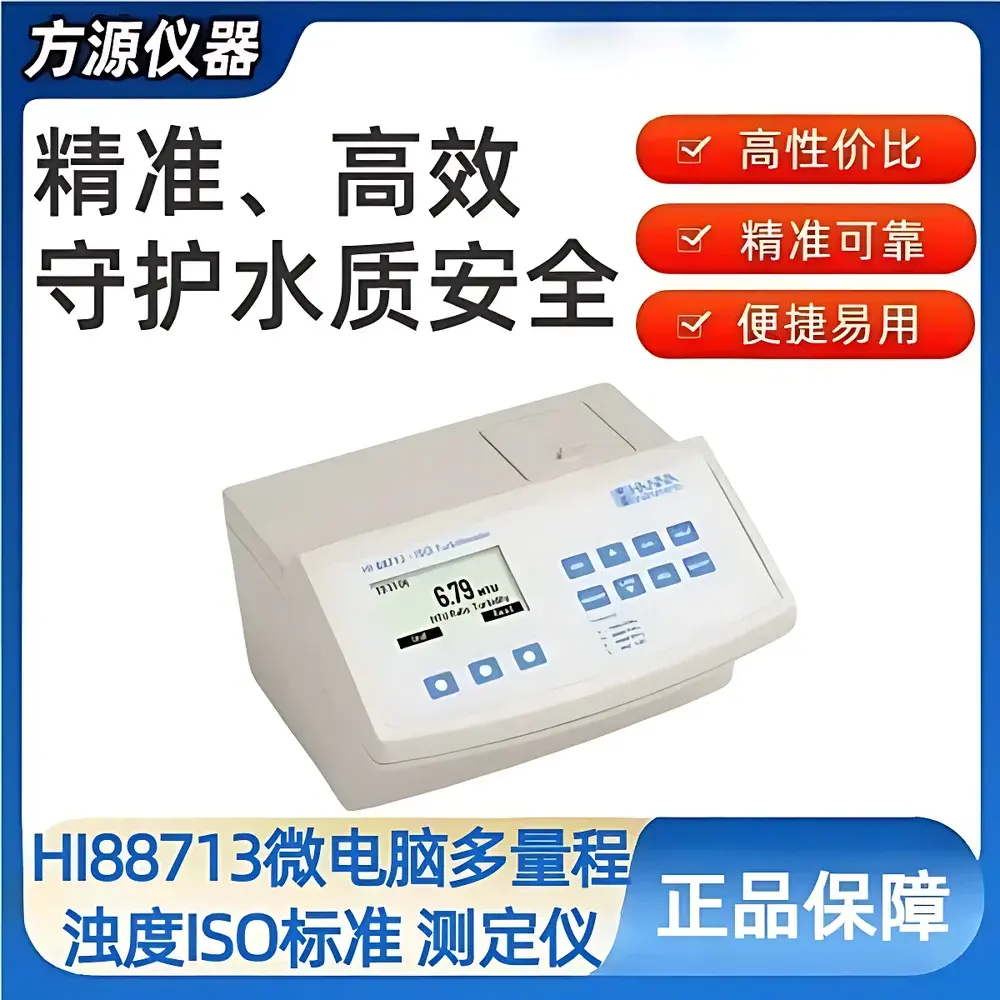
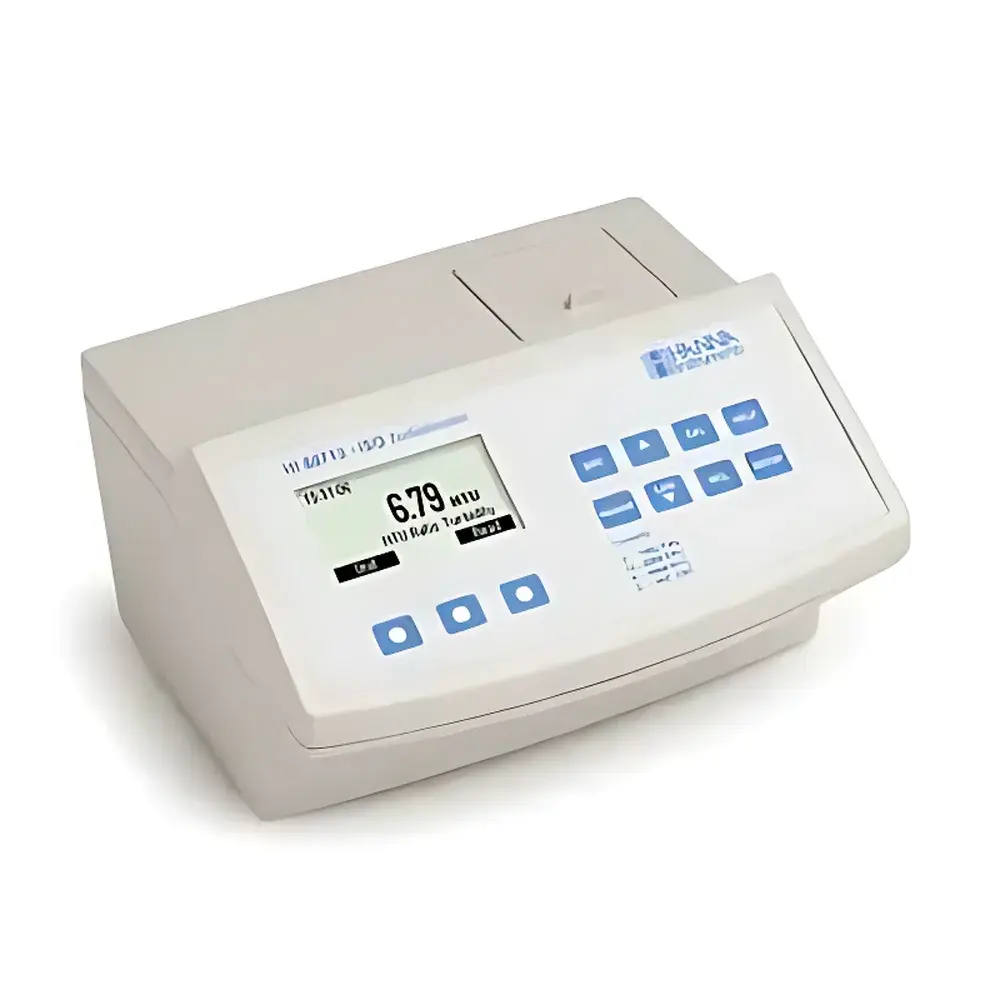
Hanna HI88713 Portable Multi-Range Turbidimeter (ISO 7027 Compliant)
| Brand | Hanna Instruments |
|---|---|
| Origin | Italy |
| Model | HI88713 |
| Instrument Type | Portable Turbidimeter |
| Parameter Type | Single-Parameter (Turbidity) |
| Measurement Accuracy | ±2% (≤1000 NTU), ±5% (>1000 NTU), ±10% (FAU) |
| LOD | <0.1 NTU |
| Measurement Ranges | 0.00–9.99 / 10.0–40.0 / 100–1000 FNU |
| Resolution | 0.01 / 0.1 / 1 FNU, NTU, FAU, EBC |
| Calibration Points | <0.1, 15, 100, 750 FNU and 2000 NTU |
| Compliance | ISO 7027 (Nephelometric, 90° & 180° detection) |
| Data Storage | 200 measurement records |
| Interface | USB |
| Display | 64 × 128 pixel backlit LCD (40 × 70 mm) |
| Power | 230 VAC / 50 Hz, 20 W |
| Operating Environment | 0–50 °C, ≤95% RH (non-condensing) |
| Dimensions | 230 × 200 × 145 mm |
| Weight | 2.5 kg |
Overview
The Hanna HI88713 is a portable, microprocessor-controlled turbidimeter engineered for high-reproducibility optical turbidity measurements in compliance with ISO 7027:2016. It employs nephelometric detection at 90° and backscatter detection at 180° using a tungsten lamp and calibrated photodetector array—ensuring traceable, standardized quantification of light scattering caused by suspended particulates in liquid media. Designed for routine water quality assessment across municipal drinking water facilities, wastewater treatment plants, brewing laboratories, and environmental monitoring stations, the HI88713 delivers multi-unit, auto-ranging capability across four turbidity scales: Formazin Nephelometric Units (FNU), Formazin Attenuation Units (FAU), Nephelometric Turbidity Units (NTU), and European Brewery Convention units (EBC). Its optical architecture minimizes stray light interference, while its dual-angle detection mode enables robust differentiation between low-turbidity potable water (1000 NTU), supporting both linear and non-linear calibration models required for regulatory reporting.
Key Features
- Auto-ranging measurement across three dynamic ranges per unit scale (e.g., 0.00–9.99, 10.0–40.0, 100–1000 FNU), eliminating manual range selection errors
- Dual-mode turbidity analysis: linear mode for broad-spectrum applications (e.g., surface water, treated effluent) and non-linear mode optimized for beer and low-color beverages per EBC protocols
- Integrated CAL CHECK™ verification system—optical validation of sensor integrity and lamp stability prior to each calibration or measurement sequence
- GLP-compliant data logging with time/date stamping, calibration history tracking, and instrument configuration audit trail
- Four-point manual calibration using certified formazin standards: <0.1, 15, 100, and 750 FNU, plus 2000 NTU reference point for extended-range validation
- Backlit graphical LCD (64 × 128 pixels) with intuitive icon-driven navigation and real-time status indicators for battery, calibration, and measurement mode
Sample Compatibility & Compliance
The HI88713 is validated for aqueous samples including potable water, filtered wastewater, process streams, and brewed beverages. Its optical path accommodates standard 25-mm round glass cuvettes (HI731315) and is compatible with ISO 7027-mandated formazin-based calibration standards. The instrument meets essential regulatory requirements for turbidity monitoring under EPA Method 180.1, ASTM D6695, and EU Directive 98/83/EC for drinking water. While not inherently 21 CFR Part 11 compliant, its GLP data structure—including immutable timestamps, user ID fields (via optional password setup), and full calibration record retention—supports audit-ready documentation for ISO/IEC 17025-accredited laboratories and GMP-aligned QA/QC workflows.
Software & Data Management
Measurements are stored locally in non-volatile memory (200 records maximum), each containing turbidity value, unit, date/time stamp, operator ID (if assigned), calibration status, and measurement mode. Data export is performed via USB interface to PC using Hanna’s free HI92000 Windows software, which supports CSV and PDF report generation, trend graphing, and batch export for LIMS integration. The software enforces hierarchical user access control and generates electronic audit trails compliant with basic GLP documentation standards. No cloud connectivity or remote firmware updates are supported—ensuring data sovereignty and network isolation for regulated environments.
Applications
- Drinking water utilities: verification of filtration efficiency and disinfection barrier integrity per WHO and US EPA turbidity action levels (≤0.3 NTU)
- Wastewater treatment: final effluent turbidity verification against discharge permits (e.g., ≤5–30 NTU depending on jurisdiction)
- Brewing industry: EBC-compliant haze measurement in finished beer, wort, and filtration aids evaluation
- Environmental field labs: rapid screening of river, lake, and reservoir turbidity for sediment transport modeling
- Pharmaceutical water systems: purified water (PW) and water-for-injection (WFI) clarity monitoring during distribution loop validation
FAQ
Does the HI88713 require annual factory recalibration?
No—routine user calibration using traceable formazin standards satisfies ISO/IEC 17025 metrological requirements. Annual verification against NIST-traceable references is recommended but not mandatory unless specified by internal QA policy.
Can the instrument measure turbidity in colored samples without compensation?
The HI88713 does not include absorbance compensation algorithms. For highly colored samples (e.g., humic-rich groundwater), users should validate correlation between FNU and true particle concentration via parallel gravimetric or particle-counting methods.
Is the 2000 NTU calibration point traceable to NIST SRM 2102?
Yes—the HI88713-11 calibration kit (sold separately) contains NIST-traceable formazin standards, including SRM 2102-equivalent 2000 NTU reference material, certified per ISO Guide 34 and ISO/IEC 17025.
What is the minimum detectable turbidity level?
The instrument achieves a limit of detection (LOD) of <0.1 NTU (0.05 EBC) under controlled ambient light conditions, verified per ISO 7027 Annex B.
How is stray light error mitigated in high-turbidity measurements?
Stray light contribution is minimized through precision-aperture optics, black-anodized sample chamber walls, and algorithmic correction based on 180° backscatter signal normalization—validated across the full 0–4000 NTU range per manufacturer test report HI-TB-2023-087.
Related Products





