
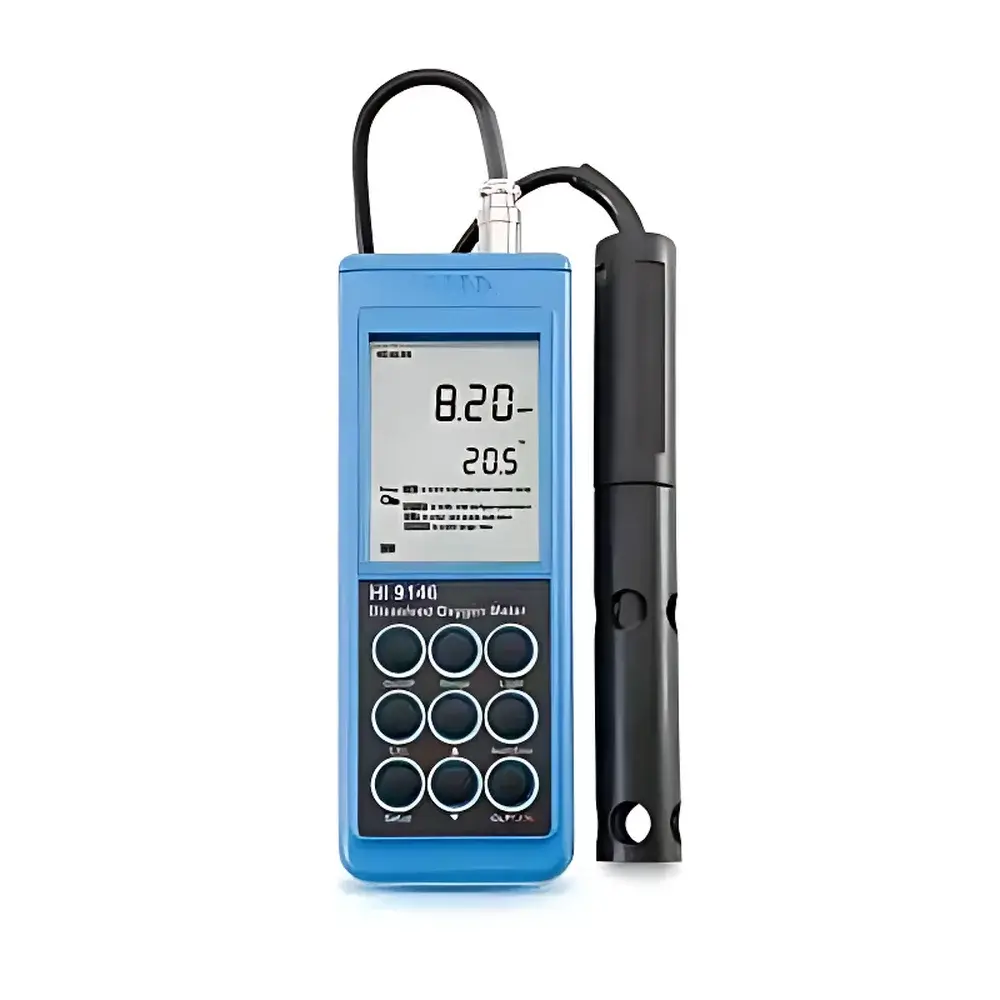
Hanna Instruments HI9146 Portable Dissolved Oxygen and Saturation DO Meter
| Brand | Hanna Instruments |
|---|---|
| Origin | Italy |
| Model | HI9146 |
| Instrument Type | Portable |
| Parameter Type | Single-Parameter |
| Measurement Range | DO: 0.00 to 45.00 mg/L (ppm) |
| Saturation | 0.0 to 300.0 % |
| Resolution | DO: 0.01 mg/L (ppm) |
| Saturation | 0.1 % |
| Accuracy | ±1.5% of full scale or ±1 digit at 25°C (77°F), whichever is greater |
| Temperature Compensation | Automatic, 0.0 to 50.0°C (32.0 to 122.0°F) |
| Altitude Compensation | Manual, 0 to 4000 m (100 m increments) |
| Salinity Compensation | Manual, 0 to 80 g/L (1 g/L increment) |
| Electrode | HI76407F Clark-type polarographic DO probe with integrated Pt1000 temperature sensor |
| Power | 3 × 1.5 V AAA batteries |
| Dimensions | 185 × 72 × 36 mm (7.3 × 2.8 × 1.4 in) |
| Weight | 300 g (10.6 oz) |
| Environmental Rating | 0 to 50°C |
Overview
The Hanna Instruments HI9146 is a portable, microprocessor-based dissolved oxygen (DO) and saturation DO meter engineered for field and laboratory applications requiring reliable, traceable electrochemical measurements. It employs the Clark-type polarographic principle—where molecular oxygen diffuses through a gas-permeable membrane and undergoes reduction at a cathode in an electrolyte-filled cell—enabling precise quantification of aqueous oxygen concentration. The instrument simultaneously reports DO in mg/L (ppm) and percent saturation (%), both critical metrics for environmental monitoring, wastewater treatment, aquaculture, and bioprocess control. Its built-in Pt1000 temperature sensor ensures automatic temperature compensation across 0.0–50.0°C, while manual altitude (0–4000 m) and salinity (0–80 g/L) compensation aligns readings with site-specific physical chemistry conditions—essential for compliance with ASTM D888, ISO 5814, and EPA Method 360.5.
Key Features
- Auto-endpoint detection with LCD hold function: stabilizes and locks readings upon signal convergence, minimizing operator interpretation error.
- Backlit graphical LCD display: enhances readability under low-light or outdoor conditions without compromising battery life.
- Dual-unit measurement mode: toggles between mg/L (ppm) O₂ and % saturation—configurable per user preference and regulatory reporting requirements.
- Integrated polarographic electrode (HI76407F): features a replaceable Teflon membrane and KCl-based electrolyte (HI7041S), optimized for long-term stability and low drift.
- One- or two-point calibration: supports zero-point (using sodium sulfite solution) and 100% air-saturation calibration (8.26 mg/L at 25°C, 1 atm, 0 g/L salinity).
- GLP-compliant data logging: stores calibration history—including date, time, calibration points, ambient temperature, altitude, and salinity settings—for audit-ready documentation.
Sample Compatibility & Compliance
The HI9146 is validated for use with freshwater, seawater, wastewater effluents, fermentation broths, and surface water samples. Its rugged IP67-rated housing meets IEC 60529 for dust and temporary immersion resistance. Calibration protocols conform to Good Laboratory Practice (GLP) and support 21 CFR Part 11 readiness when paired with optional PC software (HI92000). While the meter itself does not enforce electronic signatures, its timestamped calibration records—including operator-defined environmental parameters—facilitate traceability required by ISO/IEC 17025-accredited laboratories and EPA-regulated monitoring programs.
Software & Data Management
Data export is enabled via optional HI92000 Windows-compatible software and USB-to-serial adapter (HI920014). This interface permits real-time graphing, batch calibration report generation, and CSV export for LIMS integration. All stored calibration events retain metadata: exact calibration date/time, selected reference values (e.g., 8.26 mg/L for air saturation), applied altitude/salinity offsets, and measured temperature. No cloud storage or proprietary firmware updates are required—firmware remains stable and field-serviceable via standard battery replacement and membrane maintenance.
Applications
- Environmental field surveys: stream health assessments, lake stratification studies, and wetland restoration monitoring.
- Wastewater treatment plants: activated sludge process control, aeration basin optimization, and discharge compliance verification per NPDES permits.
- Aquaculture operations: dissolved oxygen management in recirculating aquaculture systems (RAS) and hatchery tanks.
- Pharmaceutical water systems: USP purified water and WFI monitoring during distribution loop validation.
- Academic research: undergraduate and graduate-level water chemistry labs emphasizing sensor fundamentals and environmental parameter interdependence.
FAQ
What calibration standards are recommended for routine use?
Air-saturated water (8.26 mg/L at 25°C, 1 atm, 0 g/L salinity) is the primary reference for 100% saturation calibration. For zero-point calibration, freshly prepared 0.5% sodium sulfite (Na₂SO₃) solution is recommended per ASTM D888 Section 8.3.
How often should the DO membrane and electrolyte be replaced?
Hanna recommends replacing the HI76407A/P membrane and HI7041S electrolyte every 2–4 weeks under continuous use, or immediately after exposure to oils, surfactants, or high-sediment samples.
Does the HI9146 meet FDA or ISO 17025 traceability requirements?
Yes—the instrument’s GLP log captures all calibration metadata required for ISO/IEC 17025 Clause 7.7 and supports internal audit trails consistent with FDA expectations for instrument qualification (IQ/OQ) documentation.
Can altitude and salinity compensation be disabled?
Yes—both parameters are user-configurable and may be set to zero or held constant if ambient conditions are stable and compensation is not required for the application.
Is the HI76407F electrode compatible with other Hanna meters?
The HI76407F is electrically and mechanically designed exclusively for the HI9146 platform; it is not cross-compatible with HI98186, HI98198, or benchtop DO analyzers due to proprietary pinout and firmware handshake protocols.





