
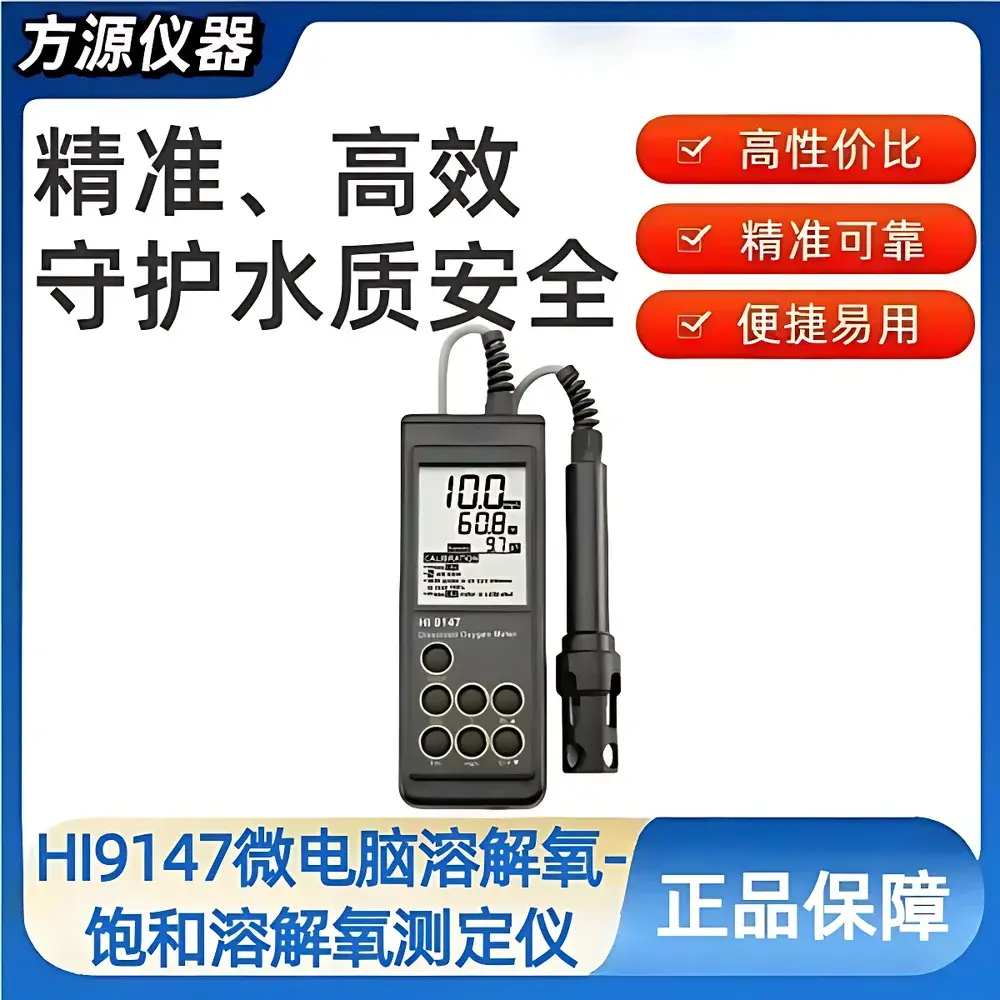
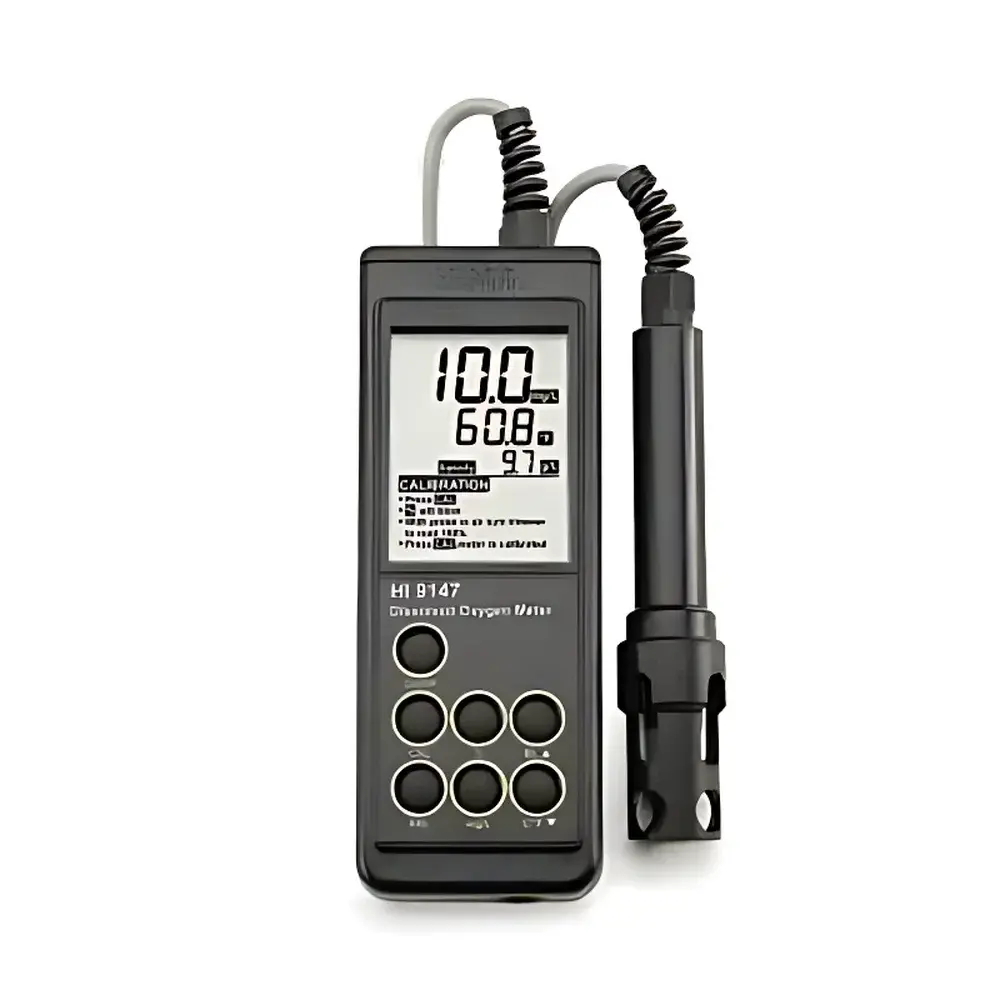
Hanna Instruments HI9147 Portable Electrochemical Dissolved Oxygen and Saturation DO Meter
| Brand | Hanna Instruments |
|---|---|
| Origin | Italy |
| Model | HI9147 |
| Instrument Type | Portable Benchtop Electrochemical Analyzer |
| Parameter Type | Single-Parameter (DO) |
| Measurement Principle | Galvanic Cell (Self-Polarizing) |
| DO Range | 0.0 to 50.0 mg/L (ppm) |
| Saturation Range | 0 to 600 % |
| Resolution | 0.1 mg/L (ppm) / 1 % |
| Accuracy | ±1% of reading at 25°C (77°F) |
| Temperature Compensation | Automatic, 0.0 to 50.0°C (32.0 to 122.0°F) |
| Altitude Compensation | Manual, 0 to 4000 m (100 m increments) |
| Salinity Compensation | Manual, 0 to 51 g/L (1 g/L increment) |
| Calibration | Single-point manual calibration in air (100% saturation ≈ 8.26 mg/L at 25°C, 1 atm) |
| Electrode | HI76409 galvanic DO probe with integrated NTC thermistor |
| Cable Length Options | 4 m, 10 m, or 15 m |
| Power | 3 × 1.5 V AAA batteries |
| IP Rating | IP67 (dust-tight and water-immersible up to 1 m for 30 min) |
| Operating Environment | 0 to 50°C, ≤95% RH (non-condensing) |
| Dimensions | 185 × 72 × 36 mm |
| Weight | 450 g |
Overview
The Hanna Instruments HI9147 is a portable, benchtop-ready electrochemical dissolved oxygen (DO) and saturation meter engineered for field and laboratory applications requiring high reproducibility in variable environmental conditions. It employs a self-polarizing galvanic cell principle—eliminating the need for external polarization voltage—where molecular oxygen diffuses through a selective hydrophobic membrane and undergoes electrochemical reduction at a silver cathode against a zinc anode. The resulting diffusion-limited current is linearly proportional to the partial pressure of dissolved O₂, enabling direct quantification of both concentration (mg/L or ppm) and saturation percentage (%). Designed for compliance with standard water quality monitoring protocols—including ASTM D888, ISO 5814, and APHA Standard Methods 4500-O—this instrument delivers traceable, temperature-compensated measurements across freshwater, estuarine, and full-strength seawater matrices (up to 51 g/L salinity), making it particularly suited for aquaculture, wastewater treatment, environmental surveying, and process control in bioreactors.
Key Features
- Galvanic DO sensor (HI76409) with integrated NTC thermistor for true automatic temperature compensation (0.0–50.0°C)
- Two display modes: dissolved oxygen concentration (mg/L or ppm) and percent saturation (%DO), selectable per measurement
- Manual altitude compensation (0–4000 m, 100 m steps) and salinity compensation (0–51 g/L, 1 g/L steps) to correct for local atmospheric pressure and ionic strength effects on O₂ solubility
- Backlit large-format LCD display with high-contrast digits for low-light or outdoor use
- IP67-rated housing ensures operational reliability in humid, dusty, or splash-prone environments
- Single-point air-saturation calibration (100% O₂ at ambient pressure) with built-in validation logic to guide users through proper membrane hydration and stabilization (≥15 min post-membrane/fill solution replacement)
- Extended cable options (4 m, 10 m, 15 m) support submerged or remote sampling without signal degradation
Sample Compatibility & Compliance
The HI9147 is validated for use with aqueous samples ranging from deionized water to full-strength seawater (≤51 g/L TDS). Its galvanic electrode design exhibits minimal stirring dependence compared to polarographic sensors, enhancing stability in low-flow or static conditions—critical for pond monitoring and sediment interface profiling. The instrument conforms to GLP data integrity expectations: all calibrations are timestamped and stored in non-volatile memory; no user-editable audit trail is provided, but calibration history (date, time, reference value) is retained for internal QA review. While not FDA 21 CFR Part 11 compliant out-of-the-box (lacking electronic signature capability), its measurement traceability aligns with ISO/IEC 17025 requirements when used within documented SOPs that define calibration frequency, membrane replacement intervals, and verification checks using certified standard solutions (e.g., Winkler titration reference).
Software & Data Management
The HI9147 operates as a standalone instrument with no proprietary PC software or Bluetooth connectivity. All measurement data—including DO value, saturation %, temperature, altitude, and salinity settings—are displayed in real time and retained in volatile memory until power-off. No onboard data logging or export functionality is included; however, users may manually record values via the integrated hold function and backlight-assisted visual readout. For regulated environments requiring documentation, integration with external lab notebooks or LIMS systems is achieved through manual transcription or optional third-party serial-to-USB adapters (not supplied). Calibration parameters are preserved across battery changes, ensuring continuity between field sessions.
Applications
- Aquaculture facility management: continuous DO monitoring in hatcheries, raceways, and recirculating aquaculture systems (RAS)
- Environmental field surveys: stream, lake, and coastal water quality assessment under varying elevation and salinity conditions
- Wastewater treatment plant operations: aeration basin optimization and effluent compliance verification per local discharge permits
- Educational laboratories: hands-on instruction in aquatic chemistry, respiration kinetics, and sensor electrochemistry principles
- Research on hypolimnetic oxygen depletion, eutrophication dynamics, and benthic flux studies
FAQ
What type of electrochemical principle does the HI9147 employ?
It uses a self-polarizing galvanic cell, where O₂ reduction at the Ag cathode and Zn oxidation at the anode generate a current proportional to dissolved oxygen partial pressure—no external voltage required.
Is temperature compensation automatic?
Yes. The HI76409 probe integrates a precision NTC thermistor, enabling continuous automatic temperature compensation across 0.0–50.0°C.
Can the HI9147 measure in seawater?
Yes. With manual salinity compensation up to 51 g/L and a robust polymer membrane, it maintains accuracy in marine and brackish environments.
How often should the DO membrane and electrolyte be replaced?
Hanna recommends replacing the HI76409A membrane and HI7042S fill solution every 2–3 months under routine use, or immediately after exposure to oils, sulfides, or heavy metals.
Does the instrument meet any international standards?
Its measurement methodology complies with ISO 5814 (electrochemical determination of dissolved oxygen) and ASTM D888 (standard test methods for dissolved oxygen in water), supporting method-validated reporting.
Related Products





