
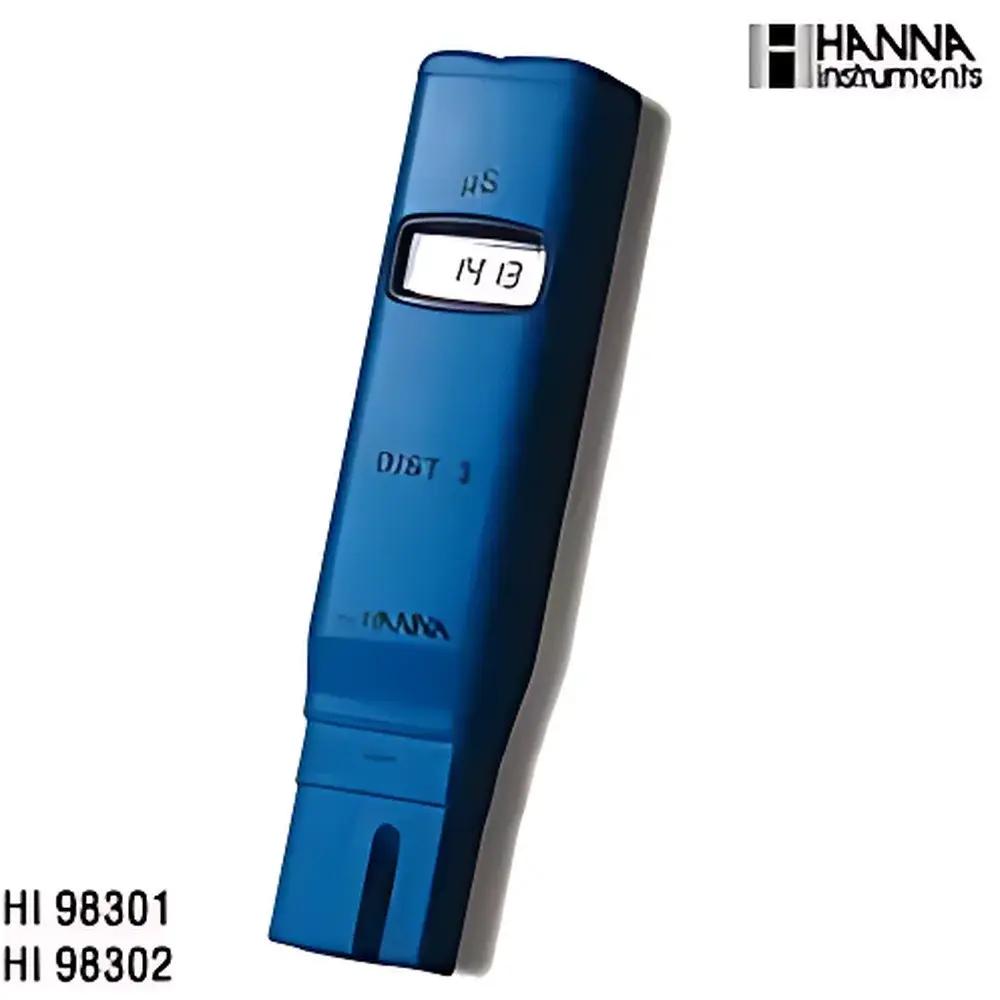
Hanna Instruments HI98301 and HI98302 Pocket-Sized TDS Meters
| Brand | Hanna Instruments |
|---|---|
| Origin | Italy |
| Model | HI98301 / HI98302 |
| Measurement Range (HI98301) | 0–1999 ppm (mg/L) |
| Resolution (HI98301) | 1 ppm |
| Measurement Range (HI98302) | 0.00–10.00 ppt (g/L) |
| Resolution (HI98302) | 0.01 ppt |
| Accuracy | ±2% of full scale |
| Calibration | Manual single-point with HI7032L (for HI98301) or HI70038P (for HI98302) |
| Temperature Compensation | Automatic, 0–50 °C |
| Power | 4 × 1.5 V AAA batteries |
| Dimensions | 175 × 41 × 23 mm |
| Weight | 95 g |
| Operating Environment | 0–50 °C, ≤95% RH |
Overview
The Hanna Instruments HI98301 and HI98302 are compact, pocket-sized total dissolved solids (TDS) meters engineered for rapid, on-site water quality assessment in field, laboratory, and industrial settings. These instruments operate on the principle of conductivity-based TDS estimation: they measure the electrical conductivity of an aqueous sample and convert it to TDS concentration using a fixed linear conversion factor (typically 0.5–0.7, factory-set at 0.5 for HI98301 and 0.7 for HI98302), consistent with standard industry practice for non-specific ionic solutions. Designed for simplicity and robustness, each unit integrates a graphite conductivity sensor, built-in temperature sensor for automatic compensation (0–50 °C), and a sealed, splash-resistant housing suitable for routine environmental monitoring, aquaculture, hydroponics, drinking water verification, and wastewater pre-screening. Neither model supports data logging or PC connectivity; their architecture prioritizes mechanical reliability, low power consumption, and immediate readability over advanced functionality—making them ideal for technicians requiring repeatable, traceable spot checks without software dependency.
Key Features
- True pocket-portable form factor (175 × 41 × 23 mm, 95 g) with ergonomic pen-style grip and integrated protective cap
- Dual-model configuration: HI98301 optimized for low-to-mid range TDS (0–1999 ppm, 1 ppm resolution); HI98302 calibrated for higher-concentration applications (0.00–10.00 ppt, 0.01 ppt resolution)
- Graphite conductivity sensor with stable response and resistance to polarization drift in moderate ionic strength samples
- Automatic temperature compensation (ATC) across 0–50 °C using a built-in NTC thermistor, referenced to 25 °C per ASTM D1125 and ISO 7888
- Manual single-point calibration protocol compliant with basic GLP documentation requirements—calibration status is indicated visually on display
- Low-power design powered by four standard AAA batteries (IEC LR03), providing >100 hours of continuous operation under typical usage
- IP67-rated enclosure when cap is secured, enabling operation in high-humidity environments (≤95% RH) and incidental splash exposure
Sample Compatibility & Compliance
These meters are validated for use with aqueous solutions exhibiting conductivity in the range of approximately 0–10 mS/cm (HI98301) and 0–14 mS/cm (HI98302), corresponding to their respective TDS scales. They are not intended for highly viscous, suspended, or non-aqueous media, nor for samples containing oils, solvents, or strong oxidizers that may degrade the graphite electrode surface. Calibration is performed using certified reference standards: HI7032L (1382 µS/cm, equivalent to ~691 ppm TDS at 25 °C) for HI98301, and HI70038P (12.88 mS/cm, equivalent to ~9.00 ppt TDS at 25 °C) for HI98302. While not FDA 21 CFR Part 11–compliant due to absence of audit trail or electronic signature capability, both models support basic quality assurance workflows under ISO/IEC 17025 and EPA Method 120.1 when used with documented calibration records and environmental controls.
Software & Data Management
The HI98301 and HI98302 operate as standalone analog-digital hybrid instruments with no embedded firmware update capability, USB interface, or wireless transmission. All measurement data remain transient—displayed only on the LCD screen—and are not stored internally. Users must manually record readings alongside time, location, operator ID, and calibration batch number to satisfy minimum traceability requirements under GLP or internal QA protocols. No proprietary software or drivers are required or provided. For laboratories requiring digital data capture, Hanna recommends pairing these meters with external logging systems or upgrading to the HI98307 series, which includes RS232 output and optional data logging accessories.
Applications
- Routine verification of reverse osmosis (RO) and deionized (DI) water purity in pharmaceutical and semiconductor cleanrooms
- Field screening of municipal drinking water compliance with WHO and EPA secondary maximum contaminant levels (SMCLs) for TDS
- Monitoring nutrient solution concentration in commercial hydroponic and aeroponic cultivation systems
- Pre-treatment and effluent assessment in small-scale wastewater treatment plants and decentralized systems
- Educational demonstrations of ionic concentration principles in chemistry and environmental science curricula
- Baseline assessment during environmental site investigations where rapid reconnaissance-level data inform sampling strategy
FAQ
What is the difference between HI98301 and HI98302?
The HI98301 reports TDS in parts per million (ppm or mg/L) with a range of 0–1999 ppm and 1 ppm resolution; the HI98302 reports in parts per thousand (ppt or g/L) with a range of 0.00–10.00 ppt and 0.01 ppt resolution. Their internal conversion factors differ (0.5 vs. 0.7), making them suited for distinct application ranges.
Can these meters measure conductivity directly?
No. The HI98301 and HI98302 are dedicated TDS-only instruments. For direct conductivity measurement, Hanna offers the HI98303 and HI98304 models.
Is temperature compensation adjustable?
No. Both units feature fixed automatic temperature compensation (ATC) based on a built-in NTC sensor and a default β coefficient of 2%/°C, aligned with standard NaCl-based calibration conventions.
How often should I calibrate?
Calibration is recommended before each critical measurement session or at least once per day when used continuously. Always recalibrate if the instrument has been exposed to extreme temperatures or after cleaning the sensor with DI water.
Are replacement electrodes available?
The graphite sensor is integrated and not user-replaceable. Units exhibiting persistent drift or physical damage beyond cleaning protocols should be serviced or replaced per Hanna’s warranty and repair policy.
Related Products




