
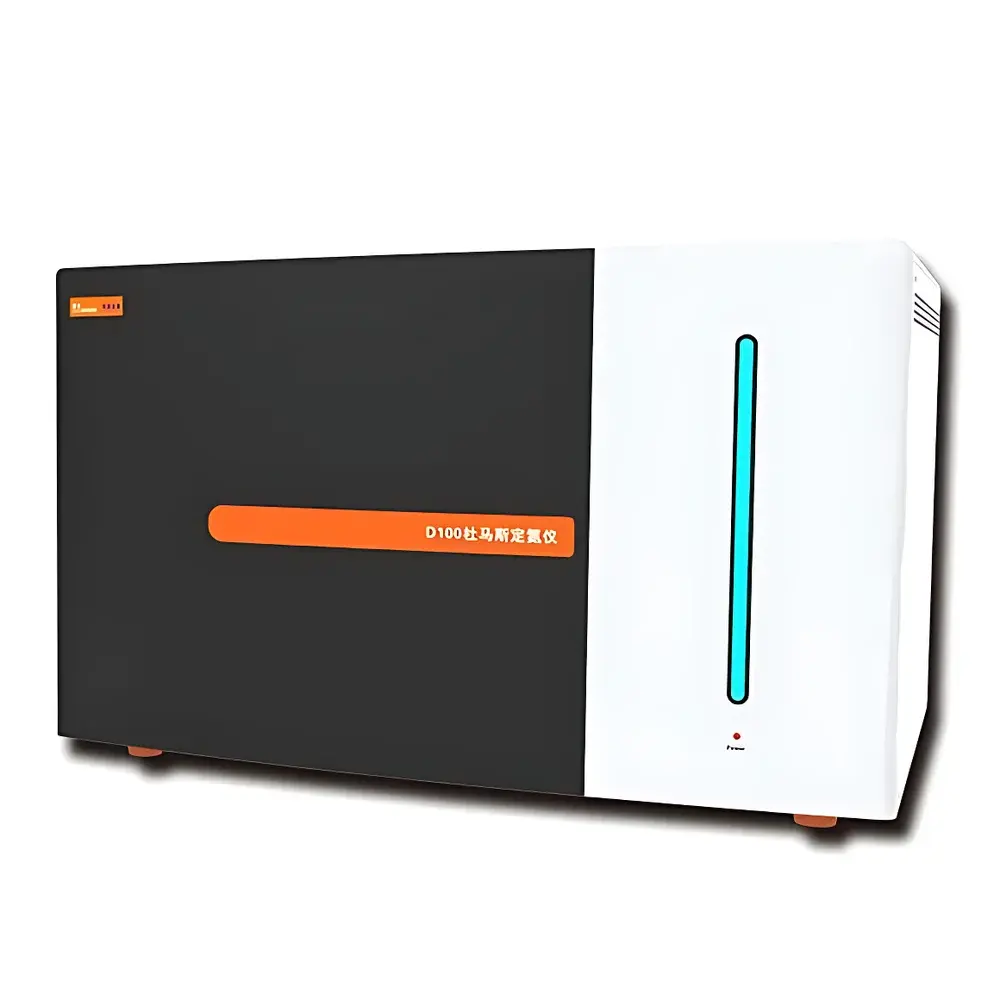
Hanon D100 Dumas Nitrogen Determinator
| Brand | Hanon |
|---|---|
| Origin | Shandong, China |
| Model | D100 |
| Principle | Dumas combustion method |
| Nitrogen range | 0–500 mg N (absolute) or up to 100% N |
| Analysis time | 3–4 min per sample |
| Repeatability | RSD < 0.5% (EDTA standard, 9.57% N) |
| Sample mass | ≤1 g (solid) or ≤1 mL (liquid) |
| Recovery rate | >99.5% |
| Power rating | 2000 W |
| Dimensions (L×W×H) | 735 mm × 560 mm × 560 mm |
| Detector | Thermal conductivity detector (TCD) |
| Carrier gas | CO₂ (99.999% purity) |
| Oxygen purity | 99.999% |
| Combustion temperature | ~960 °C |
| Detection limit | 0.01 mg N |
| Weighing precision | ≤0.1 mg |
| Calibration | Linear or user-defined non-linear curve |
| Autosampler capacity | 120 positions |
| Operating environment | 5–30 °C, ≤85% RH, AC 220 V ±10%, 50 Hz |
Overview
The Hanon D100 Dumas Nitrogen Determinator is a fully automated elemental analyzer engineered for rapid, precise, and compliant total nitrogen quantification in organic matrices using the standardized Dumas high-temperature combustion method. It operates on the principle of complete oxidative pyrolysis at ~960 °C under controlled oxygen flow, followed by catalytic oxidation, multi-stage water removal, tungsten-mediated reduction of nitrogen oxides to molecular nitrogen (N₂), and final detection via high-stability thermal conductivity detection (TCD). This architecture ensures stoichiometric conversion of all organic and inorganic nitrogen forms—including nitrate, nitrite, amide, amine, and heterocyclic nitrogen—into measurable N₂ without derivatization or wet chemistry. The instrument meets rigorous regulatory expectations for method traceability, analytical reproducibility, and system suitability, making it suitable for routine quality control and research-grade nitrogen analysis across food, agricultural, environmental, and industrial laboratories.
Key Features
- Triple-stage dehydration system: Combines electronic condensation (primary), magnesium perchlorate chemical drying (secondary), and post-reduction desiccation (tertiary) to eliminate water interference with exceptional efficiency and reduced consumable usage.
- Optimized combustion and reduction architecture: Dual-oxidation zone (CuO + Pt/CuO catalyst blend) ensures complete mineralization of refractory nitrogen compounds; tungsten-based reduction column provides quantitative conversion of NOx to N₂ while scavenging excess O₂.
- Intelligent gas management: Real-time monitoring and closed-loop control of CO₂ carrier gas flow and O₂ pressure, with adaptive oxygen dosing based on sample mass and matrix type to minimize reagent consumption and extend tungsten lifetime.
- Integrated autosampler and weighing interface: 120-position robotic sampler with positional self-check; bidirectional communication with analytical balances (USB/RS232) enables automatic sample mass acquisition, voice-assisted verification, and concurrent weighing during analysis.
- Comprehensive diagnostics and maintenance intelligence: Self-diagnostic boot sequence identifies readiness status; predictive maintenance alerts calculate consumable depletion (e.g., Mg(ClO₄)₂, tungsten, CuO) using cumulative sample count, O₂ consumption, and thermal history data.
- Enhanced operational safety: Overpressure isolation valve; low-voltage combustion furnace design; dual thermal cutoffs with independent overtemperature alarm and automatic power cutoff.
Sample Compatibility & Compliance
The D100 accommodates solid samples ≤1 g and liquid samples ≤1 mL—including grains, seeds, meat and meat products, dairy, feedstuffs, fertilizers, soils, AUS 32 (diesel exhaust fluid), wine, and biomass materials. Its methodology aligns with multiple national and industry standards, including GB 5009.5-2016 (food protein), GB 29518-2013 (AUS 32), GB/T 24318-2009 (feed), GB/T 31578-2015 (grains), NY/T 2007-2011 (cereals and legumes), SN/T 2115-2008 (import/export food/feed), GB/T 35809-2018 (lignocellulosic biomass), NY/T 2542-2014 (fertilizer), NY/T 1977-2010 (water-soluble fertilizer), and SN/T 3097-2012 (combustion-based fertilizer testing). While not pre-certified for FDA 21 CFR Part 11, its audit trail logging, electronic signature support (via optional software module), and configurable user access levels facilitate GLP/GMP-aligned deployment when integrated into validated laboratory workflows.
Software & Data Management
Hanon’s proprietary D100 Control Suite runs on Windows 7 or later and supports both USB and RS232 connectivity. It features an embedded expert method library with pre-validated protocols for common matrices (e.g., cereal, feed, fertilizer), editable user-defined methods with adjustable combustion parameters, dynamic calibration (linear or polynomial), and customizable report templates—including configurable headers, unit symbols, and institutional logos. Gas flow, pressure, temperature, and detector response are visualized in real time. Leak-check routines guide post-maintenance validation. All raw signal data, calibration logs, sample metadata, and system event timestamps are stored in structured binary files with optional export to CSV or PDF. Audit trail functionality records operator actions, parameter changes, and error events—supporting internal review and regulatory documentation requirements.
Applications
- Protein content determination in cereals, legumes, flour, and processed foods per AOAC and ISO-aligned protocols
- Quality assurance of diesel exhaust fluid (AUS 32) per GB 29518-2013 and ISO 22241
- Crude protein calculation in animal feed, pet food, and aquafeed formulations
- Total nitrogen profiling in organic fertilizers, compost, and soil amendments
- Research-level nitrogen balance studies in plant physiology and agronomy
- Environmental monitoring of nitrogen load in biomass and biochar feedstocks
- Regulatory compliance testing for nitrogen declarations on nutritional labeling
FAQ
What carrier gas does the D100 require, and why is CO₂ used instead of helium or argon?
CO₂ (≥99.999% purity) serves as the carrier gas. Its thermal conductivity differential relative to N₂ enables sensitive TCD detection, and its cost-effectiveness significantly reduces operational expenses compared to noble gases—without compromising accuracy or linearity across the 0.01–500 mg N range.
Can the D100 analyze volatile or high-moisture samples directly?
Solid samples must be homogeneous and dry enough to prevent clogging or incomplete combustion. High-moisture samples (e.g., fresh tissue) require lyophilization or oven-drying prior to analysis. Liquid samples up to 1 mL may be introduced via sealed tin capsules compatible with the autosampler.
Is method validation support available for GxP environments?
Yes—Hanon provides IQ/OQ documentation templates, performance qualification test scripts (including repeatability, recovery, LOD/LOQ verification), and traceable calibration standards. Full 21 CFR Part 11 compliance requires site-specific configuration and third-party validation, but the platform’s architecture supports required controls.
How frequently must the tungsten reduction column be replaced?
Under typical use (≤20 samples/day, mixed matrices), the tungsten column lasts ≥1,500 analyses. The software estimates remaining service life based on cumulative oxygen exposure and thermal cycles, triggering replacement alerts well in advance.
Does the D100 support external LIMS integration?
Raw data and summary reports can be exported programmatically via CSV or XML. While native HL7 or ASTM E1384 interfaces are not included, custom API wrappers or middleware solutions may be implemented using the instrument’s RS485 command protocol and file-based output structure.




