
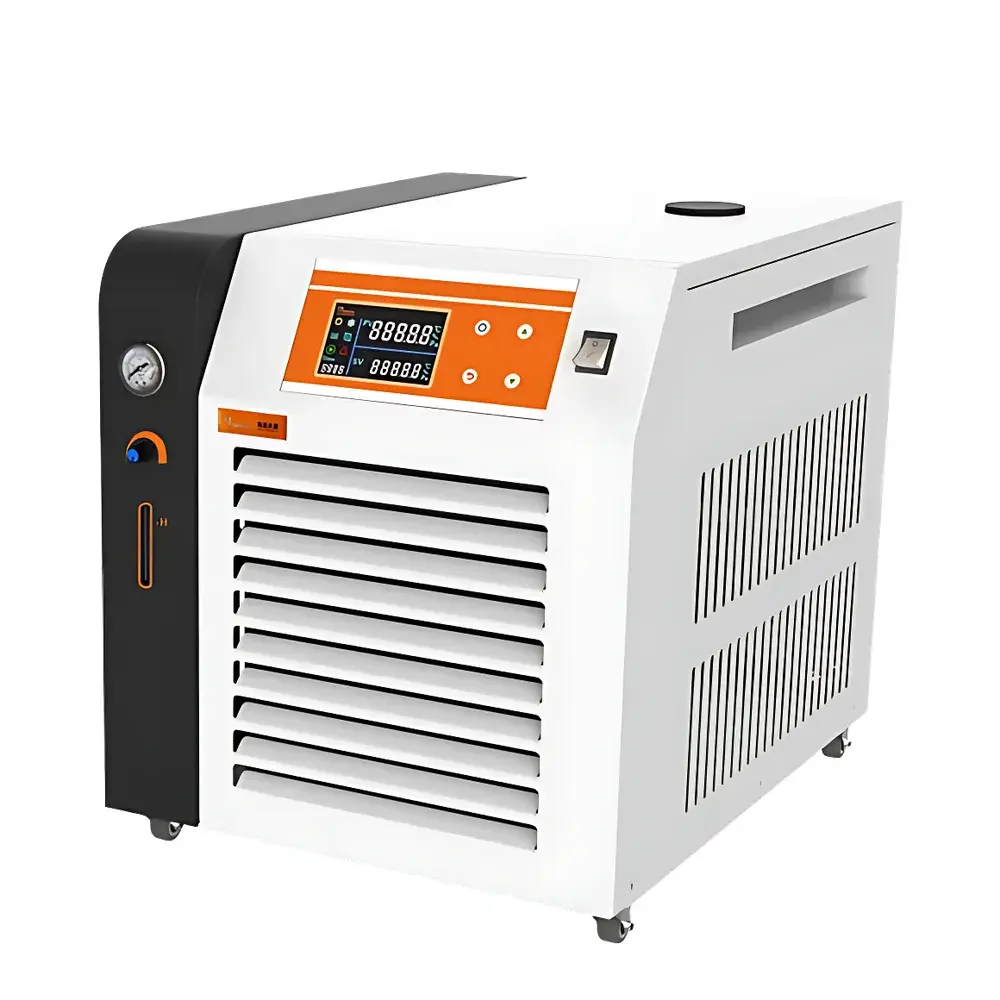
Hanon FC1200E Circulating Chiller
| Brand | Hanon |
|---|---|
| Origin | Shandong, China |
| Model | FC1200E |
| Instrument Type | Integrated Circulating Chiller |
| Cooling Method | Water-Cooled |
| Temperature Control Range | −5.0 °C to Ambient |
| Refrigeration Capacity | 1200 W @ 20 °C |
| Temperature Stability | ±2 °C |
| Circulation Pump Pressure | 0–1.5 bar (adjustable) |
| Flow Rate | 20 L/min |
| Reservoir Volume | 6 L |
| Operating Mode | Continuous |
| Refrigerant | R134a |
| Temperature Sensor | PT100 |
| Display Resolution | 0.1 °C |
| Pump Head | 15 m |
| Dimensions (W×D×H) | 618 × 477 × 540 mm |
| Power Supply | 220 V AC ±10%, 50 Hz |
Overview
The Hanon FC1200E Circulating Chiller is an integrated, water-cooled thermal management system engineered for precision temperature control in laboratory and analytical instrument applications. It operates on a compressor-based refrigeration cycle using environmentally compliant R134a refrigerant, delivering stable cooling performance across a controlled range from −5.0 °C up to ambient temperature. Designed for continuous-duty operation, the unit maintains consistent thermal output under variable load conditions—critical when supporting heat-sensitive instruments such as atomic absorption spectrometers, rotary evaporators, electrophoresis systems, and automated synthesis platforms. Its thermodynamic architecture incorporates a high-efficiency Danfoss (or equivalent Tier-1 OEM) hermetic compressor, optimized condenser coil geometry, and PID-assisted start-stop temperature regulation logic to balance energy efficiency with thermal responsiveness. The chiller’s core function is to absorb excess heat from external equipment via a closed-loop coolant circuit and reject it through forced-air convection at the condenser—enabling reliable, long-term stabilization of process temperatures without direct refrigerant exposure to the user environment.
Key Features
- Integrated design with compact footprint (618 × 477 × 540 mm), suitable for benchtop or under-bench installation in regulated lab spaces.
- Refrigeration capacity of 1200 W at 20 °C ambient—sufficient to manage thermal loads from multiple concurrent instruments including Kjeldahl digesters, Soxhlet extractors, and rheometers.
- Adjustable circulation pump delivering 20 L/min flow at up to 1.5 bar pressure and 15 m head, with mechanical pressure regulation via front-panel knob and real-time analog gauge readout.
- 6 L stainless-steel reservoir equipped with dual-level monitoring: optical liquid-level window plus electronic low-level sensor triggering audible alarm and automatic pump shutdown to prevent dry-run damage.
- Intelligent flow path management—automatically detects external loop blockage and switches to internal recirculation mode to preserve pump integrity and thermal stability.
- Full-color LCD interface with 0.1 °C display resolution, dynamic status icons, and real-time visualization of setpoint, actual bath temperature, pump status, and fault indicators.
- Compressor-based temperature control with over-temperature/under-temperature safety cutoffs, adhering to IEC 61010-1 Class II electrical safety requirements for laboratory equipment.
Sample Compatibility & Compliance
The FC1200E is compatible with standard aqueous glycol/water mixtures (e.g., 20–30% propylene glycol) used in analytical instrument cooling loops. Its sealed hydraulic system prevents contamination of connected devices such as AAS flame atomizers or HPLC column ovens. While not certified to ISO/IEC 17025 calibration standards, the unit meets general-purpose laboratory equipment requirements per GB/T 20937–2018 (Chinese national standard for circulating chillers) and complies with CE marking directives for EMC (2014/30/EU) and Low Voltage (2014/35/EU). Its PT100 temperature sensor enables traceable thermal monitoring, supporting GLP documentation workflows where temperature logs are required for audit trails.
Software & Data Management
The FC1200E operates as a standalone instrument with no embedded Ethernet or USB data logging capability. All operational parameters—including setpoint, measured temperature, pump pressure, and alarm history—are accessible via the front-panel LCD. For integration into centralized lab monitoring systems, optional third-party analog voltage (0–10 V) or 4–20 mA output modules may be installed to relay temperature and status signals to SCADA or LIMS platforms. No proprietary software is required; however, users deploying the chiller in FDA-regulated environments (e.g., pharmaceutical QC labs) should validate its temperature stability and alarm response per USP Analytical Instrument Qualification protocols.
Applications
- Thermal stabilization of atomic absorption spectrometry (AAS) graphite furnace coolants and nebulizer gas lines.
- Cooling jacket support for rotary evaporation systems operating below ambient, particularly during solvent recovery of heat-labile compounds.
- Condenser temperature control in reflux, Soxhlet, and accelerated solvent extraction (ASE) apparatuses.
- Temperature regulation of electrophoresis buffer tanks and capillary electrophoresis cartridges.
- Heat dissipation management for high-power laser sources, CCD detectors, and automated peptide synthesizers.
- Process cooling in small-scale bioreactors and fermentation monitoring setups requiring sub-ambient bath stability.
FAQ
What is the minimum operating temperature achievable with the FC1200E?
The unit achieves a stable setpoint down to −5.0 °C, provided ambient conditions remain ≤25 °C and adequate ventilation is maintained around the condenser.
Can the FC1200E be used with organic solvents in the coolant loop?
No—only water-based coolants with approved corrosion inhibitors or food-grade glycols are permitted. Halogenated or hydrocarbon solvents will degrade seals and compromise refrigerant system integrity.
Does the chiller support remote start/stop or digital communication protocols?
Not natively. RS232, Modbus RTU, or Ethernet connectivity requires aftermarket interface modules and firmware customization, which voids standard warranty coverage.
How often should the refrigerant charge be verified?
Under normal operation and proper maintenance, the sealed R134a system requires no periodic recharge. Verification is only necessary if cooling capacity degrades significantly or compressor current draw increases abnormally—indicating potential leakage or oil migration.
Is the FC1200E suitable for cleanroom environments?
Yes, provided the unit is installed outside the cleanroom (e.g., in a utility corridor) with coolant lines routed through wall penetrations. Its acoustic noise level (<58 dB(A)) and zero refrigerant leakage risk make it appropriate for ISO Class 7–8 supporting infrastructure.



