
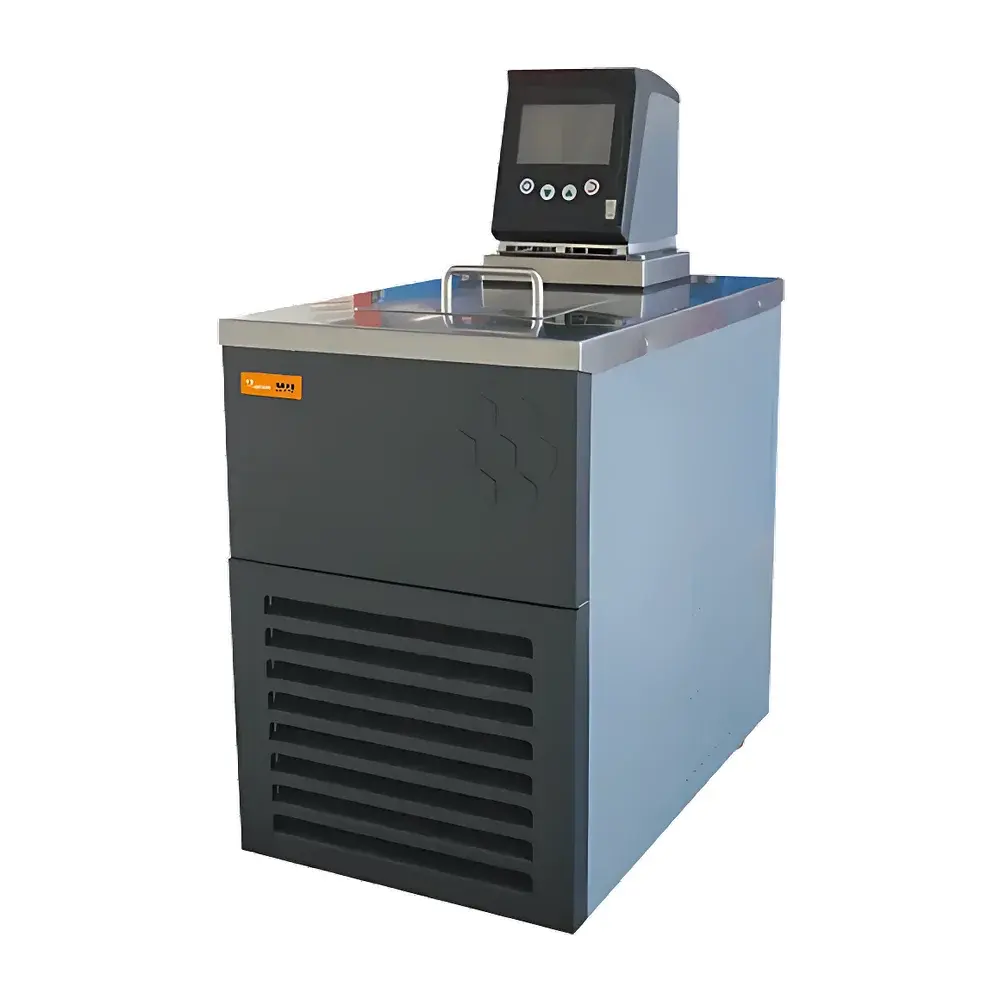
Hanon FC1500 Circulating Chiller/Heater
| Brand | Hanon |
|---|---|
| Origin | Shandong, China |
| Model | FC1500 |
| Instrument Type | Constant-Temperature Bath |
| Circulation Mode | Internal & External |
| Temperature Control | Refrigeration & Heating |
| Bath Volume | 10 L |
| Temperature Range | 5 °C to 100 °C |
| Temperature Stability | ±0.05 °C |
| Display Resolution | 0.1 °C |
| Control Algorithm | Fuzzy PID |
| Sensor Type | PT100 |
| Heating Power | 2000 W |
| Refrigeration Capacity | 1500 W (at 20 °C ambient) |
| Refrigerant | R134a |
| Pump Flow Rate | 10 L/min |
| Pump Pressure | 0.35 bar |
| Dimensions | 555 mm × 350 mm × 750 mm |
| Weight | 40 kg |
| Power Supply | 220 VAC ±10%, 50 Hz |
| Operating Ambient | 10 °C–25 °C |
| Protection Features | Overcurrent, High/Low Temperature, Overtemperature, Low-Level Audible/Visual Alarm, Dry-Run Prevention |
Overview
The Hanon FC1500 Circulating Chiller/Heater is an engineered thermal management system designed for precision temperature control in laboratory and industrial R&D environments. It operates on a dual-mode thermoregulation principle—integrating compressor-based refrigeration with resistive heating—to deliver stable, uniform thermal conditions across a wide operational range (5 °C to 100 °C). Unlike passive baths or single-function units, the FC1500 employs active liquid circulation via a sealed, electrically isolated centrifugal pump, enabling both internal bath homogenization and external heat exchange through closed-loop jacketed reactors, spectrophotometer cells, or analytical instrumentation cooling lines. Its core architecture prioritizes thermal inertia minimization and dynamic response fidelity: the 10 L 316 stainless steel bath—deep-drawn in one piece—ensures corrosion resistance and dimensional stability under repeated thermal cycling, while the fuzzy PID algorithm continuously adjusts power output based on real-time PT100 feedback, achieving ±0.05 °C stability at setpoint under steady-state load.
Key Features
- Integrated dual-mode thermal control: hermetically sealed R134a refrigeration circuit combined with 2000 W high-efficiency heating element
- Electrically isolated, mold-cast turbine pump delivering 10 L/min flow at 0.35 bar pressure—designed for low-noise, long-life operation without electrolytic coupling risks
- 5.5-inch high-brightness color LCD interface with intuitive navigation, real-time trend display, and parameter logging capability
- Modular service design: removable front grating and bottom drain valve facilitate routine maintenance, fluid replacement, and residue removal
- Comprehensive safety architecture including overtemperature cutoff, low-level fluid detection with audible/visual alert, overcurrent protection, and dry-run prevention logic
- Compact footprint (555 × 350 × 750 mm) optimized for benchtop integration in regulated lab spaces with limited floor area
Sample Compatibility & Compliance
The FC1500 supports compatibility with aqueous, ethylene glycol–water mixtures (up to 50% v/v), and other non-aggressive heat transfer fluids commonly used in pharmaceutical QC, bioprocess development, and materials testing. Its 316 stainless steel bath and fluoropolymer-sealed pump housing meet ASTM G48 and ISO 9223 standards for corrosion resistance in chloride-containing environments. While not certified to UL/CSA or CE for standalone medical device use, the unit complies with IEC 61010-1:2010 for laboratory electrical safety and incorporates design elements aligned with GLP documentation requirements—including timestamped temperature logs, user-accessible calibration offset fields, and non-volatile parameter storage. It is routinely deployed in facilities operating under ISO/IEC 17025-accredited quality systems for method validation support.
Software & Data Management
The FC1500 includes embedded firmware supporting RS232 and optional RS485 communication protocols (Modbus RTU), enabling integration into centralized lab monitoring networks or SCADA platforms. Logged data—including setpoint, actual bath temperature, pump status, and alarm events—is stored internally for up to 30 days (1-minute intervals) and exportable via USB flash drive in CSV format. The system supports manual calibration offset entry for PT100 sensor traceability and allows configuration of user-defined alarm thresholds and hysteresis bands. For regulated environments, audit trail functionality (including operator ID tagging and change timestamps) can be enabled when connected to compliant third-party LIMS or ELN systems meeting FDA 21 CFR Part 11 requirements.
Applications
- Stabilizing optical components in UV-Vis and FTIR spectrometers requiring sub-0.1 °C thermal drift control
- Maintaining consistent reaction temperatures in small-scale catalytic screening and polymerization studies
- Providing controlled cooling for HPLC column ovens, rotary evaporators, and vacuum manifold condensers
- Supporting accelerated stability testing per ICH Q1A(R3) guidelines in pharmaceutical formulation labs
- Serving as a temperature source for calorimetric calibration, viscometer thermostating, and rheometer environmental chambers
FAQ
What fluids are compatible with the FC1500 bath system?
Deionized water, 20–50% ethylene glycol/water mixtures, and low-viscosity silicone oils are approved. Avoid halogenated solvents, strong acids/bases, or fluids with vapor pressures exceeding 10 kPa at 100 °C.
Can the FC1500 be integrated into automated workflows?
Yes—via RS232 serial interface or optional RS485 Modbus RTU, allowing remote setpoint adjustment, status polling, and alarm triggering within LabVIEW, Python-controlled test benches, or PLC-based manufacturing lines.
Is calibration certificate included with shipment?
A factory-as-tested performance report (covering temperature stability, setpoint accuracy, and pump flow verification) is supplied. NIST-traceable calibration certificates are available upon request with additional lead time and fee.
How often does the refrigerant require servicing?
R134a is sealed for life under normal operating conditions. Refrigerant recharge is only necessary following verified leakage events confirmed by electronic leak detector—typically beyond 8–10 years of continuous use.
Does the unit meet noise emission limits for open-lab environments?
At rated load, sound pressure level is ≤52 dB(A) at 1 m distance—within typical ISO 15710 Class 2 laboratory ambient noise specifications.



