
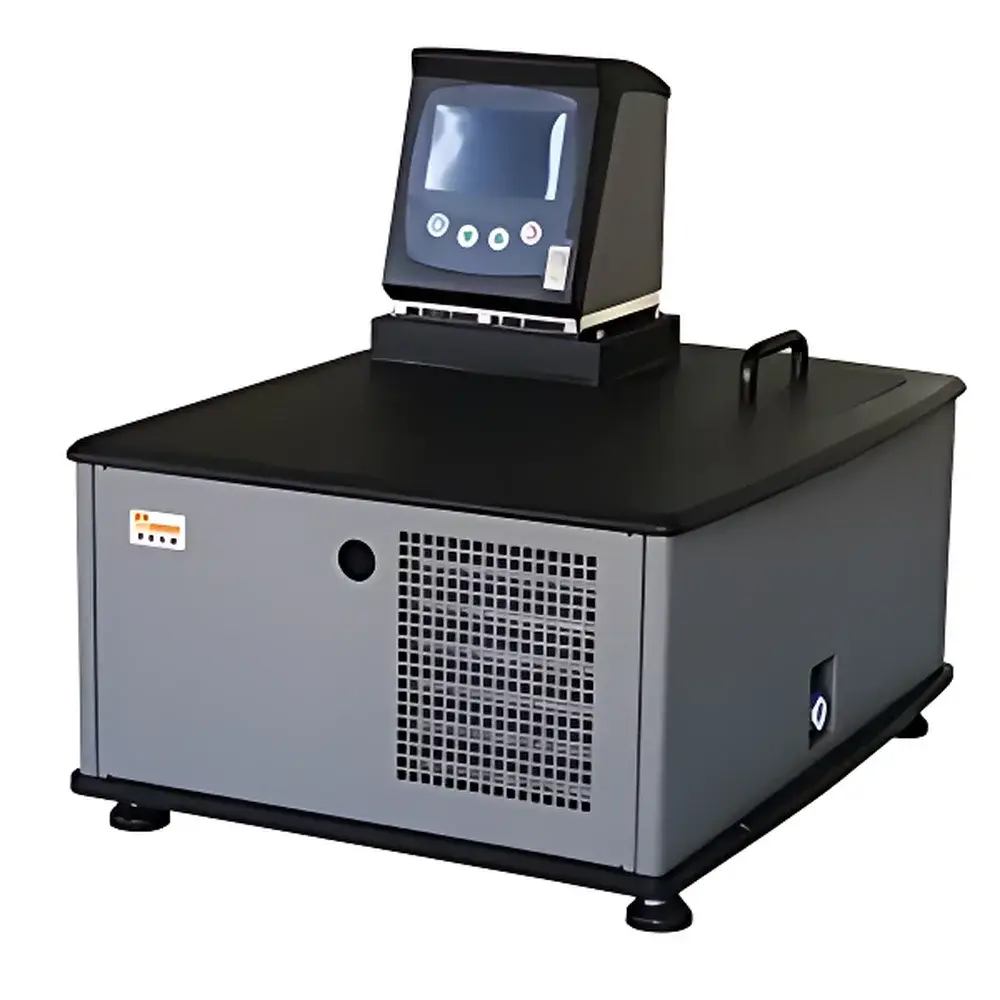
Hanon FCLW6-20 Precision Circulating Chiller/Heater Bath for Viscometers
| Brand | Hanon |
|---|---|
| Origin | Shandong, China |
| Model | FCLW6-20 |
| Bath Volume | 6 L |
| Temperature Range | -20 °C to 100 °C |
| Temperature Stability | ±0.05 °C |
| Display Resolution | 0.1 °C |
| Pump Flow Rate | 10 L/min |
| Pump Pressure | 0.35 bar |
| Heating Power | 1000 W |
| Cooling Power | 250 W |
| Refrigerant | R134a |
| Temperature Sensor | PT100 |
| Control Algorithm | Fuzzy PID |
| Circulation Mode | Internal & External |
| Protection Features | Over-current, High/Low Temperature, Over-temperature, Low-level Audio-Visual Alarm |
| Power Supply | 220 V AC ±10%, 50 Hz |
Overview
The Hanon FCLW6-20 Precision Circulating Chiller/Heater Bath is an engineered thermal management system designed specifically to support rotational and capillary viscometers requiring stringent temperature control during rheological measurements. It operates on a dual-mode thermoregulation principle—combining resistive heating with vapor-compression refrigeration—to deliver stable, uniform thermal environments across a broad operational range of −20 °C to +100 °C. Its core architecture integrates a hermetically sealed R134a refrigeration circuit with a high-efficiency 1000 W heating element, enabling rapid thermal equilibration and sustained stability of ±0.05 °C—critical for ASTM D445, ISO 3104, and USP viscosity compliance testing. The bath’s compact footprint and modular internal layout facilitate seamless integration beneath or adjacent to benchtop viscometers, minimizing fluid path length and thermal lag.
Key Features
- Fuzzy PID temperature control algorithm ensures minimal overshoot and fast settling time (<15 min from 25 °C to 80 °C), significantly improving measurement repeatability in multi-point viscosity profiles.
- Motor-driven, mold-cast turbine pump delivers consistent 10 L/min flow at 0.35 bar pressure with full electrical isolation (no direct contact between motor windings and circulating fluid), eliminating risk of electrolytic corrosion or electrical leakage.
- 5.5-inch high-brightness color LCD display provides simultaneous readout of setpoint, actual bath temperature, pump status, and active alarm conditions—with 0.1 °C resolution and intuitive icon-based navigation.
- Removable stainless-steel grating and bottom-mounted quick-release drain port enable tool-free maintenance, residue-free cleaning, and rapid fluid exchange—essential for labs performing solvent-switched viscosity protocols.
- Comprehensive safety architecture includes over-current protection, dual-stage high/low temperature cutoffs, over-temperature lockout, and low-fluid-level audio-visual alarm with automatic heater shutdown to prevent dry-run damage.
Sample Compatibility & Compliance
The FCLW6-20 is optimized for use with Brookfield, Anton Paar, Thermo Fisher, and other major-brand viscometers requiring external temperature-controlled baths. Its 6 L reservoir accommodates standard U-tube, Cannon-Fenske, and suspended-level viscometer configurations while supporting both internal recirculation (for standalone operation) and external loop circulation (for inline thermal conditioning). The system complies with IEC 61010-1:2010 for laboratory electrical safety and meets RoHS Directive 2011/65/EU requirements. Its R134a refrigerant conforms to EPA SNAP Program guidelines and carries zero ozone depletion potential (ODP = 0). For regulated environments, the unit supports audit-ready documentation of temperature logs when paired with optional RS485/Modbus RTU interface modules.
Software & Data Management
While the FCLW6-20 operates as a standalone instrument, its analog voltage output (0–5 V) and digital Modbus RTU interface (optional) allow integration into centralized lab data acquisition systems. When connected to compliant SCADA or LIMS platforms, real-time temperature, pump status, and alarm events can be timestamped and archived—supporting 21 CFR Part 11 electronic record integrity where enabled by host software. No proprietary drivers or cloud dependencies are required; communication follows open industrial protocol standards. Firmware updates are performed via USB, ensuring long-term maintainability without vendor lock-in.
Applications
- Temperature-dependent viscosity profiling of lubricants, polymer melts, pharmaceutical suspensions, and edible oils per ASTM D7042 and ISO 2555.
- Calibration verification of capillary viscometers under controlled thermal gradients (e.g., 25 °C, 40 °C, 100 °C) in accordance with ISO/IEC 17025 accredited laboratories.
- Stabilization of sample cells during dynamic shear experiments involving time-temperature superposition (TTS) analysis.
- Support of QC workflows in food, chemical, and cosmetics manufacturing where batch release hinges on kinematic viscosity consistency at defined process temperatures.
FAQ
What viscometer models is the FCLW6-20 certified to interface with?
The bath is mechanically and thermally compatible with all major rotational and capillary viscometers featuring standard ¼” NPT or M12 quick-connect ports—including Brookfield DVNext, Anton Paar Lovis 2000, and Cannon Instrument Co. models. No OEM-specific adapters are required.
Can the unit maintain ±0.05 °C stability across the full −20 °C to 100 °C range?
Yes—stability specification applies across the entire operating range, verified per ISO 17025 traceable calibration using dual-reference PT100 probes and a metrology-grade data logger.
Is external cooling water required for refrigeration?
No—the system uses an integrated air-cooled condenser with R134a refrigerant; no chilled water supply or plumbing is needed.
How often does the bath require preventive maintenance?
Under normal use (8 hrs/day, 5 days/week), annual inspection of refrigerant charge, pump seal integrity, and sensor calibration is recommended; the PT100 sensor is field-replaceable with NIST-traceable calibration certificates available.
Does the unit support GLP/GMP audit trails?
When integrated via Modbus RTU into validated LIMS or ELN systems, temperature history, operator IDs, and alarm timestamps can be captured in compliance with ALCOA+ data integrity principles—but native audit trail functionality requires host-system implementation.



