
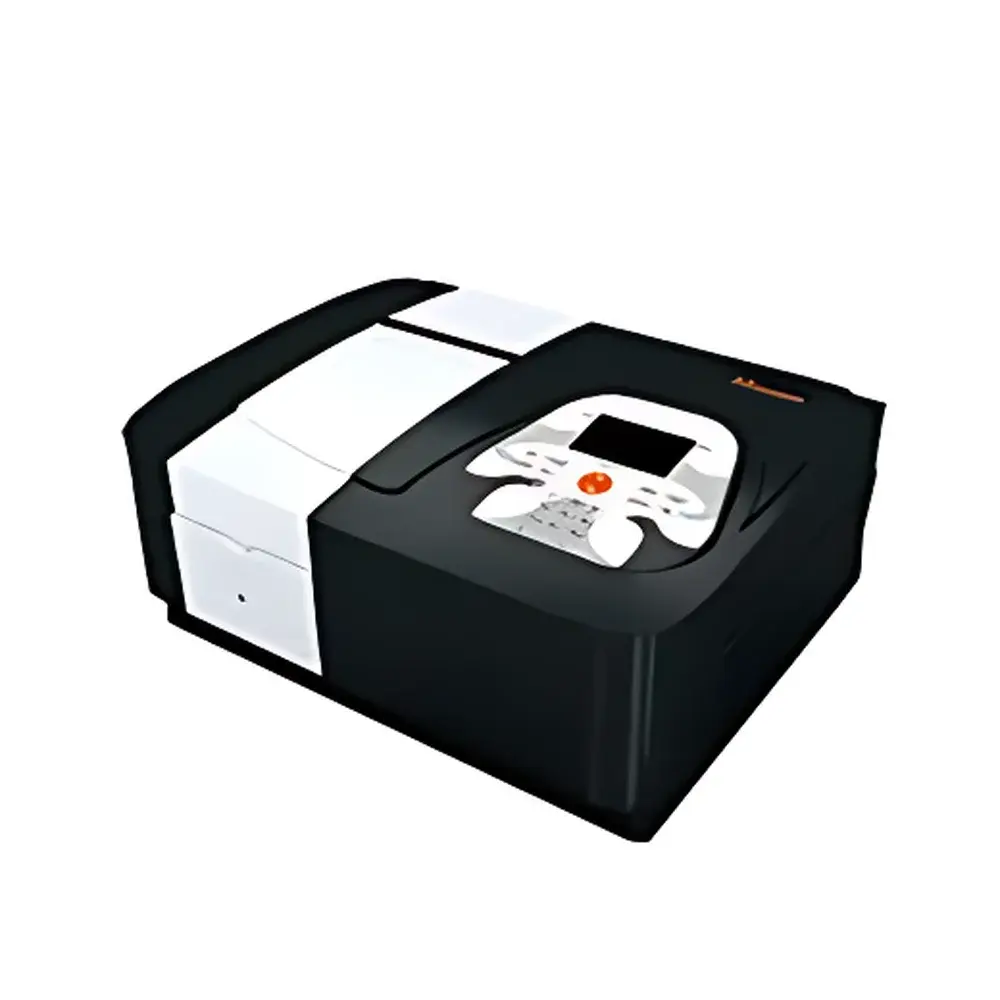
Hanon i2 UV-Vis Spectrophotometer
| Brand | Hanon |
|---|---|
| Origin | Shandong, China |
| Model | i2 |
| Optical Design | Double-beam |
| Detector | Photodiode Array (PDA) |
| Wavelength Range | 190–1100 nm |
| Wavelength Accuracy | ±0.1 nm (at D₂ line, 656.1 nm), ±0.3 nm across full range |
| Wavelength Repeatability | ≤0.2 nm |
| Spectral Bandwidth | 0.5 / 1 / 2 / 4 / 5.0 nm (selectable) |
| Stray Light | ≤0.03% T |
| Wavelength Scanning | Automatic |
| A/D Resolution | 24-bit |
| Data Storage | 200 measurement sets + 200 calibration curves |
| Baseline Flatness | ±0.001 A |
| Photometric Accuracy | ±0.3% T |
| Photometric Repeatability | ≤0.15% T |
| Drift | ±0.001 A/h at 500 nm |
| Noise | ±0.0005 A/h |
| Photometric Range | 0–200% T, –0.3 to 3 A, 0–9999 C |
| Display | 128 × 64 LCD |
| Interface | USB port for data export |
| Power Supply | AC 220 V/50 Hz or 110 V/60 Hz |
| Dimensions | 460 × 380 × 180 mm |
| Weight | 15 kg |
Overview
The Hanon i2 UV-Vis Spectrophotometer is a double-beam, microprocessor-controlled analytical instrument engineered for precision absorbance and transmittance measurements across the ultraviolet, visible, and near-infrared spectral regions (190–1100 nm). Its optical architecture employs a high-stability tungsten-halogen lamp and deuterium lamp combination, coupled with a photodiode array (PDA) detector, enabling rapid full-spectrum acquisition without mechanical scanning. The double-beam configuration compensates in real time for source intensity fluctuations and environmental drift, ensuring high reproducibility in routine quantitative analysis and kinetic studies. Designed for compliance with standard laboratory workflows, the i2 supports regulatory requirements for method validation under ISO/IEC 17025 and GLP environments—particularly where trace-level quantitation of organic compounds, nucleic acids, proteins, and colored dyes is required.
Key Features
- 24-bit analog-to-digital conversion for enhanced signal resolution and improved detection sensitivity at low absorbance levels
- Selectably adjustable spectral bandwidth (0.5, 1, 2, 4, or 5.0 nm) to optimize resolution versus signal-to-noise ratio per application
- Automated wavelength calibration and self-diagnostic routines—including automatic baseline correction and lamp alignment verification
- Suspended optical bench design with reinforced cast-aluminum baseplate to minimize mechanical vibration and thermal-induced optical misalignment
- Tool-free tungsten lamp replacement—no recalibration or optical realignment required post-service
- Integrated firmware with built-in photometric validation protocols compliant with ASTM E275 and USP
Sample Compatibility & Compliance
The i2 accommodates standard 10-mm pathlength cuvettes (quartz, glass, or plastic), as well as optional micro-volume adapters and flow cells for specialized applications. Its optical system meets key international performance criteria for spectrophotometers, including stray light specification (≤0.03% T at 220 nm), wavelength accuracy (±0.1 nm at reference lines), and photometric linearity over three decades of absorbance (–0.3 to 3 A). Instrument operation and data handling are compatible with Good Laboratory Practice (GLP) documentation standards; audit trails, user access control, and electronic signature support can be implemented via external LIMS integration through its USB interface. While not pre-certified for FDA 21 CFR Part 11, the system’s deterministic firmware behavior and non-volatile memory storage enable validated deployment in regulated QC/QA laboratories when accompanied by site-specific risk assessment and procedural controls.
Software & Data Management
The included PC-based scanning software provides native support for seven core operational modes: photometric measurement, quantitative analysis (single-point and multi-point calibration), spectral scanning, kinetics, multi-wavelength analysis, nucleic acid/protein quantification (using built-in extinction coefficients), and spectral derivative processing. All spectra and results are timestamped and stored internally (200 datasets + 200 calibration curves) or exported via USB to CSV or ASCII formats for downstream statistical analysis. The software enforces data integrity through checksum validation during transfer and supports batch report generation with customizable templates aligned to internal SOPs. No proprietary runtime dependencies or cloud synchronization are employed—ensuring full data sovereignty and compatibility with air-gapped lab networks.
Applications
- Quantitative determination of pharmaceutical actives and excipients per USP monographs
- Enzyme kinetics and inhibitor screening using time-resolved absorbance monitoring
- Quality control of dyes, pigments, and food colorants in manufacturing environments
- DNA/RNA concentration and purity assessment (A₂₆₀/A₂₈₀ and A₂₆₀/A₂₃₀ ratios)
- Water quality analysis (e.g., nitrate, phosphate, and COD estimation via colorimetric assays)
- Educational use in undergraduate chemistry and biochemistry laboratories for spectral interpretation and Beer-Lambert law validation
FAQ
What wavelength calibration standards are recommended for routine verification?
Deuterium (656.1 nm) and holmium oxide (241.1, 279.4, 287.5, 333.7, 360.9, 418.5, 460.0, 484.5, 536.2 nm) filters are advised per ISO 6326-2 and ASTM E275 guidelines.
Is the i2 compatible with third-party spectrophotometric assay kits?
Yes—provided kit protocols specify absorbance endpoints within the instrument’s photometric range (–0.3 to 3 A) and do not require proprietary hardware interfaces.
Can the PDA detector be recalibrated in-field?
No. The photodiode array is factory-aligned and sealed; only lamp intensity and wavelength calibration functions are user-accessible.
Does the instrument support GMP-compliant electronic record retention?
While the i2 itself does not embed 21 CFR Part 11 features, its deterministic output format and USB export capability allow integration into validated electronic lab notebook (ELN) or LIMS platforms that provide compliant archiving and audit trail functionality.




