
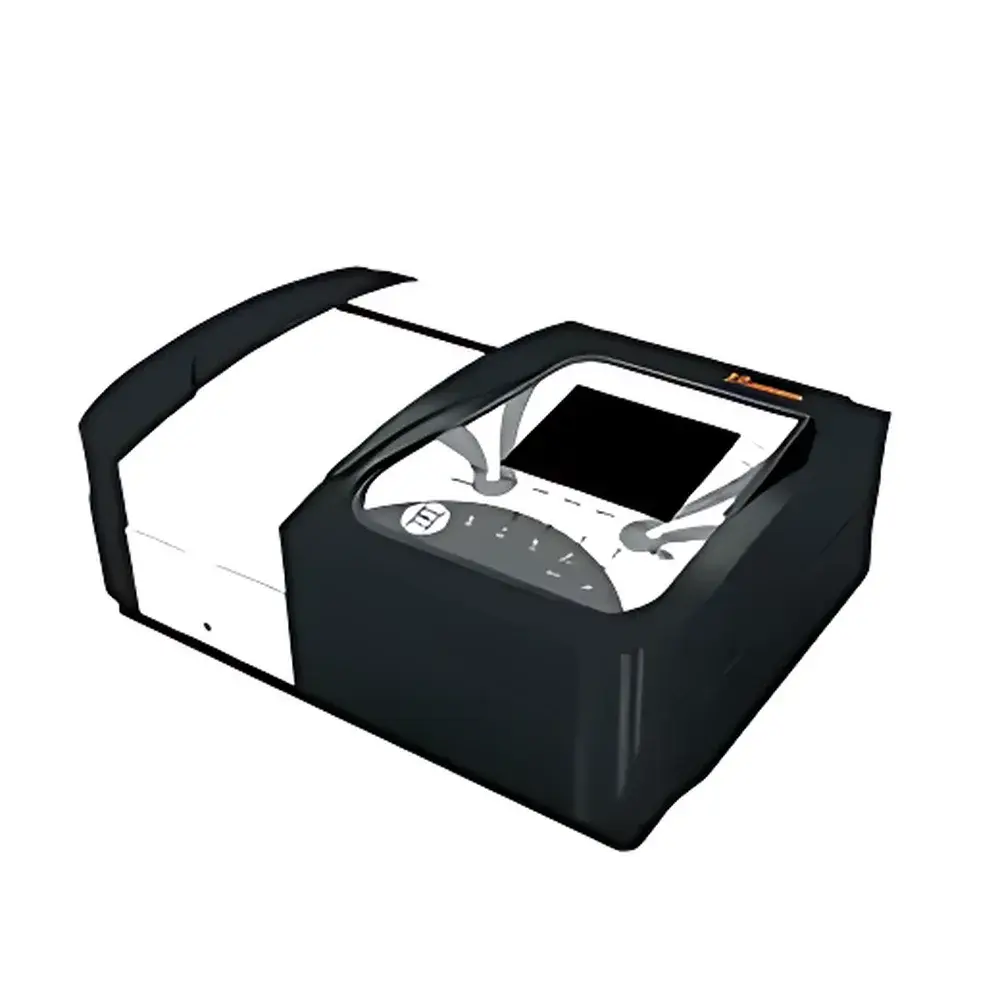
Hanon i5 UV-Vis Spectrophotometer
| Brand | Hanon |
|---|---|
| Origin | Shandong, China |
| Model | i5 |
| Optical Design | Double-beam |
| Detector | Photodiode Array (PDA) |
| Wavelength Range | 190–1100 nm |
| Wavelength Accuracy | ±0.1 nm (at D₂ line, 656.1 nm), ±0.3 nm across full range |
| Wavelength Repeatability | ≤0.2 nm |
| Spectral Bandwidth | 0.5 / 1 / 2 / 4 / 5.0 nm (selectable) |
| Stray Light | ≤0.03% T |
| A/D Resolution | 24-bit |
| Baseline Flatness | ±0.001 A |
| Photometric Accuracy | ±0.3% T |
| Photometric Repeatability | ±0.15% T |
| Drift | ≤0.001 A/h (at 500 nm) |
| Noise | ≤0.0005 A |
| Photometric Range | 0–200% T, –0.3 to 3 A, 0–9999 C |
| Wavelength Setting | Automatic |
| Scan Speed | High/Medium/Low (user-selectable) |
| Display | 320 × 240 LCD |
| Light Sources | Imported Deuterium & Tungsten Lamps |
| Power Supply | AC 220 V/50 Hz or 110 V/60 Hz |
| Dimensions | 460 × 380 × 180 mm |
| Weight | 20 kg |
Overview
The Hanon i5 UV-Vis Spectrophotometer is a double-beam, microprocessor-controlled analytical instrument engineered for precision absorbance, transmittance, and concentration measurements across the ultraviolet, visible, and near-infrared spectral regions (190–1100 nm). It employs a high-stability optical architecture featuring imported deuterium and tungsten lamps, a photodiode array (PDA) detector, and a synchronized sine-bar wavelength drive mechanism—ensuring high photometric fidelity and long-term measurement reproducibility. The instrument’s core optical design incorporates a suspended optical bench with reinforced baseplate construction, minimizing mechanical drift induced by ambient vibration or thermal expansion. Its 24-bit analog-to-digital conversion system delivers enhanced signal resolution and dynamic range, supporting low-noise detection down to 0.0005 A RMS and baseline stability of ±0.001 A over the full scan range.
Key Features
- Double-beam optical configuration with real-time reference beam compensation for improved photometric accuracy and drift resistance
- Selectably variable spectral bandwidth (0.5, 1, 2, 4, or 5.0 nm) optimized for resolution–sensitivity trade-offs in diverse sample matrices
- High-precision wavelength calibration verified against primary standards (D₂ 656.1 nm line; certified ±0.1 nm accuracy)
- Robust mechanical design: suspended optical path + thickened chassis suppresses sensitivity to bench-level perturbations
- Integrated dual-platform operation—standalone LCD interface (320 × 240) and PC-based software both support full method execution including photometric, quantitative, kinetic, multi-wavelength, and biomolecular (DNA/protein) analysis
- USB and parallel port connectivity for flexible data export, instrument control, and printer integration
- Compliant lamp management with automatic source switching and lifetime monitoring
Sample Compatibility & Compliance
The i5 accommodates standard 10-mm rectangular cuvettes (glass, quartz, or plastic), as well as optional accessories for microvolume, flow-cell, or solid-sample reflectance measurements. Its optical performance meets key international specifications for routine laboratory use—including ASTM E275, ISO 6425, and USP requirements for spectrophotometric validation. While not pre-certified for regulated GxP environments, the system supports audit-ready operation when paired with compliant PC software: user access controls, electronic signatures, and full audit trails (including method parameters, raw spectra, and calibration logs) can be implemented per FDA 21 CFR Part 11 guidelines. Instrument qualification documentation (IQ/OQ) templates are available upon request for GLP/GMP-aligned laboratories.
Software & Data Management
The i5 is supplied with Hanon SpectraPro™ PC software—a Windows-based application enabling comprehensive spectral acquisition, peak identification, derivative analysis, multi-curve overlay, and kinetic modeling. All raw spectral data are stored in vendor-neutral ASCII format (.txt) and industry-standard JCAMP-DX (.jdx), ensuring long-term archival integrity and third-party compatibility (e.g., with OriginLab, MATLAB, or ChemDraw). The software supports customizable report generation with embedded metadata (date/time, operator ID, instrument serial number, calibration status), and permits direct export to Excel, PDF, or image formats (PNG, TIFF). For laboratories requiring traceability, optional software modules provide electronic signature enforcement, role-based permissions, and automated backup to network drives or cloud repositories.
Applications
- Quantitative analysis of pharmaceutical actives and excipients per USP/EP monographs
- Enzyme kinetics and protein-ligand binding studies using time-resolved absorbance monitoring
- Water quality assessment (e.g., nitrate, phosphate, COD estimation) in environmental labs
- Quality control of dyes, pigments, and polymer additives via spectral fingerprinting
- DNA/RNA quantification and purity evaluation (A₂₆₀/A₂₈₀, A₂₆₀/A₂₃₀ ratios) with built-in nucleic acid calculation modules
- Educational instruction in analytical chemistry, biochemistry, and materials science curricula
FAQ
Is the i5 compliant with FDA 21 CFR Part 11?
The hardware itself does not enforce Part 11 requirements; however, when operated with the optional validated SpectraPro™ software package—including user authentication, electronic signatures, and immutable audit trails—the system supports full Part 11 compliance.
Can the i5 perform kinetic measurements over extended time periods?
Yes. The instrument supports programmable time-scan protocols up to 9999 data points with user-defined intervals (100 ms to 60 min), suitable for monitoring slow enzymatic reactions or degradation kinetics.
What cuvette materials are supported at 190 nm?
Quartz (fused silica) cuvettes are required for measurements below 350 nm. Standard glass or plastic cuvettes absorb strongly in the far-UV and are unsuitable for 190–220 nm work.
Does the i5 include NIST-traceable wavelength and photometric calibration standards?
A set of factory-installed, NIST-traceable holmium oxide and neutral density filters is included for initial verification. Full calibration certificates (with uncertainty budgets) are available as an optional add-on.
How is lamp life monitored and managed?
The firmware tracks cumulative on-time for both deuterium and tungsten sources, displays remaining estimated lifespan, and triggers visual alerts prior to end-of-life—reducing unplanned downtime and ensuring consistent spectral output.




