
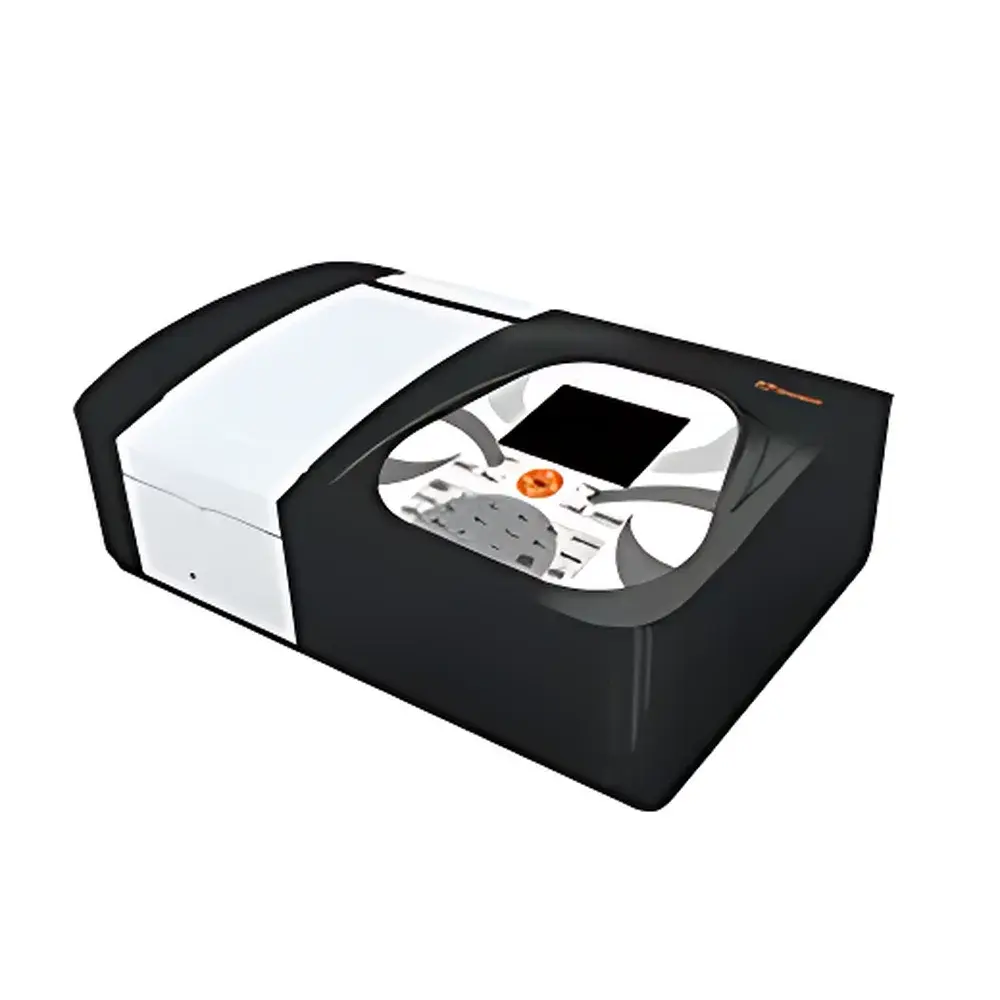
Hanon i7 Ultraviolet-Visible Spectrophotometer
| Brand | Hanon |
|---|---|
| Origin | Shandong, China |
| Model | i7 |
| Optical Design | Double-beam |
| Detector | Photodiode Array (PDA) |
| Wavelength Range | 190–1100 nm |
| Wavelength Accuracy | ±0.1 nm at 656.1 nm (D₂ line), ±0.3 nm across full range |
| Wavelength Repeatability | ≤0.1 nm |
| Spectral Bandwidth | 0.5 / 1.0 / 2.0 / 4.0 / 5.0 nm (user-selectable) |
| Stray Light | ≤0.03% T |
| Photometric Accuracy | ±0.2% T |
| Photometric Repeatability | ±0.15% T |
| Baseline Flatness | ±0.001 A |
| Drift | ≤0.001 A/h at 500 nm |
| Noise | ≤0.0005 A |
| Photometric Range | 0–200% T, –4.0 to +4.0 A, 0–9999 C |
| Wavelength Setting | Automatic |
| Scan Speed | High/Medium/Low (3 modes) |
| A/D Resolution | 24-bit |
| Display | 320 × 240 LCD |
| Light Sources | Imported Tungsten and Deuterium Lamps |
| Detector Type | Imported Silicon Photodiode |
| Power Supply | AC 220 V/50 Hz or 110 V/60 Hz |
| Dimensions | 470 × 370 × 180 mm |
| Weight | 20 kg |
Overview
The Hanon i7 Ultraviolet-Visible Spectrophotometer is a precision double-beam instrument engineered for high-fidelity absorbance, transmittance, and concentration measurements across the ultraviolet, visible, and near-infrared spectral regions (190–1100 nm). Its optical architecture employs a suspended optical system mounted on a reinforced baseplate—designed to isolate the beam path from mechanical vibration and structural deformation, thereby ensuring long-term alignment stability critical for regulatory-compliant analysis. The instrument utilizes a photodiode array (PDA) detector coupled with imported deuterium and tungsten-halogen lamps, enabling rapid, simultaneous acquisition of full-spectrum data without moving parts. This configuration supports both single-wavelength quantitation and high-resolution spectral scanning with selectable spectral bandwidths (0.5–5.0 nm), making it suitable for routine QC testing as well as method development in pharmaceutical, environmental, biochemical, and materials laboratories.
Key Features
- Double-beam optical design with real-time reference compensation for enhanced photometric stability and baseline fidelity.
- Suspended optical platform with thickened baseplate to minimize sensitivity to ambient vibration and thermal drift.
- 24-bit high-speed analog-to-digital conversion delivering improved signal-to-noise ratio (SNR) and dynamic range resolution.
- Five-step adjustable spectral bandwidth (0.5 / 1.0 / 2.0 / 4.0 / 5.0 nm) optimized for resolution–throughput trade-offs in diverse sample matrices.
- Automated wavelength calibration using D₂ (656.1 nm) and other internal reference lines; validated against NIST-traceable standards.
- Integrated dual light source management: automatic lamp switching between deuterium (UV) and tungsten (VIS-NIR) with intelligent lifetime monitoring.
- Large-format 320 × 240 backlit LCD display supporting standalone operation—no PC required for basic photometric, quantitative, kinetic, or multi-wavelength assays.
Sample Compatibility & Compliance
The i7 accommodates standard 10-mm rectangular cuvettes (glass, quartz, or plastic), microvolume adapters (down to 50 µL), and optional fiber-optic probes for non-contact or flow-through applications. Its optical performance meets or exceeds key international specifications outlined in ISO 6223, ASTM E275, and USP for UV-Vis spectrophotometers used in pharmaceutical quality control. The instrument’s photometric accuracy (±0.2% T), stray light suppression (≤0.03% T), and baseline flatness (±0.001 A) support compliance with ICH Q2(R2) analytical method validation requirements. While not inherently 21 CFR Part 11–compliant in standalone mode, the PC software package supports audit trail generation, electronic signatures, and user-access controls when deployed in GLP/GMP environments under validated configurations.
Software & Data Management
The bundled PC software provides comprehensive data acquisition, processing, and reporting functionality—including spectral overlay, peak identification, derivative spectroscopy, DNA/protein quantitation (using built-in ε values for 260/280 nm), enzyme kinetics modeling, and multi-component regression analysis. Raw data are stored in vendor-neutral ASCII format (.csv) and instrument-specific binary files with embedded metadata (wavelength, slit width, scan speed, date/time stamp). USB 2.0 interface enables direct instrument-to-PC communication; parallel port output supports legacy laboratory printers. Software supports customizable report templates compliant with ISO/IEC 17025 documentation standards, including calibration history, maintenance logs, and operator ID tagging.
Applications
- Pharmaceutical QC: Assay of active pharmaceutical ingredients (APIs), excipient compatibility studies, dissolution testing, and cleaning validation via residual solvent analysis.
- Biochemistry: Quantification of nucleic acids and proteins, Bradford/Lowry/BCA assays, enzyme activity kinetics (e.g., NADH oxidation at 340 nm), and ligand-binding studies.
- Environmental testing: Nitrate/nitrite, phosphate, heavy metal (e.g., Cr(VI) as diphenylcarbazide complex), and COD determination per EPA and APHA methods.
- Materials science: Bandgap estimation of semiconductors, thin-film thickness calculation via interference fringes, and pigment dispersion analysis.
- Food & beverage: Colorimetric assessment (e.g., AOAC methods for anthocyanins, carotenoids), preservative (sulfite, nitrite) quantification, and authenticity screening.
FAQ
Does the i7 support GLP-compliant data integrity practices?
Yes—when operated with the validated PC software suite under controlled IT infrastructure, the system supports electronic signatures, audit trails, and role-based access control aligned with ALCOA+ principles.
Can the instrument perform kinetic measurements over extended time periods?
Yes—time-resolved absorbance monitoring is supported up to 24 hours with programmable interval sampling and auto-zero referencing between cycles.
Is quartz cuvette compatibility confirmed across the full 190–1100 nm range?
Yes—standard synthetic fused silica cuvettes transmit effectively from 190 nm through 2500 nm; UV-grade quartz is recommended for sub-220 nm work.
What maintenance intervals are recommended for lamp replacement and optical alignment verification?
Deuterium lamp life is typically 1,000–1,500 hours; tungsten lamp life exceeds 2,000 hours. Annual optical alignment verification and wavelength calibration using certified holmium oxide or didymium filters are advised.
Is third-party software integration (e.g., LabArchives, Empower) possible?
Instrument data export in CSV and XML formats enables interoperability with LIMS and ELN platforms; API-level integration requires custom middleware development under Hanon’s OEM support agreement.






