
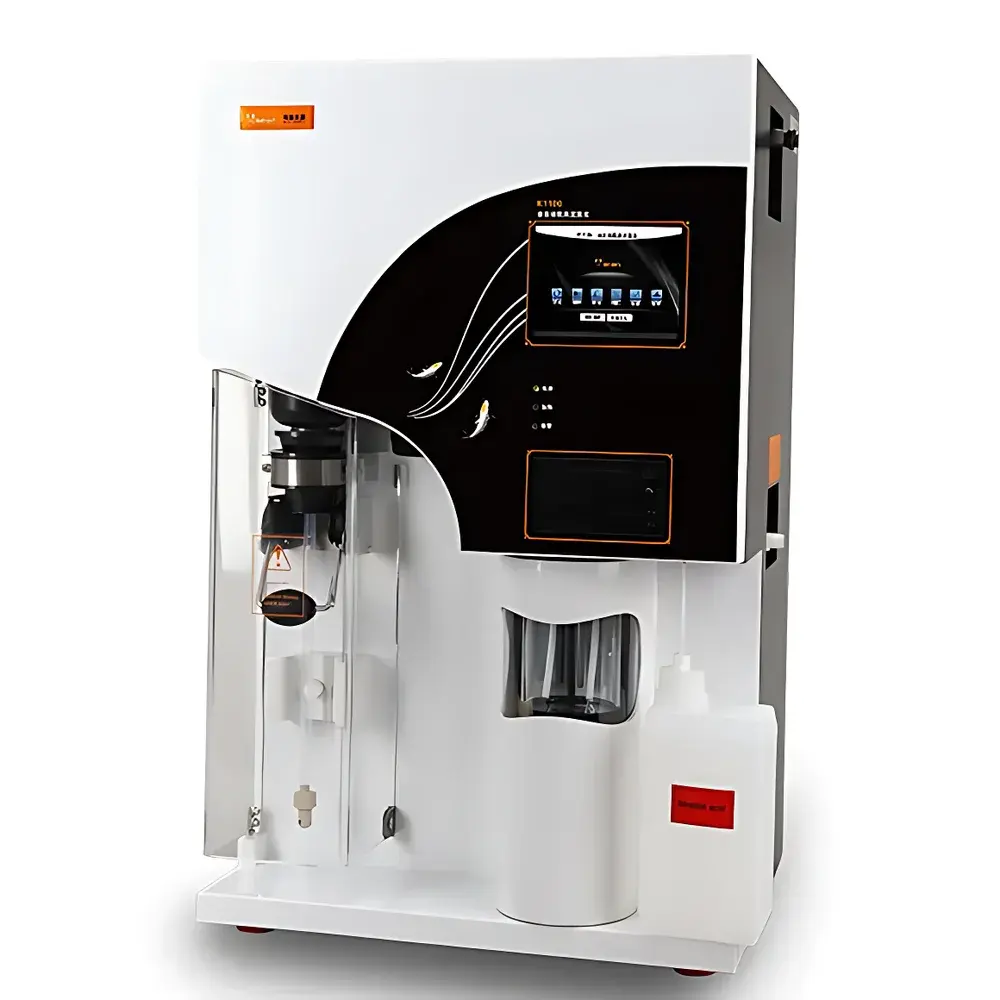
Hanon K1100 Fully Automated Kjeldahl Nitrogen Analyzer
| Brand | Hanon |
|---|---|
| Origin | Shandong, China |
| Model | K1100 |
| Instrument Type | Kjeldahl Nitrogen Analyzer |
| Automation Level | Fully Automated |
| Nitrogen Determination Range | 0.1–240 mg N |
| Sample Weight Capacity | ≤5 g (solid), ≤20 mL (liquid) |
| Repeatability | ≤0.5% RSD |
| Recovery Rate | ≥99.5% |
| Steam Generation Control | Adjustable flow with real-time distillate temperature monitoring |
| Distillation Time | Programmable |
| Titration Resolution | 1.0 µL/step |
| Cooling Water Consumption | 1.5 L/min |
| Data Storage Capacity | 1800 test records |
| Power Supply | 220 V AC ±10%, 50 Hz |
| Rated Power | 2 kW |
| Dimensions (L×W×H) | 455 mm × 391 mm × 730 mm |
| Net Weight | 38 kg |
| Compliance | GB, NY, HJ, Chinese Pharmacopoeia, AOAC Official Methods, ISO 8968 & ISO 5983 |
Overview
The Hanon K1100 Fully Automated Kjeldahl Nitrogen Analyzer is an integrated, benchtop system engineered for precise and reproducible nitrogen quantification via the classical Kjeldahl method—comprising digestion (performed off-instrument), steam distillation, boric acid trapping, and potentiometric or colorimetric titration. Unlike semi-automated or modular systems, the K1100 executes the entire post-digestion workflow autonomously: alkaline addition, acid addition, steam generation with dynamic flow regulation, condensate temperature-controlled distillation termination, automatic titrant delivery with 1.0 µL step resolution, waste evacuation, multi-cycle rinsing of digestion tubes and titration cups, and final result calculation per standardized conversion factors (e.g., N→protein). Its architecture adheres to the thermodynamic and chemical constraints of Kjeldahl chemistry—ensuring complete ammonia liberation under controlled alkaline hydrolysis, quantitative transfer via saturated steam, and stoichiometric neutralization detection—making it suitable for regulatory-compliant analysis in GLP and GMP environments.
Key Features
- Fully automated sequence control: alkali dosing, acid dosing, steam distillation, titration, waste discharge, and multi-stage cleaning—all executed without manual intervention.
- Intelligent steam generator with metal heating element and real-time distillate temperature feedback; automatically halts distillation if outlet temperature deviates beyond defined thresholds, preventing incomplete recovery or recondensation artifacts.
- Dual distillation mode: standard and gentle protocols—enabling optimization for volatile samples or high-acid digestates to minimize foaming and cross-contamination.
- Φ42 mm digestion tube compatibility: aligns with international standard tube dimensions, ensuring interoperability with legacy digestion blocks and third-party digestion systems.
- High-precision peristaltic dosing pumps and linear-motor-driven titration syringe delivering 1.0 µL resolution, calibrated traceably against gravimetric standards.
- Comprehensive safety architecture: interlocked safety door sensor, digestion tube presence detection, continuous cooling water flow monitoring (≥1.5 L/min), overtemperature cutoff, and pressure-relief steam pathways.
- 7-inch full-color capacitive touchscreen interface with intuitive workflow navigation, multilingual support (English, Chinese, Spanish), and context-sensitive help prompts.
Sample Compatibility & Compliance
The K1100 accommodates solid samples up to 5 g and liquid samples up to 20 mL, supporting routine matrix types including cereal grains, dairy powders, animal feed, soil extracts, wastewater sludge digests, pharmaceutical excipients, and botanical matrices. Its performance meets or exceeds requirements specified in AOAC Official Method 981.10, ISO 5983-1:2009 (Animal feeding stuffs), ISO 8968-1:2014 (Milk), GB/T 6423–2022 (General rules for Kjeldahl analysis), NY/T 2641–2014 (Feed analysis), HJ 717–2014 (Soil nitrogen), and relevant monographs of the Chinese Pharmacopoeia (2020 Edition). The system supports audit-ready operation through time-stamped event logging, user-level access control, and electronic signature-capable result export—facilitating alignment with FDA 21 CFR Part 11 expectations where locally deployed software configurations permit.
Software & Data Management
Embedded firmware manages all instrument functions and stores up to 1800 complete analytical records—including sample ID, digestion batch reference, distillation duration, titrant volume consumed, calculated nitrogen mass, protein equivalent (using configurable conversion factors), operator ID, and timestamped system events. Data export is supported via USB flash drive in CSV format for LIMS integration or offline statistical review. While the base system does not include network connectivity or remote diagnostics, its structured data schema enables straightforward mapping to laboratory information management systems (LIMS) via middleware or custom scripts. All calibration parameters—including pump stroke volume, titrant concentration, and temperature offset values—are password-protected and version-logged.
Applications
The K1100 serves as a primary nitrogen quantification platform across regulated and research-intensive sectors: quality control laboratories in food and feed manufacturing verify label claims for crude protein content; environmental testing labs determine total Kjeldahl nitrogen (TKN) in municipal effluents and agricultural runoff; agronomy and soil science facilities assess organic nitrogen availability in fertilized soils; pharmaceutical QC units validate nitrogen content in amino acid APIs and excipient blends; and academic teaching labs employ its transparent workflow to demonstrate fundamental wet-chemistry principles with industrial-grade reproducibility. Its ≤0.5% RSD and ≥99.5% recovery rate meet acceptance criteria for proficiency testing schemes administered by FAPAS and other international PT providers.
FAQ
Does the K1100 perform sample digestion?
No—the K1100 is a post-digestion analyzer. Digestion must be completed separately using a dedicated block digester or microwave system prior to loading digestion tubes onto the K1100.
What digestion tube size is required?
The instrument accepts standard Φ42 mm round-bottom digestion tubes, compatible with most commercially available Kjeldahl digestion systems.
Is method validation documentation provided?
Yes—Hanon supplies a Factory Acceptance Test (FAT) report, installation qualification (IQ) checklist, and operational qualification (OQ) protocol templates aligned with ISO/IEC 17025 and GMP Annex 15 expectations.
Can the K1100 be integrated into a LIMS?
Direct network integration is not supported; however, exported CSV files contain all required fields for automated ingestion via LIMS import modules or scripting interfaces.
What maintenance is required for long-term accuracy?
Recommended quarterly verification includes titrant standardization, pump calibration using gravimetric checks, steam trap inspection, and condenser efficiency assessment—procedures detailed in the Maintenance Manual supplied with the system.





