
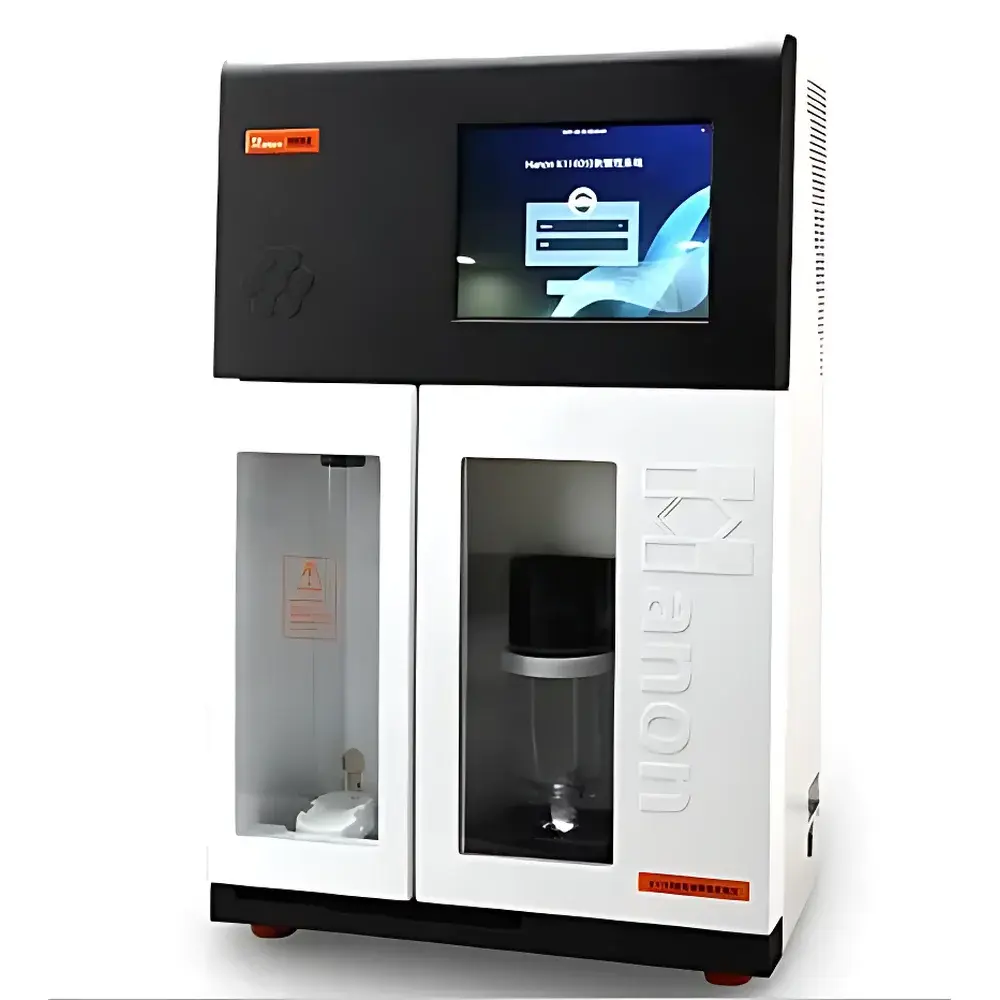
Hanon K1160 + K1124 Fully Automated Kjeldahl Nitrogen Analyzer
| Brand | Hanon |
|---|---|
| Origin | Shandong, China |
| Model | K1160 + K1124 |
| Instrument Type | Fully Automated Kjeldahl Nitrogen Analyzer |
| Nitrogen Determination Range | 0.1–240 mg N |
| Distillation Time | 3–8 min |
| Repeatability | ≤0.5% RSD |
| Sample Weight Capacity | ≤5 g (solid), ≤20 mL (liquid) |
| Nitrogen Recovery Rate | ≥99.5% (0.7–240 mg N) |
| Titration Resolution | 0.2, 0.4, or 1.0 µL/step |
| Power Consumption | 2 kW |
| Dimensions (L×W×H) | 460 × 360 × 725 mm (K1160) |
| Net Weight | 38 kg (K1160), 80 kg (K1124) |
| Data Storage | 1 million local records + cloud-based unlimited storage |
| Compliance | FDA 21 CFR Part 11, GMP-aligned audit trail, user permission hierarchy (3 levels) |
| Cooling System | Metal condenser with real-time effluent temperature monitoring |
| Steam Flow Control | 0–100% adjustable |
| Titration Speed | Up to 40 mL/min |
| Auto-sampler Capacity | 24-position, integrated K1124 unit (24 × 300 mL digestion tubes), no external power required |
Overview
The Hanon K1160 + K1124 Fully Automated Kjeldahl Nitrogen Analyzer is an integrated, high-throughput solution engineered for precise and traceable total nitrogen quantification via classical Kjeldahl digestion and distillation-titration methodology. Based on the principle of acid digestion (using concentrated H₂SO₄ and catalysts), followed by alkaline distillation and potentiometric or colorimetric titration of liberated ammonia, this system delivers metrologically sound nitrogen results across diverse matrices — from high-protein foodstuffs and animal feed to low-nitrogen environmental soils and pharmaceutical excipients. Its architecture adheres to ISO 8968 (milk), ISO 5983 (feed), AOAC 981.10 (cereals), and USP residual solvent guidance where nitrogen content serves as a surrogate for protein or contaminant load. Designed for routine QC laboratories operating under GLP or GMP frameworks, the K1160+K1124 eliminates manual intervention in all critical steps — including reagent dosing, steam generation, condensate management, endpoint detection, and result calculation — ensuring analytical continuity, inter-operator consistency, and full method traceability.
Key Features
- Fully automated workflow: sequential addition of dilution water, NaOH, boric acid receiving solution; programmable distillation delay; precision titration with three resolution modes (0.2 / 0.4 / 1.0 µL/step); auto-emptying of digestion tubes and receivers; real-time steam flow modulation (0–100%)
- Integrated 24-position auto-sampler (K1124): accepts standard 300 mL digestion tubes; mechanical arm with dual-zone design separates washing and analysis stations to prevent cross-contamination; powered via CAN bus from K1160 — no auxiliary power supply required
- High-speed titration engine: variable-rate titration up to 40 mL/min enables ~33% reduction in per-sample cycle time versus fixed-speed systems; concurrent distillation and titration capability further compresses throughput latency
- Industrial-grade metal condenser: actively monitors outlet coolant temperature to guarantee complete ammonia condensation; reduces water consumption by 50% relative to traditional coil-based systems
- Android-based 10-inch capacitive touchscreen interface: intuitive UI with batch-oriented sample entry, live titration curve visualization, and on-the-fly method parameter adjustment
- Comprehensive data governance: three-tier user authentication (admin/operator/analyst), password aging policy, electronic signatures, and immutable audit trails compliant with FDA 21 CFR Part 11 Annex 11 requirements
- Embedded 8 GB internal storage supporting ≥1,000 customizable methods and 1 million test records; optional cloud synchronization via encrypted HTTPS channel with role-based access control
Sample Compatibility & Compliance
The K1160+K1124 accommodates solid samples up to 5 g (e.g., flour, meat meal, soil) and liquid samples up to 20 mL (e.g., milk, wastewater, digest liquor), covering nitrogen concentrations from 0.1 mg to 240 mg per sample — equivalent to ~0.6–1500% protein depending on conversion factor (e.g., 6.25 for cereals, 6.38 for dairy). It meets recovery specifications ≥99.5% across the validated range (0.7–240 mg N), satisfying AOAC 992.15 and ISO 1871 accuracy criteria. The system supports multi-parameter reporting: total nitrogen, crude protein, ammoniacal nitrogen, volatile basic nitrogen (VBN), and cation exchange capacity (CEC) in soils when coupled with appropriate digestion protocols. All firmware and software modules are developed under a documented V-model lifecycle aligned with IEC 62304, and the instrument’s electronic record architecture conforms to ALCOA+ principles (Attributable, Legible, Contemporaneous, Original, Accurate, Complete, Consistent, Enduring, Available).
Software & Data Management
The embedded Android OS hosts a purpose-built laboratory application with built-in calculation libraries for 15 standardized methods (e.g., AOAC, ISO, DIN), each preconfigured with digestion time/temperature profiles, reagent volumes, and stoichiometric coefficients. Users may create, validate, and version-control custom methods using a structured editor that enforces parameter dependencies (e.g., alkali volume scaling with sample mass). Raw titration curves, distillation thermograms, and event logs are stored with timestamps and operator IDs. Data export is supported via USB, LAN (SMB/CIFS), RS232, and Wi-Fi — formatted as CSV, PDF, or XML for LIMS integration. Cloud backup utilizes TLS 1.3 encryption and implements zero-knowledge key management; administrators define retention policies and granular permissions (view/edit/delete) per project or user group. Audit trail reports include all critical events: login/logout, method modification, result override, calibration execution, and error recovery actions.
Applications
This analyzer is routinely deployed in accredited food testing labs for nutritional labeling compliance (EU Regulation 1169/2011, FDA 21 CFR 101.9); feed mills validating crude protein content per AAFCO guidelines; environmental agencies measuring total Kjeldahl nitrogen (TKN) in wastewater per EPA Method 351.2; agricultural extension services assessing soil fertility indices; pharmaceutical quality control units verifying nitrogen content in APIs and excipients; and academic research groups studying nitrogen cycling in ecological or biochemical systems. Its robustness in handling heterogeneous solids (e.g., fibrous plant tissue, mineral-rich sediments) and compatibility with alternative catalysts (e.g., selenium-free Cu/TiO₂ mixtures) make it suitable for green chemistry adaptation and regulatory method modernization initiatives.
FAQ
Does the K1160+K1124 support unattended overnight operation?
Yes — the 24-position auto-sampler, combined with automatic tube ejection, receiver rinsing, and fault self-diagnosis, enables fully unattended batch processing of up to 24 samples without operator intervention.
Can the system be validated for GMP-regulated environments?
Yes — its electronic signature implementation, audit trail integrity, user access controls, and configurable electronic records meet core requirements of FDA 21 CFR Part 11 and EU Annex 11 for computerized system validation (CSV). IQ/OQ/PQ documentation templates are available upon request.
Is method transfer possible from legacy Kjeldahl systems?
Yes — the instrument accepts standard digestion tube formats (e.g., 300 mL borosilicate), uses conventional reagents (H₂SO₄, NaOH, boric acid), and allows direct import of existing titration endpoints and calculation formulas, minimizing method requalification effort.
What maintenance routines are required for long-term reliability?
Recommended quarterly tasks include steam generator descaling, condenser coil inspection, titration pump calibration verification, and sensor drift checks (pH electrode, temperature probe); all procedures are guided by on-screen prompts and logged automatically.
How is data security ensured during cloud synchronization?
All data transmissions use AES-256 encryption in transit and at rest; cloud storage adheres to ISO/IEC 27001-certified infrastructure; no raw data is processed server-side — computations occur exclusively on the instrument’s local Android runtime.



