
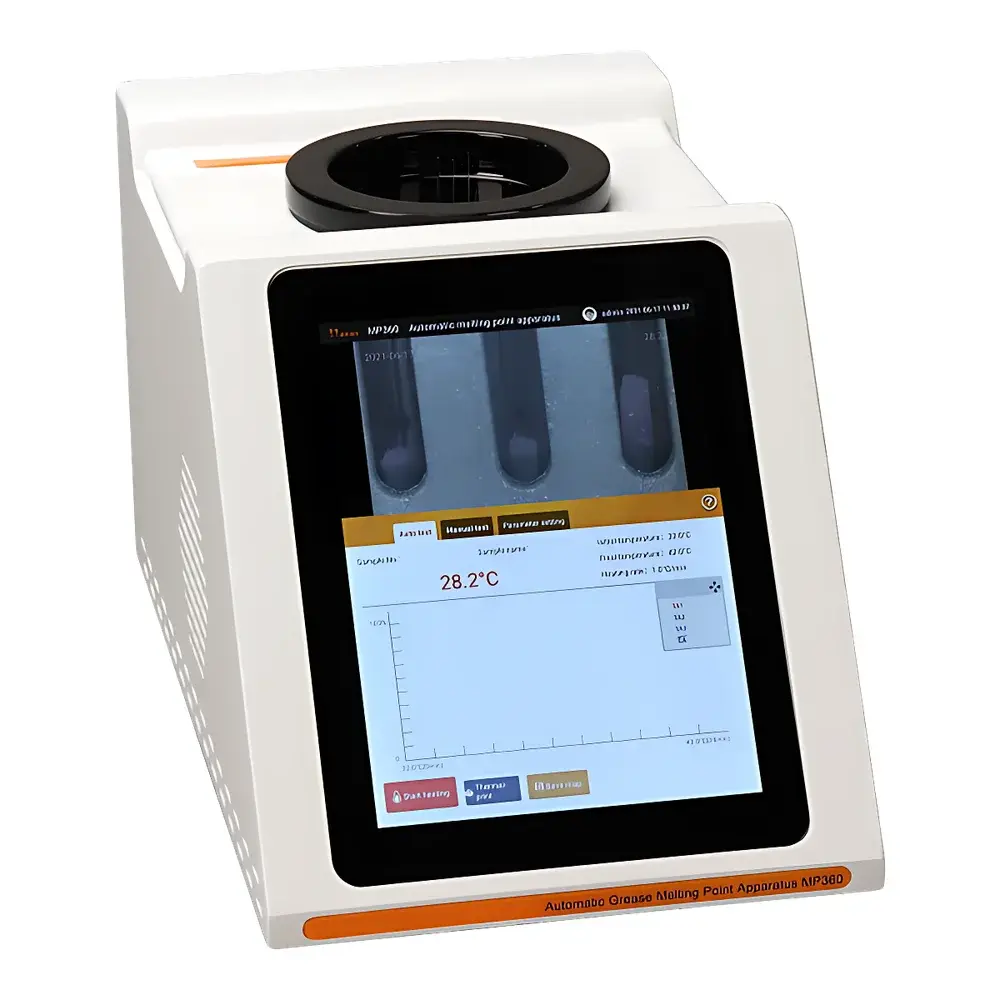
Hanon MP360 Fully Automated Fat Melting Point Analyzer
| Brand | Hanon |
|---|---|
| Origin | Shandong, China |
| Model | MP360 |
| Temperature Range | 0–100 °C |
| Heating Rate | 0.1–20.0 °C/min |
| Temperature Repeatability | ±0.2 °C (at 0.20 °C/min) |
| Temperature Accuracy | ±0.3 °C |
| Capillary Dimensions | ID 0.9–1.1 mm, Wall Thickness 0.10–0.15 mm (optional 1.6 mm OD) |
| Sample Capacity | 3 samples per run |
| Temperature Resolution | 0.1 °C |
| Data Storage | 32 GB internal |
| Video Storage | ~10,000 minutes (H.264 encoded) |
| Compliance | FDA 21 CFR Part 11, ASTM D3104, GB/T 24892–2010, GB/T 12766–2008, SN/T 0801.5–1999 |
| Connectivity | USB ×3, RS-232, Wi-Fi, RJ45 Ethernet |
| Calibration | Multi-point temperature calibration |
| User Management | Role-based access control with audit trail |
Overview
The Hanon MP360 Fully Automated Fat Melting Point Analyzer is a thermally controlled, video-integrated instrument engineered for precise and reproducible determination of melting point (slip point) of fats, waxes, and other semi-crystalline or amorphous organic materials. Unlike conventional capillary-based melting point apparatuses relying solely on visual endpoint detection, the MP360 employs real-time optical imaging synchronized with high-resolution temperature profiling to objectively identify phase transitions—specifically the onset of softening, slippage, and complete liquefaction. Its measurement principle follows standardized thermal ramping protocols defined in ASTM D3104 (Standard Test Method for Melting Point of Fats and Oils), ISO 6321 (Animal and Vegetable Fats and Oils — Determination of Slip Point), and GB/T 24892–2010 (Determination of Slip Point of Edible Fats). The system utilizes a dual-zone, layered insulation architecture to minimize ambient thermal interference while enabling rapid heating and cooling cycles—critical for throughput in QC laboratories processing multiple batches daily.
Key Features
- 8-inch capacitive touchscreen interface running embedded Android OS for intuitive method setup, real-time monitoring, and local data management
- Integrated 720p HD camera with 8× optical zoom and adjustable LED illumination for high-fidelity observation of sample morphology changes—including color shift, surface gloss transition, and lateral movement during melting
- Programmable linear heating rate from 0.10 to 20.00 °C/min in 0.01 °C/min increments, supporting both standard compliance testing and accelerated screening
- Triple-sample independent measurement chamber with individual thermal sensors and optical paths, ensuring parallel analysis without cross-contamination or thermal crosstalk
- H.264 video encoding engine optimized for long-term archival—enabling storage of up to 10,000 minutes of time-stamped, watermarked video at full resolution within the onboard 32 GB eMMC memory
- Multi-point temperature calibration using NIST-traceable reference standards across the full 0–100 °C range, with automatic correction applied to all subsequent measurements
- FDA 21 CFR Part 11-compliant software architecture featuring electronic signatures, role-based user permissions, and immutable audit trail logging of all method edits, calibrations, and result exports
Sample Compatibility & Compliance
The MP360 accommodates standard thin-wall capillaries (ID 0.9–1.1 mm, wall thickness 0.10–0.15 mm) as specified in ISO 6321 and ASTM D3104; optional 1.6 mm outer-diameter capillaries are available for viscous or particulate-laden samples. It supports routine analysis of edible oils, hydrogenated vegetable shortenings, cocoa butter equivalents, cosmetic waxes (e.g., carnauba, beeswax), pharmaceutical excipients, and industrial lubricants. The instrument meets regulatory requirements for GLP/GMP environments through its built-in validation support tools—including IQ/OQ documentation templates, calibration certificate generation, and automated system suitability checks prior to each analytical run. All firmware and application logic are validated per ICH Q9 principles and aligned with Annex 11 (Computerized Systems) expectations.
Software & Data Management
Data integrity is enforced via a secure SQLite database with write-once, append-only logging. Every measurement session generates a structured metadata bundle containing raw temperature/time arrays, annotated video segments, digital signature logs, and environmental context (ambient temperature, humidity, operator ID). Export options include PDF reports with embedded video thumbnails and traceable calibration certificates, Excel-compatible CSV files with full time-series data, and encrypted ZIP archives for LIMS integration. USB host ports support direct printing to thermal, dot-matrix, or Wi-Fi-enabled laser printers; networked deployment allows remote access via HTTPS-enabled web dashboard. Audit trails record timestamps, user actions, IP addresses (for network logins), and hash-verified file integrity checks for all exported artifacts.
Applications
- Quality control of edible fats in food manufacturing (e.g., palm oil fractionation verification, margarine consistency grading)
- Raw material release testing for cosmetic wax suppliers under ISO 16128 guidelines
- Stability assessment of lipid-based drug delivery systems (e.g., solid lipid nanoparticles, suppositories)
- R&D formulation optimization for phase-change materials used in thermal energy storage
- Regulatory submission support for FDA GRAS dossiers requiring documented slip point profiles
- Teaching laboratories demonstrating polymorphism, eutectic behavior, and thermal hysteresis in organic solids
FAQ
Does the MP360 comply with FDA 21 CFR Part 11 requirements for electronic records and signatures?
Yes. The system implements full Part 11 controls including user authentication, audit trail generation, electronic signature capture with biometric or token-based verification, and data immutability enforcement.
Can the instrument operate without external cooling when ambient temperatures exceed 30 °C?
It can function independently using its internal Peltier-assisted thermal regulation; however, connection to an external recirculating chiller (via standard RJ45-controlled relay interface) is recommended for optimal repeatability above 25 °C ambient.
Is video playback synchronized with temperature curves during retrospective analysis?
Yes. All recorded videos are time-stamped at 10 Hz and overlaid with real-time temperature annotations, enabling frame-accurate correlation between optical events and thermal transitions.
How is calibration traceability maintained across instrument lifetime?
The multi-point calibration module accepts certified reference materials with NIST-traceable uncertainty statements; calibration coefficients are digitally signed and stored with cryptographic hashes to prevent tampering.
What file formats are supported for third-party data import/export?
Input: CSV (temperature/time), JPEG/PNG (reference images). Output: PDF/A-2u, XLSX, CSV, MP4 (H.264), and XML (ASTM E1382-compliant analytical data exchange schema).



